

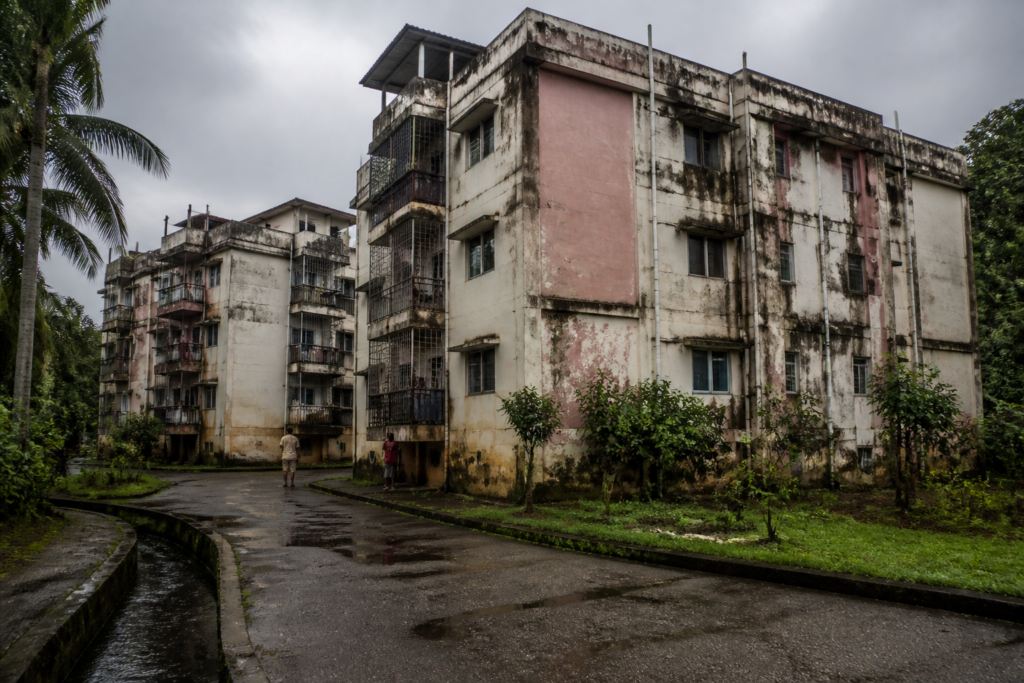
The Kerala High Court has directed attention to the urgent relocation of residents from the Mundamveli P&T rehabilitation apartments in Kochi after an inspection report documented sewage leakage, corrosion, fire-safety gaps and other serious risks in the complex.
Justice Devan Ramachandran made the observations after examining a report submitted by court-appointed amicus curiae advocate Govind Padmanabhan. The report was prepared following a site inspection involving the Deputy Collector, the Greater Cochin Development Authority, Kochi Corporation and revenue officials.
The apartments were built to rehabilitate families who had lived in the P&T Colony on the banks of the Perandoor Canal. The complex accommodates 81 families, with more than 300 people estimated to be living there. Each flat measures 350 square feet.
According to the report, wastewater from toilets and kitchens is leaking into apartments on lower floors. Sewage from the septic tank is also overflowing into open areas, creating what the report described as a serious health threat. The sewage treatment plant at the complex has insufficient capacity, it said.
The inspection report also identified structural and electrical concerns. The mandatory safety distance from a nearby 110-kilovolt high-tension line has not been maintained, while equipment foundations in electrical control rooms were found to be rusted. Continuous sewage leakage has caused corrosion to the steel columns and sheets of the apartment building, raising concerns about weakening of the structure.
The report further noted the absence of a lift, making access difficult for residents who are ill or have mobility challenges. It also identified inadequate earthing and fire-control systems. A technical committee has been recommended to assess the structural strength and usability of the building.
During the hearing, District Collector G. Priyanka told the court online that approximately Rs 14 crore had been spent on construction and that a similar amount could be required for restoration. The court was informed that the apartments took years to complete and that intervention by the court had been required during the construction process. The report also noted that the contractor had at one stage abandoned the work.
The High Court questioned who should be held responsible for the present condition and said that contractors among others had responsibilities. The court’s observations followed the amicus curiae’s account of conditions faced by residents inside the complex.
The District Collector said a report had been submitted to the government seeking the immediate relocation of residents. A ministerial-level decision is required, and assistance from experts at the Indian Institute of Technology Madras is also being sought, according to the report presented to the court.
The court has directed the government and other parties to state their positions on the amicus curiae report. The matter will be considered again next week, when the authorities are expected to respond to the concerns and proposed measures.


