

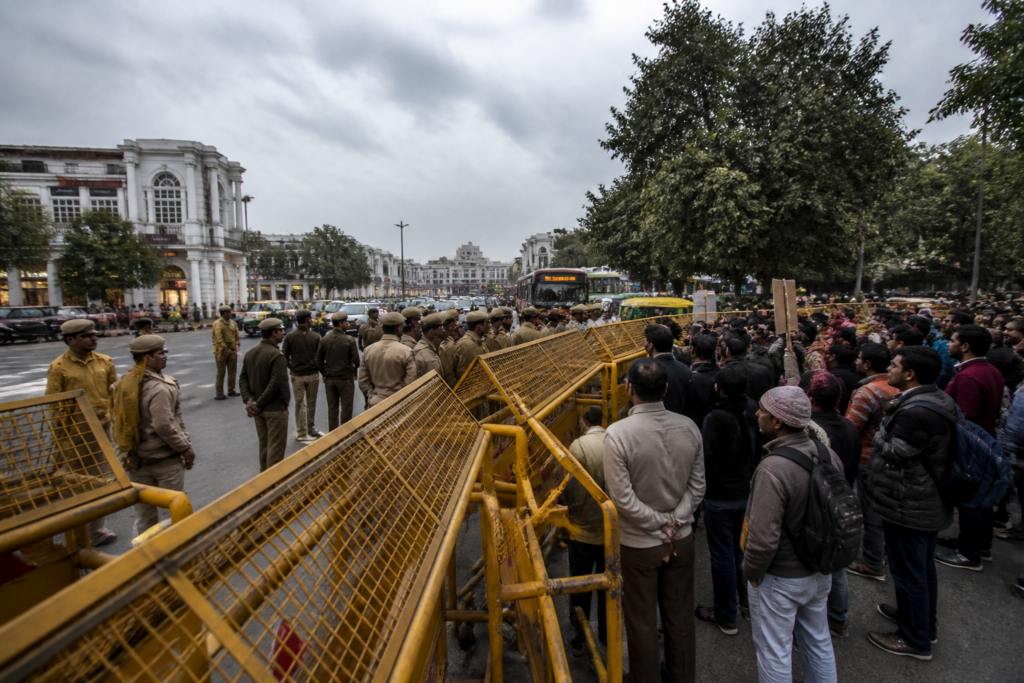
The detention of CJP founder Abhijeet Dipke while he was travelling towards a proposed protest in central Delhi has brought the city’s preventive-policing system into focus. Delhi Police have initiated action against him under Sections 126 and 170 of the Bharatiya Nagarik Suraksha Sanhita (BNSS), while AISA national president Neha Bora, detained during the same episode, was released after formalities under Section 65 of the Delhi Police Act.
The immediate question is whether Dipke will be sent to Tihar jail, as CJP leaders Saurav Das and Ashutosh Ranka were after a separate protest-related detention. But the larger issue is not limited to one person or one organisation. The sequence shows how protest management in Delhi can move from preventive detention to executive-magisterial proceedings, peace bonds and, where alleged violations are raised, judicial custody. It also shows how the legal route taken by authorities can differ between people detained in the same broad operation.
## Delhi protest detentions and the preventive-power framework
According to the report, Dipke was detained on Friday, 16 October, in the Jhandewalan area while travelling towards Connaught Place, where a protest called ‘Lehra Do Tiranga’ was expected to take place. Delhi Police said the action was intended to maintain law and order and keep traffic moving. A large number of protesters were also detained during the operation.
The police later stated that action against Dipke was being taken under Sections 126 and 170 of the BNSS and that he would be produced before a Special Executive Magistrate. The report describes Section 126 as a provision linked to requiring a bond for keeping the peace when an Executive Magistrate receives information that a person may disturb public peace. Section 170 is described as allowing arrest without a warrant in certain circumstances when police have information about a possible cognisable offence and believe that there is no other way to prevent it.
These provisions place the early decision-making process outside the ordinary pattern of a completed criminal investigation. The stated purpose is preventive: authorities act because they believe a breach of peace or another cognisable offence may occur. That makes the facts relied upon by the police, the necessity of detention and the subsequent order of the magistrate central to the process.
The report also notes that detention under Section 170 is generally not expected to exceed 24 hours unless further custody is authorised under another legal provision. In Dipke’s case, the next institutional step identified in the report is his appearance before the Special Executive Magistrate. The outcome of that appearance had not been reported at the time of publication.
## The importance of the earlier peace bond
Dipke’s current position cannot be separated from an earlier episode involving him, Das and Ranka. The three were detained on 10 October before a proposed protest in Delhi and produced before a Special Executive Magistrate the following day. They were released after furnishing bail-cum-personal bonds of Rs 50,000 each and agreeing to maintain peace and good conduct for one year.
That earlier bond is now important because the police have linked later protest activity involving two of the men to an alleged breach of the conditions. On 14 October, Das and Ranka were detained again during a protest at Jantar Mantar. Police alleged that they had entered the restricted protest site and violated the peace-related conditions already in force. A court subsequently sent them to judicial custody for five days, and they were taken to Tihar jail.
The sequence creates a distinction that is important for understanding preventive proceedings. A peace bond is not, by itself, a finding that a person has committed a criminal offence. It is a legally enforceable undertaking concerning future conduct. If police later allege that its terms have been breached, that allegation can become the basis for further proceedings. Whether the conditions were actually violated, however, remains a matter for the relevant legal process.
This distinction is especially significant in Dipke’s case. The existence of an earlier bond does not automatically establish that he breached it. The key questions for the magistrate are likely to include what conduct the new action is based on, whether that conduct falls within the earlier conditions, and what authority exists for the next stage of custody. The report does not state that a court has yet found Dipke responsible for violating the bond.
## One detention operation, different legal outcomes
The contrasting treatment of Dipke and Bora underlines the role of institutional classification in protest policing. Both were detained on 16 October, but Delhi Police said Bora was released after formal procedures under Section 65 of the Delhi Police Act, while action against Dipke proceeded under Sections 126 and 170 of the BNSS.
This difference matters because detention at street level does not determine the final legal route. The same protest-related operation can produce release for one person, preventive proceedings for another and judicial custody for someone else if authorities rely on different facts, provisions or prior conditions. For citizens, lawyers and protest organisers, the practical impact is that the reason for detention and the statutory provision invoked become as important as the detention itself.
The report says CJP had earlier raised questions about Dipke’s location and status after his detention, alleging that his family, lawyers and party members faced difficulty contacting him for a prolonged period. Delhi Police, on the other hand, said that preventive action had been initiated under the BNSS and that he would be produced before the Special Executive Magistrate. These are competing accounts of the immediate experience of detention, but the report does not provide an independent finding on the communication issue.
That gap is relevant to public accountability. Preventive action is carried out before the feared disruption or offence is established through a completed trial. In such cases, the clarity of the police record, the prompt production of the detainee before the competent authority and the explanation of the legal basis become essential to understanding whether the process remained within its stated purpose.
## Jantar Mantar and the management of public protest
The events also expose the administrative tension surrounding protest spaces in Delhi. The report identifies Jantar Mantar as a restricted protest location and says police alleged that Das and Ranka entered it in violation of applicable conditions. At the same time, the 16 October operation involved people travelling towards Connaught Place for a protest and was justified by police on grounds of law and order and traffic management.
This places public space at the centre of the dispute. Roads, central business areas and designated protest locations are not only physical spaces; they are managed through permissions, restrictions, traffic arrangements and policing decisions. When authorities detain people before a demonstration, the stated reason may involve preventing disorder, protecting movement or enforcing an earlier undertaking. The public-interest question is how those reasons are documented and reviewed.
The available report does not establish the size of the planned protest, the precise restrictions imposed on it or whether the organisers had received or been denied permission. It also does not provide the full text of the peace bonds, the police grounds for Dipke’s latest detention or the Special Executive Magistrate’s eventual order. Those details will determine how the action is assessed legally and administratively.
## What remains unresolved
The central uncertainty is whether Dipke will face judicial custody. The possibility arises because Das and Ranka were sent to Tihar after police alleged that they had breached earlier peace-related conditions. But the report does not say that the same finding has been made against Dipke, nor does it report an order sending him to jail. His next appearance before the Special Executive Magistrate is therefore the immediate milestone.
The case also leaves open a broader question about the use of preventive provisions during politically sensitive demonstrations. The report records the statutory provisions cited by police, the earlier bonds, the subsequent detentions and the different outcome for Bora. It does not, however, provide the underlying police documents or the court and magistrate orders needed to test each claim in detail.
What the evidence confirms is a chain of escalating legal processes: preventive detention before a proposed protest, production before an executive magistrate, release on peace bonds, a later allegation of breach, judicial custody for two leaders and a fresh preventive action against another. What remains to be established is whether Dipke’s conduct breached the earlier conditions and what order the magistrate will issue. Those decisions will determine whether his case follows the path of Das and Ranka or ends with release after the new proceedings.


