

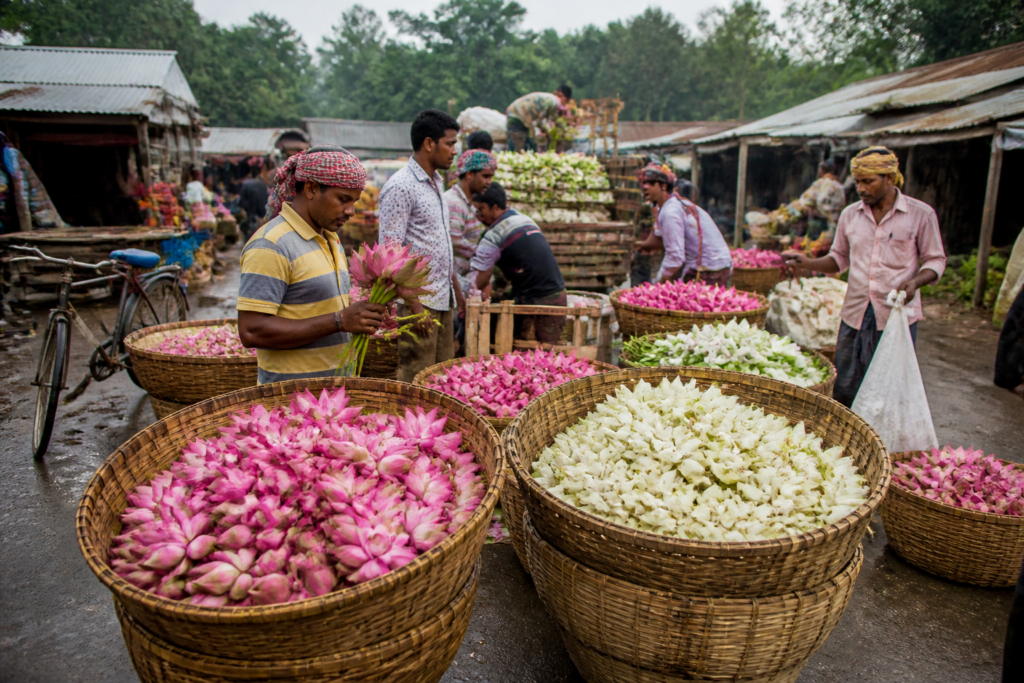
Bengal’s lotus harvest has recovered sharply ahead of Durga Puja, bringing better returns to cultivators and steadier supplies to consumers. But the revival also exposes how dependent the festive flower economy remains on weather, short storage windows, fragmented trading infrastructure and a narrow seasonal demand cycle.
The immediate story is one of relief. Farmers and traders in several flower-producing districts are reporting a bumper lotus crop after floods damaged production last year. Wholesale prices have nearly doubled compared with the previous season, while cultivators are currently receiving between Rs 5 and Rs 6 per flower, against Rs 2.50 to Rs 3 earlier. The improved harvest has reduced the need to bring supplies from outside Bengal and has helped keep lotus prices relatively stable for devotees.
That recovery matters beyond the fields. Lotus is not only a crop sold at village markets. During the festive season, it moves through a distribution network linking cultivation hubs such as Ahmedpur in Birbhum with Mallick Ghat in Kolkata and markets in Siliguri, Malda, New Delhi, Mumbai, Chennai and Bengaluru. The condition of this network determines whether a ritual requirement reaches urban consumers on time, at an affordable price and in usable condition.
The supply chain remains highly exposed to disruption because flowers are perishable and demand is concentrated around a few festivals. Last year’s flooding in Birbhum, Bankura, East Midnapore, Howrah and Hooghly devastated key lotus-producing areas, according to the report. Wholesalers then had to import nearly 30 per cent of their supplies from outside the state. This year, production has rebounded despite an extended monsoon, allowing local growers to capture a larger share of the festive market.
The contrast between the two seasons shows how quickly a weather event can travel through the food-and-flower economy. Damage at cultivation sites becomes a supply deficit in wholesale markets, which then affects prices, sourcing decisions and the reliability of festival procurement. The system can compensate through imports, but that adds distance, handling and logistical dependence at precisely the time when demand is most concentrated.
Ahmedpur illustrates the scale of the local economy. More than 4,000 farmers and traders there are working to pack and dispatch flowers to markets across the country. The report identifies Ahmedpur as one of Bengal’s major lotus-growing hubs, while also naming cultivation centres in Kalna in East Burdwan, Howrah, East Midnapore, Barjora and Manar Char in Bankura. These places are connected not by a single formal market system, but by a seasonal chain of growers, traders, wholesalers and urban flower markets.
The present harvest has improved bargaining conditions for cultivators. Narayan Chandra Nayak, general secretary of the All Bengal Flower Growers and Flower Traders Association, said the bumper crop had helped stabilise the market. Growers are receiving remunerative prices, while retail rates for lotus have remained accessible to devotees. This combination is significant: a healthy seasonal market must provide an acceptable return to producers without turning a culturally important offering into an unaffordable purchase for households and community organisers.
The position of other flowers is less comfortable. The report says supply deficits in marigold and rajanigandha, or tuberose, have pushed their prices higher. This unevenness is a reminder that “the flower market” is not one market. Different crops respond differently to rainfall, cultivation conditions, harvesting cycles, storage capacity and demand patterns. A strong lotus harvest can therefore coexist with shortages and price pressure in other flowers needed for the same festival.
The urban connection becomes clearer at Mallick Ghat, one of Asia’s largest flower markets. Traders supplying the Kolkata market are handling both pink and white lotus varieties, while consignments are also travelling to distant metropolitan markets. For cities, the issue is not simply whether flowers are available somewhere in the state. It is whether they can be collected, sorted, transported, stored and sold within the short period before their quality declines.
That is where the sector’s infrastructure gap becomes visible. Khokon Das, a trader from Ahmedpur, has called for a permanent marketplace dedicated to lotus trading, along with crop insurance, financial assistance and specialised cold-storage facilities. Das said flowers can currently be stored for only about 15 days. A dedicated cold-storage network across lotus-producing districts, he argued, would help preserve flowers during the extended festive season.
The storage limitation has direct implications for both producers and city buyers. When flowers cannot be held for long, farmers and traders have less ability to stagger sales or respond to demand across different festivals. They must move large volumes within a narrow window, increasing the importance of transport timing and wholesale coordination. Any disruption during that period can quickly become a loss because the product cannot simply be stored and sold later like a non-perishable commodity.
The calendar itself intensifies this pressure. Demand rises during Durga Puja, continues through Jagadhatri Puja and is followed by advance orders from New Delhi for Diwali, according to lotus farmer Rupen Sarkar. The supply chain therefore operates through a sequence of closely spaced cultural and religious events. A good crop creates an opportunity for higher earnings, but it also requires the market to manage successive demand peaks without adequate long-term infrastructure.
The ritual importance of the lotus helps explain this recurring demand. During Sandhi Puja, the 45-minute transition between Ashtami and Navami, devotees traditionally offer 108 lotus flowers and light 108 oil lamps. The report also recounts the Ramayana tradition of Akal Bodhan, in which Lord Rama is said to have invoked Goddess Durga before fighting Ravana and prepared to offer one of his eyes when a lotus was missing from the required offering.
This cultural demand gives the crop a dependable seasonal market, but it does not eliminate economic risk. The same dependence on a narrow period of high demand can make the sector vulnerable to flooding, transport delays, weak storage and price volatility. The previous season’s experience, when outside supplies accounted for nearly 30 per cent of the market, demonstrates that local production is not automatically secure simply because the crop is grown widely across the state.
The report also links stronger demand to an increase in community festivals receiving permission under the current administration. Sarkar said the number of authorised Durga Pujas had increased and cited 60 new pujas in the Labhpur police station area this year. These claims are attributed to the farmer and are not independently quantified in the supplied material. They nevertheless point to the role of permissions and local administration in shaping the size and timing of seasonal demand.
That administrative layer is important because the flower economy depends on decisions beyond cultivation. Festival permissions influence procurement requirements; market arrangements affect how goods are assembled and sold; and transport and storage infrastructure determine how much of the harvest reaches distant cities in marketable condition. The sector’s future therefore involves not only farm productivity but also coordination between growers, traders, local authorities and market institutions.
The central evidence from Bengal’s lotus season is consequently mixed. Production has recovered, cultivators are receiving better prices and local supply has reduced the need for imports. At the same time, traders are asking for permanent market space, insurance, financial support and specialised cold storage. The improvement in one season has not removed the structural weaknesses revealed by last year’s floods.
For urban consumers, the most visible result is a relatively stable lotus price during a major festival. For the producers and traders who make that availability possible, the larger challenge is building a system that can withstand weather shocks and manage several demand peaks without depending almost entirely on rapid movement from field to market. The next test will be whether the current bumper harvest can translate into durable infrastructure and policy support for Bengal’s seasonal flower economy.


