

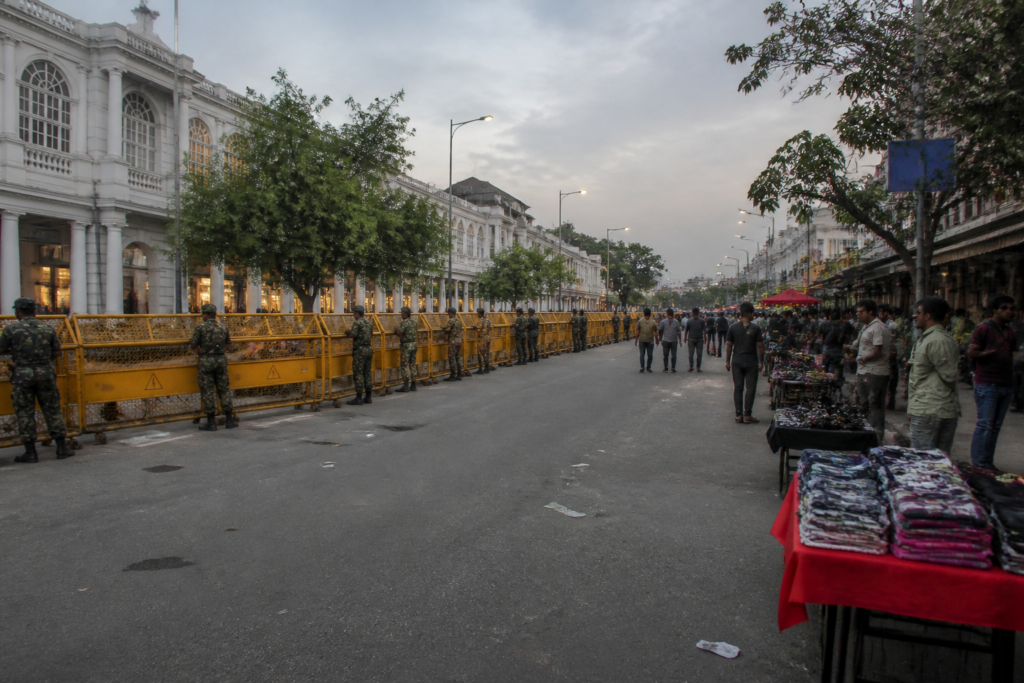
Central Delhi’s latest protests have exposed a recurring urban governance problem: when authorities secure public spaces through barricades, heavy deployment and movement restrictions, the economic cost is often borne by the traders and street vendors who depend on daily access. In Connaught Place, Janpath and surrounding commercial areas, business owners say the disruption has arrived at the worst possible time—during the festive season, when footfall and sales are typically expected to rise.
The report by The Hindu records two competing explanations for the decline in business. Traders and vendors point to the protests, police barricades and visible deployment as factors that have deterred customers. The founder of the Cockroach Janta Party, Abhijeet Dipke, argued instead that the principal disruption came from restrictions imposed by authorities, including movement controls and the alleged suspension of internet services. The distinction matters because it goes to the heart of how cities manage demonstrations: whether public order measures reduce the disruption caused by a protest or deepen it by making commercial districts inaccessible.
The immediate impact described by vendors is substantial. Jay Prakash Yadav, a roadside vendor at Janpath, said access to the market was completely blocked for five days between October 2 and 11. Viran Gaikwad, a vendor in Connaught Place, said sales had fallen by more than 80 per cent and that families had been discouraged from visiting the area. These are statements from individual businesses, not an independently measured estimate of the total economic loss, but they show how a restriction on movement is experienced at street level: not as an abstract security decision, but as fewer customers, shorter trading opportunities and lost daily income.
The geography of the disruption is also important. Connaught Place and Janpath are not only protest sites or office districts. They combine retail shops, street vending, restaurants, professional establishments and visitor-oriented businesses. The report notes that the area attracts local shoppers as well as foreign tourists. This mixed urban economy depends on permeability: people must be able to arrive, move between shops, browse, eat and leave without facing uncertainty about access. When barricades and police restrictions make that movement difficult, the commercial effects can spread beyond the point where a protest is physically taking place.
Street vendors face a sharper version of this problem because their businesses depend on daily turnover and have fewer buffers against interruption. Mohammed Hayat, a member of the Town Vending Committee under the New Delhi Municipal Council, said vendors were being denied entry and restricted by police. He said the committee had written to the NDMC and Delhi police seeking an extension of vending hours until 9.30 p.m. during the protests. The request reveals a practical issue that is often missed in security planning: if access is restricted during the day, vendors may need additional operating time later to recover part of their earnings, provided that public safety conditions allow it.
This is where the institutional question becomes more complicated. The NDMC, Delhi police and the Union government have different responsibilities, while traders, vendors, residents, protesters and visitors experience the same public space as a single urban system. A decision taken for policing purposes can therefore create consequences in municipal administration, vending regulation, retail activity and tourism. The report does not establish which authority imposed each restriction or whether a formal impact assessment was carried out. That absence is itself significant: affected businesses may be expected to absorb the cost of arrangements whose purpose, duration and decision-making chain are not clearly communicated to them.
The conflict is not simply between protest and commerce. The traders quoted in the report acknowledge the right to peaceful protest, while also describing the consequences of restricted access. This distinction allows for a more precise reading of the dispute. The question is not whether demonstrations should be permitted. It is how a city can protect the right to assemble while keeping commercial districts reasonably accessible, maintaining emergency movement and preventing the blanket disruption of livelihoods.
The timing has intensified the pressure. Rajit Kumar, a jewellery vendor in central Delhi, said customers who would normally visit during the period associated with Garba and Navratri were unable to reach the market. Bhavna, who runs a sports shop in Connaught Place, attributed customer reluctance to congestion and protests across the area and argued that demonstrations should be confined to designated locations. The report does not provide comparable sales figures from previous festive seasons, so the scale of the wider commercial decline cannot be independently calculated from the available evidence. However, the accounts show why even a temporary access restriction can have an outsized effect when it coincides with a peak trading period.
The memorandum submitted by the Chamber of Indian Micro, Small & Medium Enterprises to Union Home Minister Amit Shah broadens the issue beyond individual complaints. The organisation sought measures to protect business continuity, public safety and the livelihoods of MSMEs, startups, traders and commercial establishments. It identified Connaught Place, Ramlila Ground and surrounding areas as locations supporting multiple economic activities, including retail outlets, restaurants, service providers, professional offices and startups. The memorandum therefore frames the disruption as a continuity problem affecting a cluster of urban businesses rather than only a dispute involving a few street vendors.
That framing raises an important question about the way public order is administered in dense commercial districts. Barricading is a visible and immediate tool. It can control entry, separate crowds and create a perimeter around a sensitive location. But its costs are distributed unevenly. A large formal business may withstand several days of lower footfall more easily than a vendor dependent on daily sales. A customer may postpone a shopping trip, while a vendor cannot postpone the day’s rent, food costs or household expenses. Security measures that treat all commercial actors as equally capable of absorbing disruption risk placing the greatest burden on those with the least financial resilience.
The report also indicates that the economic effects are shaped by perception, not only by physical closure. Gaikwad said families were deterred from visiting Connaught Place, while the vendors described uniformed patrolling and barricades as factors that made customers stay away. Even if a market remains technically open, uncertainty about entry, traffic and police checks can reduce footfall. For a visitor-oriented district, the difference between being open and being easy to access is crucial. Urban commerce relies on confidence that a trip will be predictable enough to undertake.
At the same time, the available material does not establish that every reported loss was caused by police restrictions or protests. Individual business accounts are important evidence of lived impact, but they do not substitute for a systematic assessment of footfall, sales, closure duration, internet access or the number of affected establishments. Nor does the report specify the full sequence of restrictions, the locations of all barricades or the operational reasons given by the authorities. These gaps limit the conclusions that can be drawn about the total economic damage and about which intervention would have reduced it most effectively.
The most immediate institutional response described is the request for extended vending hours and the memorandum to the Union Home Minister. Both point towards the need for communication between policing authorities, municipal bodies and affected businesses while restrictions remain in place. The report does not say whether either request had been accepted. It also does not provide an official response from the NDMC, Delhi police or the Union government to the allegations made by traders and vendors.
Central Delhi’s experience therefore illustrates a broader urban problem without requiring a choice between public order and economic activity. Protests occupy public space, but so do livelihoods. The same streets function as circulation routes, commercial markets, tourist destinations and civic gathering places. When one function is prioritised through restrictions, the consequences are transferred to the others. The central policy challenge is to make that transfer limited, transparent and proportionate, rather than allowing small businesses and informal workers to carry an unrecorded cost.
What the evidence confirms is that traders and vendors in central Delhi report serious disruption during a period of heightened protest activity and security deployment, with vendors describing blocked access and steep sales declines. What remains unresolved is the precise scale of the loss, the authority responsible for each restriction and whether the requested measures have been implemented. The next developments to monitor are the responses of the NDMC and Delhi police, the outcome of the traders’ memorandum, and whether access and vending arrangements change as the protests continue.


