

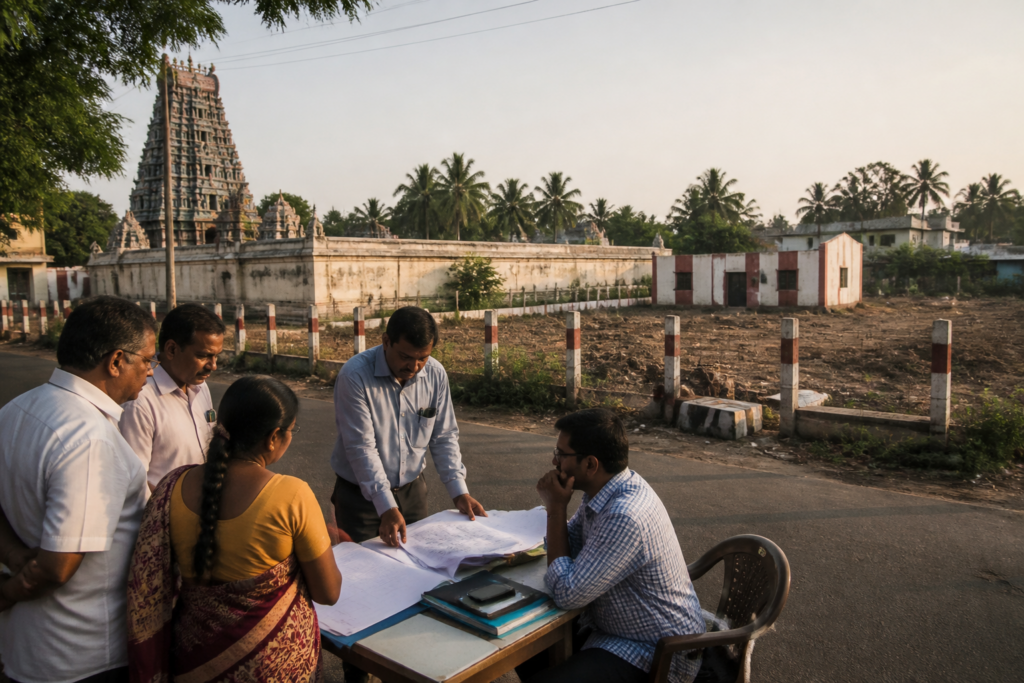
The Madurai Bench of the Madras High Court has asked Tamil Nadu’s Hindu Religious and Charitable Endowments Department to produce a district-wise account of temple-owned land, including property under temple control, land held by leaseholders, alleged encroachments, recovery measures and pending litigation. The direction turns a dispute involving land linked to the Tiruchendur Subramaniyaswamy Temple into a wider test of how the state identifies, protects and administers religious institutional assets.
The court’s request is significant because it seeks more than a response on one parcel. The judges have asked the department’s commissioner to disclose how many temples come under its administration, the total extent of land owned by them, the status of that land and the action taken to recover property from encroachment. The information is to be organised district by district, creating the possibility of a consolidated administrative picture rather than a case-by-case response.
The proceedings arose from a public interest petition filed by Salem Radhakrishnan. According to the report, the petition concerns an endowment property belonging to the Tiruchendur temple in the Srivaikuntam area of Thoothukudi district. The petitioner alleged that the patta for the land had been illegally transferred into the names of private individuals. He sought an investigation into those currently occupying or previously occupying the property, including any political background, and requested action against those responsible.
The petition also argued that the condition of the Tiruchendur temple’s endowment properties reflected a wider problem affecting temple-owned properties in Tamil Nadu. It asked the government to recover and protect endowment assets belonging to the Tiruchendur temple and other temples across the state. These remain allegations and claims made in the petition; the supplied report does not establish the final status of the disputed parcel or determine whether the alleged patta transfer was unlawful.
The court had previously directed the HR and CE commissioner to take steps to recover temple endowment properties from encroachment and submit a compliance report. When the matter came up again before Justices P. Velmurugan and R. Poornima, the department sought more time to file its report. The judges responded by specifying the information required and adjourned the matter to November 27.
That sequence is important. The court is not asking only whether officials acted in the Tiruchendur matter. It is asking the department to establish the scale of the property portfolio under its administration and the status of that portfolio. The requested categories—administrative control, leaseholder possession, encroachment, recovery action and pending cases—represent different stages of land management. Without separating them, a department could know that land is recorded as temple property while still lacking clarity on who controls it, who occupies it or whether it can be recovered.
The distinction between ownership and control is central to the court’s questions. A parcel may be recorded as belonging to a temple but not be in the temple administration’s physical or operational control. Other land may be occupied by leaseholders, while another portion may be described as encroached property. Pending litigation introduces a further layer: land may be identified as temple-owned but remain unavailable for immediate recovery because its status or occupation is being contested before a legal forum.
By requiring the department to report these categories separately, the court is seeking an administrative map of the problem. The order, as described in the report, does not provide the numbers itself. It asks the department to produce them. That means the next important public document will not simply be a statement about the Tiruchendur property, but a report that can show whether the department has a reliable, district-wise record of temple land and its present status.
The information sought also points to the institutional responsibility of the HR and CE department. The court has asked the commissioner to report on the number of temples under the department, the land owned by those institutions and the action taken on encroachments. The immediate administrative burden therefore rests with the department, while the court will examine the submission and decide whether a committee should be formed to study the material and direct appropriate action.
The proposed committee is another important feature of the proceedings. The judges indicated that, based on the department’s report, a committee could be constituted to examine the information and take suitable steps. At this stage, the report does not say that the committee has already been formed. Its creation depends on what the department submits and how the court assesses the need for further scrutiny.
The case illustrates why land records are not merely archival documents in urban and regional governance. Temple properties can include land located in areas experiencing development, changing land values and competing claims of use. The supplied report does not provide the extent, location or economic value of the properties involved, so no broader numerical assessment can be made from the available material. But the court’s demand for a district-wise inventory indicates that the basic administrative question—how much land exists and what is happening to it—has not yet been placed before the bench in the required form.
The categories listed by the judges also reveal where accountability can weaken. If the department reports only the total extent of land, readers and the court would still not know how much is under direct temple control, how much is leased, how much is allegedly encroached upon and how much is tied up in litigation. Similarly, a list of encroachments without details of recovery action would not show whether notices, proceedings or other steps have been initiated. The court’s questions connect the land inventory to action and outcomes.
This is particularly relevant to endowment properties. The petition refers specifically to temple endowment, or kattalai, properties. The report describes the disputed property as belonging to the Tiruchendur temple and located in the Srivaikuntam area. It does not state the nature of the original endowment, the date of any alleged patta transfer, the names of the private individuals involved or the current stage of any related revenue or police proceedings. Those details remain to be established through the department’s report and the court record.
The hearing therefore moves the issue from an allegation about one property towards a structured disclosure exercise. The court wants the department to identify the institutions within its administrative ambit, quantify their landholdings and classify the status of those assets. It also wants information on pending cases, which could show whether disputes are isolated or part of a larger workload involving temple land across districts. The supplied report does not provide that figure, making the forthcoming submission the key factual milestone.
For citizens, the significance lies in the connection between institutional property and public administration. The court’s direction does not decide ownership of every parcel, order immediate eviction from all disputed land or confirm the allegations in the petition. It does, however, require the responsible department to present a more complete account of the assets it administers and the steps taken to protect them.
The next stage is the filing of the HR and CE commissioner’s district-wise report before the Madurai Bench. The court has fixed November 27 for the matter and indicated that it may consider forming a committee after examining the report. Until that submission is made, the extent of temple-owned land, the amount under direct control, the land held by leaseholders, the scale of alleged encroachment and the number of related cases remain unestablished in the material supplied for this report.


