

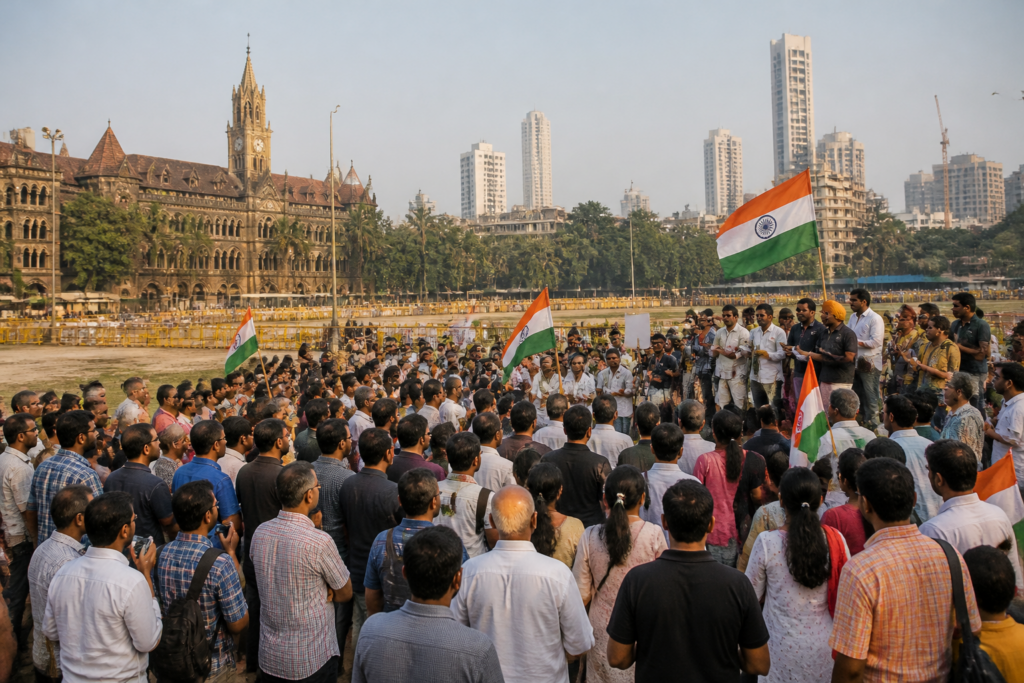
A permitted Mumbai protest at Azad Maidan on October 16 brought demands for the resignation of Chief Election Commissioner Gyanesh Kumar, withdrawal of the Special Intensive Revision of electoral rolls and release of activists detained in New Delhi, while participants also criticised the city’s limited space for public demonstrations.
The gathering was held under the banner of ‘Lehra Do Tiranga’ in solidarity with protesters in New Delhi. Amol Asulkar, coordinator of Citizens for Justice and Peace, said the Mumbai demonstration was organised to support those opposing what he described as authoritarian rule. The allegations and demands were made by the participating groups.
The Cockroach Janta Party and other groups questioned the SIR exercise and alleged that names were missing from electoral rolls. Manan Desai, a volunteer with the party, said the exercise could deny citizens their right to vote. Protesters also demanded the release of Ashutosh Ranka and Saurav Das, whose detention in New Delhi was cited during the demonstration.
Participants said protesters had been detained for waving the National Flag and raising slogans. Amey Gadigaonkar, a Class 12 student and CJP supporter, questioned why displaying the National Flag should be treated as a crime. He also alleged that personnel without visible police badges had assaulted protesters in New Delhi. The Hindu report did not independently establish those allegations.
The Mumbai demonstration was permitted by the police between 10 a.m. and 5 p.m. The permission allowed a maximum gathering of 5,000 people and included conditions restricting loudspeakers, weapons and activities that could disturb public peace. Gadigaonkar said Mumbai Police cooperated with the organisers during the event.
A separate focus of the protest was the availability of public spaces for demonstrations. Ali Bhojani, representing Hum Bharat Ke Log, said the Bombay High Court had designated only Azad Maidan as a protest site in Mumbai. He argued that infrastructure work and changes to the ground had reduced the space available for gatherings and called for additional protest locations across the city, including near the Mahatma Gandhi statue outside Mantralaya.
Bhojani said a protest site should allow citizens to reach both the public and government representatives. His comments placed the demonstration within a wider civic dispute over how Mumbai balances public assembly with traffic management, security and the regulation of large gatherings. The report did not specify any change to the existing court arrangement or announce a new protest site.
Harshada, associated with DISHA, said activists were conducting anti-SIR campaigns in several States through the Bhagat Singh Janadhikar Yatra. She alleged that the exercise could affect Muslims, Adivasis, women and other marginalised communities, and claimed that it was being used to implement parts of the National Register of Citizens through electoral processes. These claims were presented as campaign positions and were not independently verified in the report.
The protesters also demanded an investigation into alleged electoral irregularities, replacement of electronic voting machines with paper ballots, withdrawal of criminal cases against demonstrators and the arrest of the Chief Election Commissioner. The demands were made by the groups participating in the Mumbai event.
The immediate administrative framework for the gathering remained the police permission issued for Azad Maidan, including the five-hour time window, attendance cap and public-order conditions. The organisers’ call for multiple protest spaces would require consideration by the relevant civic, police and judicial authorities, but no such decision was reported.


