

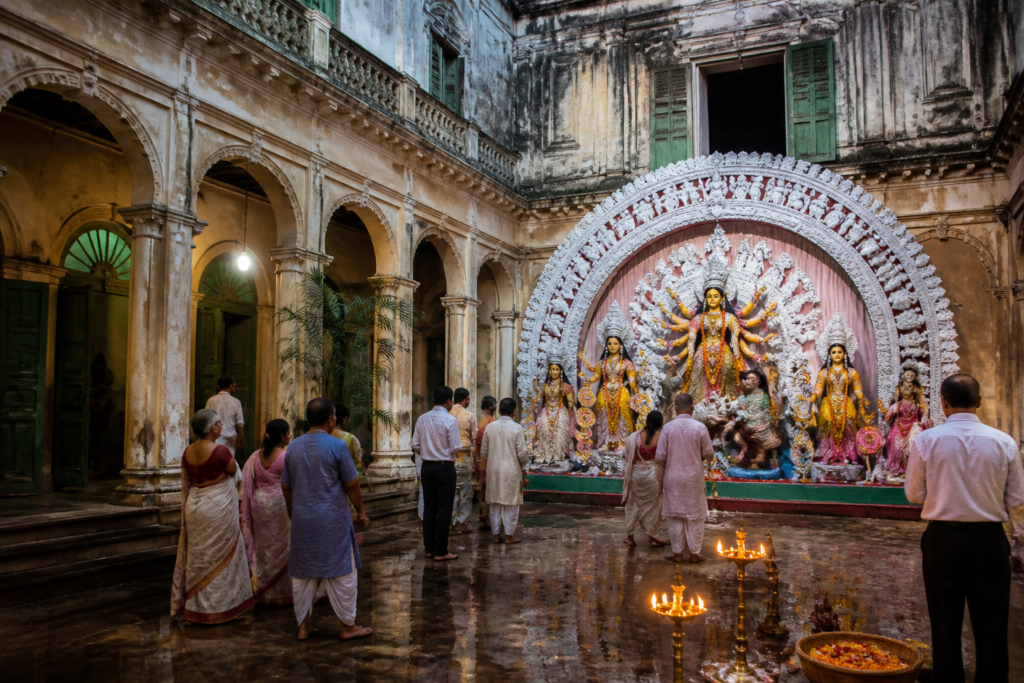
Chinsurah Durga Puja is not confined to an annual religious celebration. In the town’s centuries-old thakurdalans, or family courtyards, the festival preserves a record of migration, trade, domestic architecture and changing religious traditions. The forms of the goddess vary from one house to another, revealing how families have adapted inherited rituals while retaining the physical and social spaces in which those rituals take place.
The history of these houses is inseparable from Chinsurah’s position within the commercial landscape of Bengal. The Dutch East Indian Company established permanent trading settlements in the town in 1635. Chinsurah subsequently became home to Dutch, English, Armenian and Persian merchants, along with Mughal and Nawabi elites and Hindu occupational groups. In the 18th century, Suvarnabanik merchant families from Saptagram settled southwest of Fort Gustavus, the Dutch fort built in 1740 and named in 1742.
That layered past is visible not only in the town’s historic associations but also in the way family homes continue to function. The puja courtyard is simultaneously a religious setting, a meeting place and a repository of family memory. The houses described by The Indian Express remain connected to joint or multi-stakeholder households, where several generations continue to participate in ceremonies and maintain inherited practices.
This makes the thakurdalan more than a backdrop. Its continued use shows how heritage can survive through occupation and ritual rather than through formal preservation alone. The source material does not identify any conservation programme or official heritage framework for these houses. What it documents instead is a form of living continuity, maintained by families whose customs remain tied to particular courtyards, household arrangements, river ghats and hereditary occupations.
The Adhya family’s puja illustrates how a house can preserve a distinct religious identity through its visual and ceremonial choices. Adhyabati, or the House of Adhya, is celebrating its 292nd Durga Puja this year. Founded by Badan Chandra Adhya, the household follows strict Vaishnava traditions and describes itself as an ekannabarti, or joint family, with multiple generations living under one roof.
The Adhyas do not depict Durga in the familiar Mahishasuramardini form, in which she is shown slaying Mahishasura. Instead, she appears in the Hara-Gauri form, seated on Shiva’s lap. She has two arms, while Shiva is shown with a moustache and a pot belly. The lion is absent, as is Mahishasura, while Shiva rests on Nandi. These choices change the visual language of the festival from a representation of combat to one centred on familial and domestic relationships.
The distinction is also expressed through food, ritual and the organisation of the household. The Adhyas abstain from meat and cooked rice between Mahalaya and Vijaya Dashami. Their chaalchitra, the semi-circular backdrop behind the idol, depicts episodes from the goddess’s life, including her marriage with Shiva. The idol is made by Narayan Pal, whose family has worked as hereditary potters. Gold and silver jewellery is added on Maha Shashthi, while cultural programmes are held on Maha Navami.
The family’s description of the festival is significant because it does not separate worship from celebration. For the Adhyas, there is no distinction between puja and utsav. The statement reflects the way these ceremonies operate as social institutions within the house, bringing together religious practice, family participation, craft production and cultural activity. On Vijaya Dashami, the goddess is carried by 23 men to the ghats of the Hooghly River, linking the domestic courtyard to the riverfront that has long shaped Chinsurah’s history.
Boro Seal Bari presents another version of this continuity. Founded by Nilambar Seal in 1763, the house has been celebrating Durga Puja for 30 years, while the Seal family is also known for a Kartik Puja said to date back 224 years. Rajat Seal, a descendant and member of the family trust, distinguishes between the family’s better-known Kartik tradition and its more recent Durga Puja observance.
The family’s account also shows why inherited histories can contain competing versions. Family legends associate an ancestor, Ayodhyaram Seal, with an earlier form of Durga worship in a ceremonial earthen vessel. Rajat Seal, however, said that Ayodhyaram’s lineage ended with his generation and never constituted the main lineage of the Seal family. The detail is important because historic houses are not static archives. Their histories are carried through oral accounts, family claims and continuing negotiations over lineage.
At Boro Seal Bari, Durga is also worshipped in the Hara-Gauri form. The chaalchitra depicts the marriage of Shiva and Durga and presents them within family life. The household follows Vaishnava traditions and abstains from meat during the puja, although the source notes that this restriction does not extend into the personal lives of family members. Bhagirathi Rui Das, a resident of Masagram, has played the dhak at the house for three decades, showing how the festival’s continuity also depends on relationships beyond the family itself.
Halder Bari retains a different visual form while preserving a Vaishnavite identity. Debajyoti Halder, a descendant and the current priest, says the puja is more than 450 years old. According to family legend, Sandeshwar Tala, where the Halders live, was once a large crematorium. A poor resident Brahmin was said to have been shown a pot of gold and instructed to worship Durga and Vasuki Sridhar, the ancestral tutelary deity. An ancestor, Satyacharan Halder, later inherited the Durga Puja.
Unlike the Adhya and Seal families, the Halders worship Durga in the Mahishasuramardini form. Yet the image carries markers of their Vaishnavite distinctiveness: a white mark beneath the goddess’s third eye and a white lion. The family also retains the ritual idea of sacrifice while adapting it to restrictions on meat. A wax gourd is sacrificed on Maha Navami in place of an animal. Kumari Puja is performed on the same day, and the family abstains from cooking on Vijaya Dashami.
The Halders call their arrangement a tin-shariki Puja, or a puja of three stakeholders. The term points to another feature of living heritage: continuity is not always organised around a single undivided household. It can also depend on negotiated participation among several branches or stakeholders. The Halders continue to live under one roof, and the idol is immersed at a ghat adjoining the home.
Taken together, the three houses show that Chinsurah’s historic domestic spaces have preserved variation rather than uniformity. One household places Durga on Shiva’s lap, another follows the same Hara-Gauri form while carrying a different family history, and a third retains the warrior-goddess image but modifies its iconographic details. Their rituals also differ in food restrictions, sacrifice, household organisation, music, craft and immersion practices.
This diversity is connected to Chinsurah’s wider cosmopolitan past, but the source does not present foreign influence as a simple replacement of local traditions. Instead, the old houses absorbed elements from a town shaped by Dutch, English, Armenian, Persian, Mughal and Nawabi presences while continuing to participate in Bengal’s broader cultural fabric. The result is an accumulated urban history expressed through family courtyards rather than through a single official monument.
The account also reveals the institutional work required to keep such traditions functioning. Families maintain trusts, priests, hereditary craft relationships, musicians, ritual calendars and household rules. The participation of a hereditary potter and a dhak player from Masagram indicates that the pujas are connected to wider networks of skilled labour. At the same time, the continued presence of joint families or shared household arrangements provides the social base for rituals that require coordination across generations.
What remains unclear is the condition of the buildings themselves and the pressures they face. The supplied material does not provide information on structural maintenance, ownership disputes, municipal protection, adaptive reuse, tourism management or the cost of conducting the pujas. It also does not establish whether the three houses have formal heritage status. These gaps matter because the survival of a ritual does not automatically guarantee the survival of the architecture that hosts it.
The evidence does establish that the houses remain active cultural spaces. Their value lies in the connection between built form and practice: the thakurdalan, the idol, the chaalchitra, the family, the craftspeople, the river ghat and the ceremonial calendar operate as parts of one urban system. Removing any one element would alter the meaning of the festival, even if the ritual continued elsewhere.
Chinsurah’s Durga Puja therefore offers a useful way to understand heritage beyond monuments and façades. The town’s historic identity is carried through occupied homes, family trusts, oral histories, visual symbols and repeated movement between courtyards and the Hooghly. The immediate story is about three family pujas, but the deeper evidence concerns how urban memory survives when people continue to use inherited spaces and adapt traditions without abandoning their distinctiveness.


