

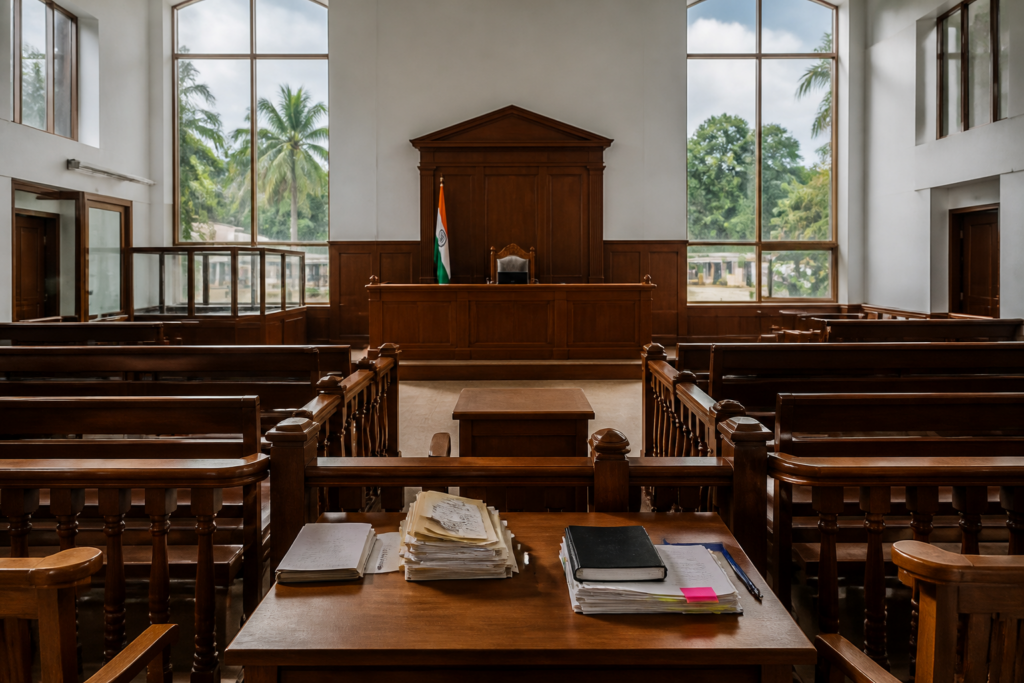
The Kerala High Court’s direction to appoint POCSO special public prosecutors exclusively for child sexual-offence cases is more than an administrative correction. It places the organisation of the state’s child-protection courts under scrutiny, tying the quality of prosecution to the availability of trained personnel, compliant courtrooms and a dedicated judicial structure.
A division bench comprising Chief Justice Soumen Sen and Justice V M Syam Kumar directed the Kerala government to appoint special public prosecutors exclusively for POCSO cases within six weeks. It also rejected the government’s decision to allow prosecutors appointed for cases under the Protection of Children from Sexual Offences Act, 2012, to conduct cases filed under the Juvenile Justice (Care and Protection of Children) Act, 2015.
The order followed a public interest litigation filed by the District Court Bar Association, Thodupuzha-Muttom. The petition challenged a government order that permitted POCSO special public prosecutors to handle non-POCSO cases under the Juvenile Justice Act. The state government had defended the arrangement by arguing that no law prohibited such an assignment. The High Court did not accept that reasoning.
The ruling matters because it treats specialisation as a functional requirement rather than merely a staffing preference. The court referred to a 2020 Supreme Court order in a suo motu case, which emphasised that prosecutors handling POCSO cases should be appointed exclusively for that work. The Supreme Court had also described the responsibility as onerous and requiring great care and sensitivity.
That reasoning places the prosecutor at the centre of how the child-protection justice system operates. A POCSO case is not simply another criminal proceeding in an already crowded court calendar. The statutory framework concerns children and requires the justice process to respond to their vulnerability. The High Court’s order indicates that this responsibility cannot be diluted by assigning the same special prosecutors unrelated cases under another child-protection law.
The order also refers to the need for a training programme to equip prosecutors to deal with issues that may arise in POCSO courts. This adds an institutional dimension to the ruling. Exclusive appointments may protect time and attention, but the court has also highlighted professional preparation as part of the system required to handle such cases.
## The court network behind the order
The High Court directed the state government to consider establishing the remaining 13 permanent, exclusive POCSO special courts, with one in each district except Ernakulam. The state must communicate its decision on this question to the High Court administration within four weeks.
This direction brings the physical and administrative capacity of the court network into the same conversation as the appointment of prosecutors. A dedicated prosecutor cannot by itself create a fully functional specialised court. The system also requires courts that are formally established for the purpose, meet the requirements of the POCSO Act and operate in accordance with the relevant guidelines under the Juvenile Justice Act.
The available report does not specify the present number, staffing strength or workload of POCSO courts in Kerala. It also does not provide a timeline for the construction, conversion or operationalisation of the 13 courts under consideration. Those details will be important in assessing how quickly the High Court’s directions translate into functioning capacity on the ground.
The four-week communication deadline and the six-week prosecutor appointment deadline create two separate administrative milestones. The first concerns the government’s decision on the remaining exclusive courts. The second concerns the appointment of prosecutors who will work only on POCSO matters. Together, they require the state to respond both to the institutional gap and to the immediate staffing issue.
## Compliance is part of capacity
The High Court also directed the registrar dealing with the district judiciary to ensure that all POCSO courts conform to the provisions of the POCSO Act. If any existing court does not meet the prescribed requirements, immediate steps must be taken to make the necessary additions and alterations. The court further referred to compliance with the guidelines under the Juvenile Justice Act.
This is significant because the order does not define capacity only through the number of courts or prosecutors. It also asks whether existing courts are actually compliant with the legal framework governing them. The direction to make additions and alterations suggests that institutional adequacy includes the physical and procedural conditions in which cases are heard, although the supplied report does not list the specific deficiencies found in any court.
For citizens, the difference between a court being designated for POCSO matters and a court being properly equipped to handle them can be substantial. The High Court’s order links formal designation to actual compliance, making the district judiciary responsible for checking whether the prescribed requirements are being followed.
The case therefore reveals a layered governance structure. The state government controls appointments and must decide on the remaining exclusive courts. The High Court administration receives the government’s decision and oversees the judicial side of the response. The registrar of the district judiciary must check compliance in existing POCSO courts. The arrangement requires these institutions to act on connected parts of the same system rather than treating the issue as a single recruitment decision.
## A specialised system with uneven institutional support
The dispute arose from a government order allowing POCSO prosecutors to conduct non-POCSO cases under the Juvenile Justice Act. The High Court’s rejection of that arrangement establishes that the special role assigned to POCSO prosecutors should remain focused on POCSO work. It also indicates that staffing flexibility cannot override the institutional purpose of a specialised appointment.
At the same time, the direction to consider 13 additional permanent exclusive courts shows that the specialised structure is not yet complete across the state, according to the report. The fact that Ernakulam is excluded from the list of remaining courts indicates that the High Court’s direction is based on an existing district-level arrangement, but the supplied material does not explain the status or performance of the Ernakulam court.
The absence of published figures in the report leaves several operational questions open. It is not clear how many POCSO cases are pending, how many prosecutors currently handle them, how many courts are fully compliant or what resources would be required to establish the 13 courts. These are not minor details: they will determine whether the directions produce additional capacity or only reorganise existing personnel and courtrooms.
The High Court’s reference to training is similarly important. The report does not identify the proposed programme, its duration, the agency responsible for conducting it or the number of prosecutors to be covered. Those details will show whether training is being treated as a formal institutional requirement or as an administrative follow-up to the appointments.
## What the deadlines will reveal
The immediate test is whether the state communicates its decision on the 13 courts within four weeks and completes the exclusive prosecutor appointments within six weeks. The court has also directed the registrar to ensure that existing POCSO courts comply with the Act and relevant Juvenile Justice Act guidelines. That makes compliance review an ongoing administrative task rather than a one-time response to the litigation.
The order does not itself establish the remaining courts, appoint individual prosecutors or specify the budget for implementation. Its significance lies in setting institutional directions and deadlines. The next stage will depend on how the government, the High Court administration and the district judiciary convert those directions into appointments, court infrastructure, training and verified compliance.
The evidence presently confirms a clear judicial position: POCSO special public prosecutors should work exclusively on POCSO cases, the state must examine the creation of 13 more permanent exclusive courts, and existing courts must conform to statutory requirements. What remains to be established is the scale of the current capacity gap and whether the administrative response meets the deadlines set by the High Court.


