

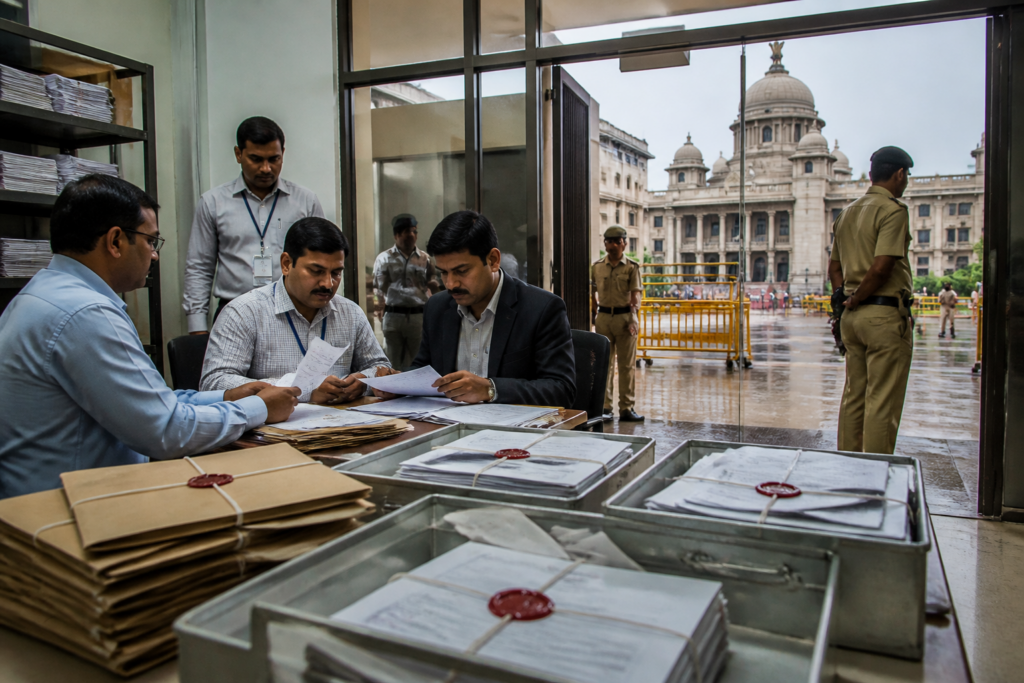
The Karnataka Public Service Commission recruitment scam has moved from an alleged examination leak to a test of whether the state’s investigative, prosecutorial and recruitment institutions can act quickly enough to protect the credibility of public hiring. The Criminal Investigation Department’s request for sanction to prosecute IAS officer Gyanendra Kumar Gangwar comes as investigators work towards a November 26 chargesheet deadline and after the Supreme Court rejected the need for a de novo investigation on the material placed before it.
Gangwar, a 2016-batch Karnataka cadre officer who served as KPSC Controller of Examinations between January 2024 and March 2026, was arrested on August 29. The CID alleges that he leaked questions from the KPSC veterinary doctors’ recruitment examination held in January to 10 candidates. Those candidates later appeared among the top 20 in the rank list, according to the report by The Indian Express.
The case therefore raises a question larger than the conduct of two accused individuals: what happens to a public recruitment system when the authority responsible for protecting an examination is alleged to have become part of the channel through which its confidentiality was breached? The supplied investigation details point to a chain involving an examination controller, a middleman, candidates willing to pay for advance access and a legal process that now depends on several institutions completing their roles within fixed timelines.
The alleged intermediary, Basvaraj Kannale, was arrested on August 30. Investigators allege that he helped identify aspirants willing to pay between Rs 20 lakh and Rs 40 lakh for questions in advance. The CID and the Enforcement Directorate have further alleged that Gangwar received Rs 1.3 crore from Kannale this year in connection with the leak. Both men have also been arrested by the ED in a money-laundering case linked to the alleged recruitment fraud.
These allegations remain subject to the legal process. The CID has booked the accused under Section 318(3) for cheating through breach of trust and Section 10 of the Karnataka Public Examination Act, 2023, according to the report. The immediate institutional task is to convert the investigative material into a chargesheet that can withstand scrutiny in court while addressing the procedural requirements that apply when a public servant is accused of an offence.
That is where prosecution sanction becomes central. CID police sources cited by The Indian Express said Section 218 of the Bharatiya Nagarik Suraksha Sanhita requires sanction when state officers are directly involved in crimes. The provision creates an additional procedural stage before prosecution can proceed against certain public servants. Under the same legal framework, sanction is deemed to have been granted if it is not issued within 120 days, the report said.
The sanction requirement is not a minor administrative formality in this case. The report notes that previous KPSC recruitment fraud investigations have been annulled by courts on the ground that prosecution sanction for arrested public servants was missing. The 2013 KAS officers’ recruitment scam is cited as a major example: sanction was not accorded by the state for a KPSC member accused of influencing selections at the interview stage, after which the Karnataka High Court ordered a Special Investigation Team and fresh investigations.
This history gives the present request a direct institutional significance. An investigation can identify an alleged leak, trace payments and record statements, but a prosecution may still face a procedural challenge if the state does not complete the sanction process correctly. The sanction question consequently sits at the intersection of executive decision-making and criminal accountability. It can determine whether a case advances on its evidence or becomes vulnerable because a statutory step was not completed.
The timeline is also important. Gangwar was arrested on August 29, and the CID is due to file a chargesheet by November 26, at the end of 90 days after the first arrest. The report notes that failure to file the chargesheet within that period can lead to the release of persons in custody. This places pressure on the investigation, the prosecution process and the state government’s handling of the sanction request at the same time.
The Supreme Court’s October 13 intervention changed the legal setting in which that work is taking place. The Karnataka High Court had ordered the constitution of an SIT and a de novo investigation into the veterinary doctors’ recruitment examination on September 21. The state government argued before the Supreme Court that there was no finding of investigative lapse or misconduct by the CID that justified starting the investigation afresh.
The Supreme Court agreed with that position in its order. Justices Manoj Misra and Vijay Bishnoi observed that a de novo investigation has serious consequences and should be ordered only in rare circumstances involving allegations such as bias, malice or serious investigative lapses, including the removal or manipulation of evidence. The bench said no such finding had been recorded in the order under challenge and held that a de novo investigation was neither warranted nor justified.
The court nevertheless allowed a Special Investigation Team to be formed and indicated that chargesheets could be filed against those arrested where necessary. This distinction matters. A fresh investigation would have reset the evidentiary and administrative process, while the Supreme Court’s position allows the existing CID investigation to move towards prosecution, subject to the applicable legal safeguards and scrutiny by the courts.
For the KPSC, the alleged leak also exposes the institutional cost of a compromised examination. Public recruitment examinations are not only selection exercises; they are the route through which the state fills specialised posts and creates confidence that advancement is based on a common test. When questions are allegedly supplied in advance to a limited group, the damage extends beyond candidates who may have lost rank. It affects the credibility of the list, the legitimacy of appointments and the willingness of future applicants to trust the process.
The available material does not establish how the January examination will ultimately be treated, whether the rank list will be cancelled or whether a new examination will be ordered. Nor does it provide the final findings of the investigation or a court determination on the allegations. Those unresolved questions are important because the institutional response to a recruitment fraud must address both individual criminal liability and the status of the examination itself.
The case also shows how several accountability systems now overlap. The CID is pursuing the criminal investigation. The state government must consider the prosecution-sanction request. The courts are examining the legality of the investigative process. The ED is pursuing a connected money-laundering case. The KPSC remains the institution whose examination process is at the centre of the alleged fraud. Each body operates under a different mandate, but delays or gaps at one stage can affect the credibility of the entire response.
The Supreme Court’s warning about de novo investigations adds another layer. The court’s stated threshold—bias, malice or serious investigative lapses supported by findings—sets a high bar for replacing an ongoing investigation. In practical terms, the case will now be judged through the evidence collected by the CID, the legality of the chargesheet, the sanction process and the subsequent proceedings, rather than through an automatic restart of the probe.
The immediate data points are therefore procedural rather than statistical: the January examination, 10 candidates allegedly supplied with questions, the 20 candidates in the top 20 rank list, the alleged payments of Rs 20 lakh to Rs 40 lakh by aspirants, the alleged Rs 1.3 crore payment to Gangwar, the August arrests, the October 13 Supreme Court order and the November 26 chargesheet deadline. Together, they describe a case in which the integrity of a public examination is tied to a rapidly narrowing legal timetable.
What the case ultimately confirms is that examination security is only the first layer of recruitment governance. The credibility of a public hiring system also depends on conflict controls within the examining authority, traceable investigations, timely prosecution decisions and court-ready documentation. What remains unresolved is whether the alleged criminal conduct will be proved, what happens to the affected examination and whether the sanction process will be completed without weakening the prosecution. The next significant milestones are the state government’s decision on sanction and the CID’s planned chargesheet by November 26.


