

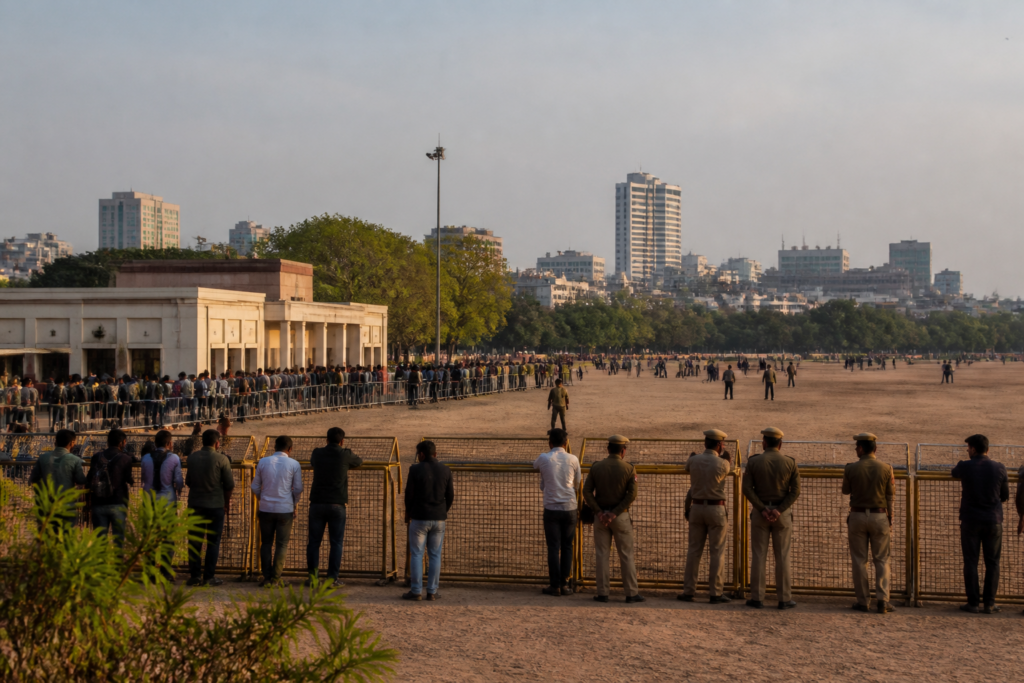
Delhi’s new protest-site policy has created a formal alternative to Jantar Mantar, but its implementation is revealing a deeper administrative problem: the capital does not yet have a common system for allocating public grounds for demonstrations. Five days after Delhi Police ordered that protests be shifted from Jantar Mantar to Ramlila Maidan, Burari and CBD grounds, MCD has prepared a booking procedure for one site while the Delhi Development Authority is still working out the rules, rates and availability for the other two.
That distinction matters because a protest site is not simply an empty plot that can be reserved like an event venue. It is public infrastructure for civic expression, and its usefulness depends on whether organisers can understand the rules, obtain permission within a reasonable period and access a site that is actually available. The current arrangement, as described in the Times of India report, provides a relatively clear process at Ramlila Maidan but leaves major operational questions unanswered for DDA-controlled land.
At Ramlila Maidan, the Municipal Corporation of Delhi has drafted a revised standard operating procedure. The ground will be available for protests without a booking fee, but organisers will need a police no-objection certificate and must submit a refundable security payment of Rs 5,000. MCD said the booking process is open and can be completed offline.
The procedure requires organisers to visit the City-Sadar Paharganj zone and submit a manual application on their organisation’s letterhead. The application must include Aadhaar details and the police NOC. Once the documents are submitted, the deputy commissioner of the zone will clear the request and book the date, according to the civic body.
This creates a defined administrative chain: the police provide the NOC, the MCD zone office receives the application, and the deputy commissioner clears the booking. The process is not digital, but the responsibilities are identifiable. For organisers, that clarity may be as important as the absence of a booking fee because it indicates where an application must be filed and which authority takes the next decision.
The position is different at CBD Ground in east Delhi. The site belongs to the DDA and an online booking facility exists on the authority’s website, but the menu does not include a category for a protest or dharna. The absence of that category is not merely a technical inconvenience. It means the administrative system currently offers a booking interface without fully recognising the use for which the site has been designated.
The financial structure at CBD Ground also points to a mismatch between ordinary event booking and protest allocation. Booking a plot of about 3,000 square metres costs Rs 1.8 lakh per day, including Rs 95,000 as security charges, according to the report. A DDA official said the ground is booked for months because it is leased to event companies for marriages and other functions. Protest dates would be given only when no other booking exists.
This makes availability a central issue. A ground may be listed as an approved protest location, but that does not mean it can function as a dependable venue unless dates are protected or a transparent priority system is established. At CBD Ground, the existing commercial and event use appears to take precedence in practice, leaving protest organisers dependent on gaps in an already committed calendar.
The difference between Ramlila Maidan and CBD Ground is therefore not only one of price. At Ramlila, the procedure is free apart from a refundable security payment and is administered through an MCD office. At CBD, the existing booking structure is expensive, the protest category is absent from the online system, and dates may be unavailable because of prior event commitments. The two locations are being treated as parts of one policy, but they do not yet operate as parts of one system.
Burari Ground presents a third version of the same problem. The DDA website does not specify the booking fee, and the process remains offline. The report says a direction was issued only last week to list the place online for permitting temporary events. DDA sources said a file would be moved to the institutional land wing of the land disposal department to formulate standard operating procedures and rates for allocating both Burari and CBD grounds for protests.
The DDA’s explanation also clarifies why the existing rules cannot simply be applied without modification. A source said normal rates cannot apply to agitations and that new SOPs must be formulated for them. This indicates that the authority is trying to distinguish between commercial or private events and civic demonstrations. However, until that distinction is converted into published rules, organisers remain without a clear answer on cost, documents, approval timelines and the order in which competing bookings will be considered.
The administrative structure behind the policy is fragmented. MCD controls the procedure at Ramlila Maidan, while DDA controls Burari and CBD grounds. Delhi Police remains involved through the NOC requirement, and the MCD zone office and DDA’s institutional land wing have separate roles in processing or designing the system. The policy therefore depends on coordination between agencies that maintain different land records, booking platforms and approval procedures.
The report does not establish whether the three sites have common capacity standards, crowd-management requirements, sanitation arrangements, emergency access rules or operating hours. It also does not state whether organisers will receive a standard response time or whether applications can be challenged if a date is denied. Those details may be addressed in the DDA’s forthcoming SOPs, but they had not been finalised at the time of the report.
The booking fee question is particularly important because it can determine whether a designated protest ground is practically accessible. Ramlila Maidan’s refundable Rs 5,000 security payment is materially different from the Rs 1.8 lakh daily charge reported for CBD Ground. The report says the CBD amount includes Rs 95,000 as security charges, but it does not establish whether a separate, lower protest rate will be approved. Until DDA fixes those rates, the listed commercial tariff cannot be treated as the final cost of holding a protest there.
The availability question is equally significant. CBD Ground’s existing lease arrangements mean that the site’s designation does not automatically create public access. If the ground is booked for months for marriages and other events, protest organisers may be left with a formal right to apply but no predictable opportunity to secure a date. The distinction between nominal availability and usable availability is central to how the policy will work on the ground.
The move away from Jantar Mantar has consequently produced a policy that is operational at one location and provisional at two others. MCD has published a process, including the documents required and the officer responsible for clearance. DDA is still developing the corresponding rules for land under its control. The result is a patchwork in which the experience of organising a protest depends heavily on the agency managing the selected ground.
For Delhi’s urban governance system, the episode shows how the allocation of public space can become an inter-agency problem. A decision to relocate protests requires more than naming alternative grounds. It also requires a functioning booking mechanism, published costs, a method for resolving schedule conflicts and a clear division of responsibility between the police, civic agencies and land-owning authorities. Without those elements, a policy can exist administratively while remaining difficult to use in practice.
The next step is the DDA’s proposed formulation of SOPs and rates for Burari and CBD grounds. Until those rules are finalised and reflected in the booking system, the implementation of Delhi’s protest-site policy will remain uneven. The immediate evidence confirms that Ramlila Maidan has a working, offline process, while the two DDA sites are still waiting for the administrative framework that would make their designation operational.


