

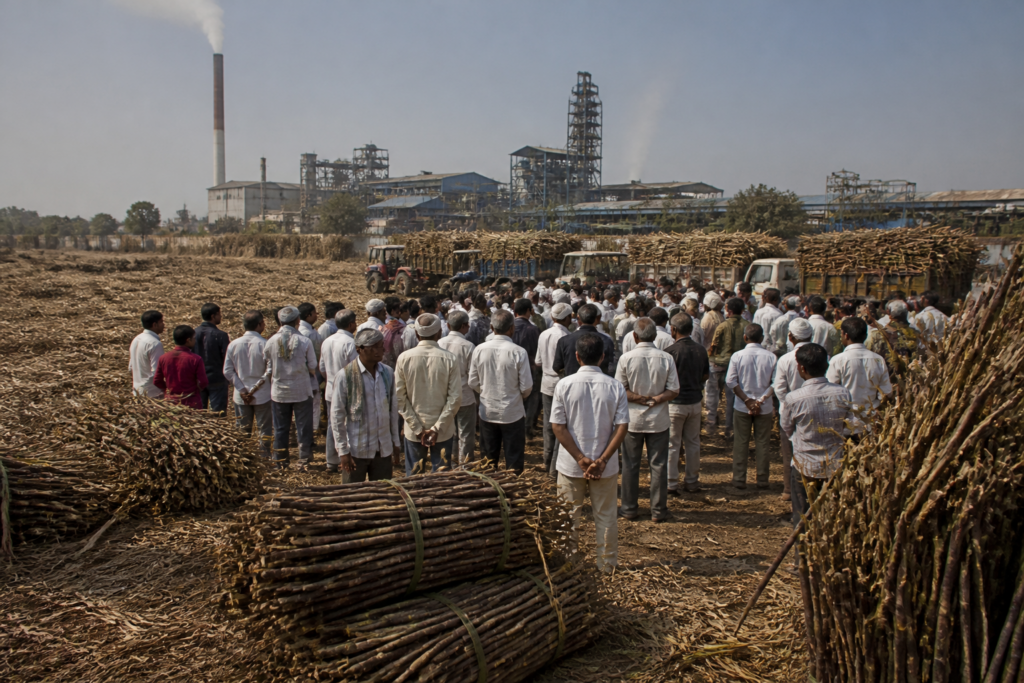
The Maharashtra State Cooperative Sugar Federation has appealed to Swabhimani Shetkari Sanghatana president Raju Shetti to help ease the ongoing sugarcane farmers’ protest, warning that drought conditions and the suspension of rabi irrigation rotations are causing standing cane to dry rapidly and lose weight.
The appeal was made through a letter jointly signed by federation president P.R. Patil and Harshavardhan Patil, a federation director and president of the National Federation of Cooperative Sugar Factories in New Delhi. The federation said farmers associated with the protest should consider the possible losses to growers if the agitation continues during the cane-crushing season.
According to the letter, the three demands raised by Shetti at a joint meeting with the Union government on October 12 were justified and in the interest of sugarcane producers. These include raising the minimum selling price of sugar to Rs 5,000 per quintal, providing a government subsidy of at least Rs 500 per tonne directly to farmers, and increasing the price of ethanol produced from C-heavy molasses to Rs 70 per litre.
The federation said these measures would support sugar factories and help prevent the wider sugar industry from collapsing. The appeal comes after the Union government constituted a committee on October 14 under the chairmanship of former NITI Aayog member Professor Ramesh Chand to examine the issues raised by the farmers’ organisation.
The protest has since been taken up in Maharashtra and Karnataka. The federation said farmers associated with Swabhimani Shetkari Sanghatana are also shareholders in cooperative sugar factories, making them stakeholders in the industry’s operations as well as producers dependent on cane payments.
The dispute links farm-level water stress with the financial and operational pressures facing sugar mills. The federation said the government’s decision to stop rabi water rotations amid drought conditions had accelerated the drying of standing sugarcane and increased weight losses. Since sugarcane payments and factory economics are closely connected to the quantity of cane crushed, delayed harvesting could affect both growers and mills.
The federation has therefore asked Shetti to take the industry’s circumstances into account and help create conditions for cane crushing to begin or continue. The letter did not announce any withdrawal of the protest or provide a revised timeline for negotiations. Further developments will depend on the committee constituted by the Union government and on discussions between the farmers’ organisation and the sugar industry.


