

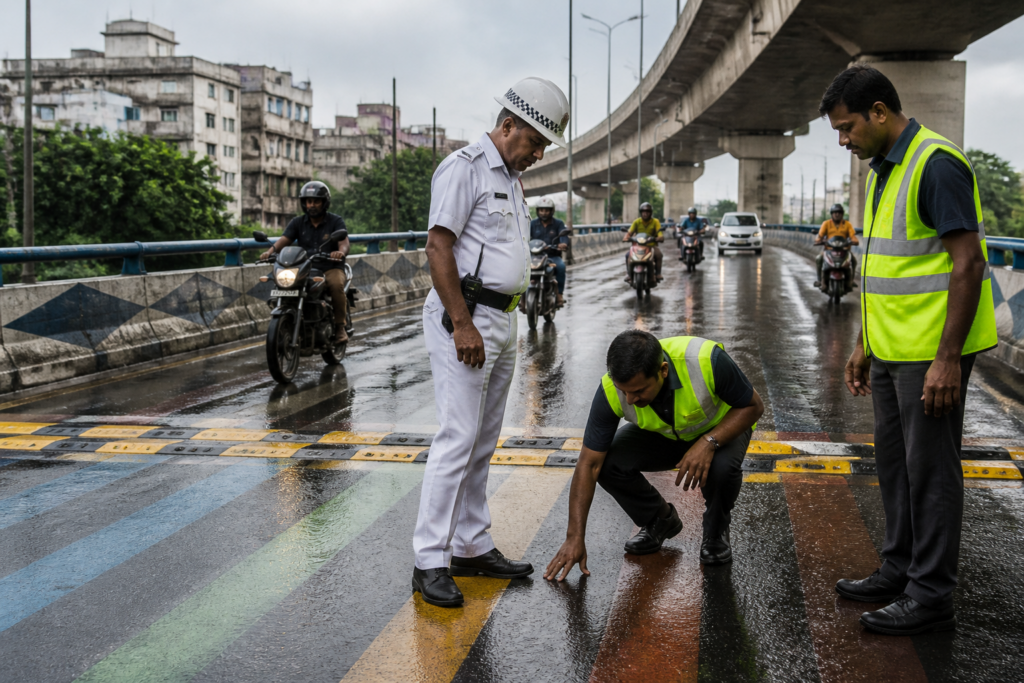
Kolkata’s Chingrighata flyover has come under renewed scrutiny after an environmental technologist and transport expert asked the city police commissioner to obtain technical certification for the paint used on the road surface, days after three motorcycles reportedly skidded and crashed following rain.
Somendramohan Ghosh wrote to Kolkata Police Commissioner on Friday, seeking details on whether the paint applied to the flyover was a thermoplastic product suitable for asphalt and whether it had been installed through a hot or cold application process. His letter followed a video recorded from a motorcycle dashboard that circulated on social media after the incidents on Wednesday, October 14.
The video showed three motorcycles losing balance one after another on the flyover after rain, according to Anandabazar’s report. The footage was recorded by Sayan deep Lahiri, whose caption questioned why vehicles had skidded on what appeared to be a newly decorated road surface. The incidents led to allegations that the decorative painting carried out before the festive season may have affected road grip.
The Kolkata Police commissioner had described the road paint as “anti-skid” after the accidents. He also said that motorcycle riders may have lost balance while attempting to make videos or reels. However, Ghosh has asked the police to seek written technical information from the companies that supplied the paint rather than assign responsibility on the basis of assumptions.
Ghosh said that the authorities should establish whether the material was designed for asphalt. He also pointed to the difference between a matt-finish coating and a glossy enamel surface, while noting that matt paint applied directly to asphalt may not last. According to his explanation, thermoplastic paint is generally melted at temperatures between 180 and 220 degrees Celsius before application and is expected to remain durable for four to five years.
He further claimed that paint was already coming off under ordinary foot traffic on the Gariahat flyover, raising questions about the quality, preparation and application of the material used in the city’s recent beautification work. The supplied report does not include an independent technical test of the Chingrighata surface or a final finding on whether the paint contributed to the crashes.
The administration began taking steps at the two flyovers after the controversy emerged. Yellow fibre blocks, functioning as speed breakers, were installed on the Chingrighata flyover from Thursday morning as a road-safety measure. At the Gariahat flyover, municipal equipment was used to remove the disputed rainbow-coloured surface. Paint was also being removed near Shahid Bhagat Singh More in Asansol.
The differing responses at Chingrighata and Gariahat have raised questions about how painted road treatments are assessed and managed after safety concerns emerge. The report does not state whether a common technical specification governed the work at the three locations.
Trinamool Congress leader Kunal Ghosh criticised the administration after a video of the Gariahat paint-removal work was posted online, questioning why allegedly unsafe paint had been applied and who would bear responsibility for the accidents and the cost of rectification. Chief Minister Suvendu Adhikari had earlier rejected the theory that the paint caused the accidents, asking whether road painting itself could lead to crashes and referring to accidents on other flyovers.
Urban Development Minister Agnimitra Pal denied that oil paint had been used on the road and said anti-skid paint had been applied. She said officials were examining whether oil paint on the walls of the flyover could have contributed to the problem. Pal also said the beautification work had not been paid for with government funds; according to her, several companies had undertaken it through their corporate social responsibility funds.
The immediate issue now before the police and relevant civic departments is whether the suppliers can provide the technical certificates and application details sought in Ghosh’s letter. Those documents, along with a formal assessment of the road surface, will determine whether the Chingrighata incidents were linked to the paint, weather, rider behaviour or another road condition.


