

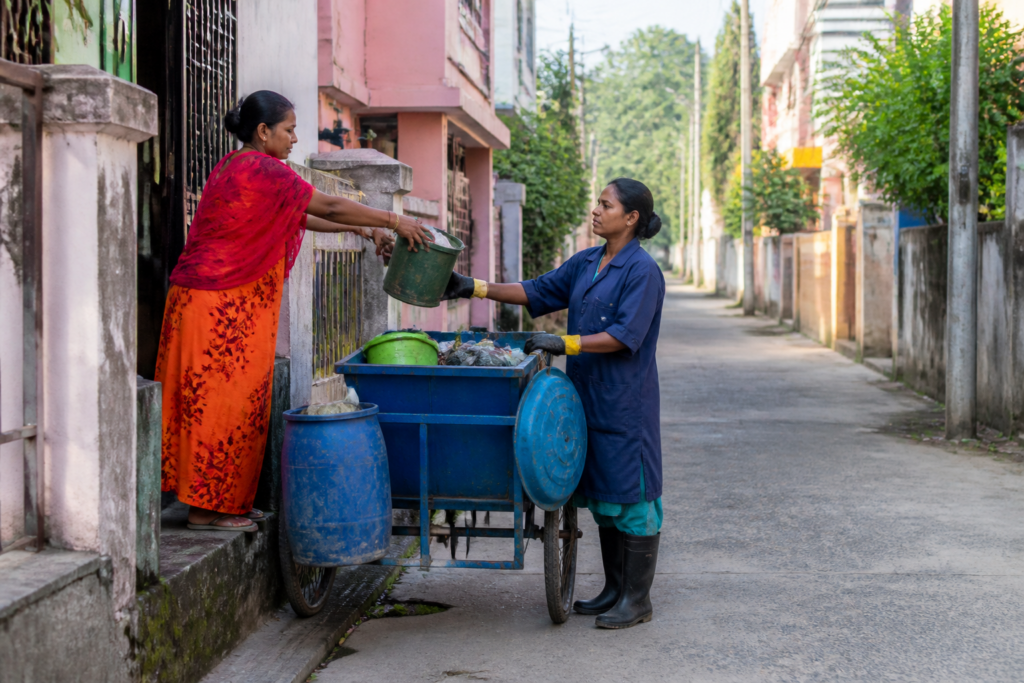
Every morning at 7, Rekha Chattopadhyay leaves her home in Sharatnagar, Ashokenagar, on the three-wheeled waste cart once operated by her late husband. Her whistle wakes residents, who bring household rubbish in blue and green plastic containers. They may see only a few minutes of a daily collection routine, but the relationship between the 51-year-old sanitation worker and the neighbourhood reveals a larger truth about urban cleanliness: municipal systems are experienced at street level through the people who collect, carry and remove waste.
Rekha works in Ward 9 of the Ashokenagar-Kalyangarh municipality in North 24 Parganas. She collects household waste from homes and transfers it to the municipal waste vehicle. The work became hers after her husband, Ajay Chattopadhyay, suffered repeated strokes and lost his eyesight. He could no longer leave the house, but the household still needed an income and the sanitation work could not simply disappear.
The decision placed Rekha inside a job for which she had not originally trained. She had not properly learnt to ride a cycle as a child. Managing a household had been her principal responsibility. Yet she had occasionally accompanied her husband while he worked and had observed the routine closely. When his illness made it impossible for him to continue, she learnt to operate the three-wheeler herself.
That transition matters because waste collection is often understood as a municipal service rather than as a chain of individual responsibilities. The municipality may organise the service and residents may hand over their rubbish, but the daily connection between those two points is maintained by a worker who must travel through the neighbourhood, stop at homes, handle waste and keep to a routine. In Ashokenagar, that routine has become recognisable through Rekha’s whistle and the arrival of her cart.
According to the report, Rekha approached the local administration after her husband fell ill and expressed her wish to continue his work. Officials offered to give her another job, but she declined. She wanted to do the work through which her husband had supported the family. Her request was accepted by the relevant authorities, allowing her to continue as a sanitation worker rather than lose the household’s existing source of income.
This administrative decision created continuity at two levels. It helped Rekha retain an occupation that she understood and wanted to perform, and it ensured that an established waste-collection route did not lose the worker familiar with its homes and residents. The supplied report does not provide details of the municipality’s appointment process, employment category, wages or service contract. It does, however, show that a personal family crisis was addressed through an institutional decision that kept a local public service functioning.
The work also illustrates the dependence of waste collection on regularity. Residents bring their domestic waste out because they expect the collector to arrive. Rekha says that if she is unwell or if there is a problem with the vehicle, she informs residents. Their response goes beyond waiting for the next collection. They call to ask about her health and whether she needs anything. The report describes this as an unusual bond, but it is also a practical relationship built around a recurring civic service.
For residents, the service is visible for only a short period each morning. For Rekha, it structures the day. She leaves at the same hour, visits homes, gathers discarded material and completes the route despite the physical and emotional demands created by her family circumstances. The account does not offer data on the quantity of waste collected, the number of households covered or the total workforce in the municipality. It therefore cannot establish how representative her experience is across Ashokenagar or other urban areas. It does show, in concrete terms, how a municipal function depends on a worker’s physical presence and personal knowledge of the locality.
Rekha’s story is also about the gendered transfer of responsibility within a household. When her husband’s health deteriorated, she took on the task of earning, operating the vehicle and maintaining the sanitation work, while continuing to manage domestic responsibilities. The report says she cared for her husband but could not restore his health. She later used her earnings to arrange the marriages of her two daughters. She now lives alone and depends on the monthly payment she receives from the municipality.
The available account does not identify the exact amount of that payment or describe the terms under which she receives it. It records, however, that the income is enough only to manage somehow. That detail places the emotional recognition she receives from residents alongside the economic limits of the work. Appreciation from a neighbourhood can provide dignity and social support, but it does not replace stable remuneration, equipment, health protection or clearly documented employment benefits.
The municipality’s recognition of her work is reflected in the bonus she received during the Durga Puja period, along with other workers. Siddhartha Mukhopadhyay, the official responsible for the Swachh Bharat Mission in the Ashokenagar-Kalyangarh municipality, described Rekha as hardworking and said residents valued her. He also said that her sense of responsibility and relationship with the area distinguished her from others working as ‘Nirmal Bandhu’, or cleanliness partners.
The official’s comments connect the individual story to the municipality’s sanitation framework. The title used for workers places them within a public cleanliness programme, but the functioning of that programme remains dependent on routines that are maintained locally. A programme can define responsibilities and provide an administrative structure; it cannot collect waste from a doorway without a worker, a vehicle, a route and cooperation from households.
The report does not provide the municipality’s wider sanitation budget, the number of workers employed, the size of Ward 9, collection frequency across other wards or the arrangements for processing and disposing of the waste after collection. Those omissions limit the conclusions that can be drawn about the system as a whole. It would be inaccurate to treat one worker’s experience as a complete assessment of municipal waste management. The evidence does support a narrower conclusion: the reliability of a local waste service is shaped by the continuity and commitment of the person residents encounter every day.
That continuity is particularly visible when it breaks. Rekha says residents notice when she does not report for work and contact her. Her absence becomes meaningful because the collection route is part of the neighbourhood’s daily rhythm. The response suggests that residents do not view her only as an anonymous service provider. They recognise the person who performs the work, know when the routine has been interrupted and understand that a vehicle problem or illness can affect the service.
This relationship should not obscure the institutional responsibility for sanitation. Residents’ goodwill cannot substitute for municipal systems, and a worker’s dedication cannot be the only safeguard against service disruption. The supplied report does not establish whether Rekha has access to protective equipment, medical support, insurance, paid leave or a replacement arrangement when she cannot work. These are important questions for any assessment of frontline urban sanitation, but the available material does not answer them.
What it does establish is the interaction of three forms of work. First is the household’s responsibility to hand over daily waste. Second is Rekha’s labour in collecting it from individual homes. Third is the municipality’s role in recognising, paying and organising the worker within its sanitation system. The service becomes visible only when these links operate together. If one fails, waste remains at the point where residents expect it to disappear.
Rekha rejects the comparison to the goddess Durga made by the municipal official, describing herself as an ordinary person. Yet her own explanation is significant: she says she takes pride in doing her husband’s work and is grateful that no one in the area turned away from her. Her account does not ask for exceptional status. It describes a worker seeking to perform a necessary job with dignity, while residents respond to her as someone whose presence matters.
The Ashokenagar case therefore raises a modest but important urban question. How much of a city’s cleanliness is sustained not by visible infrastructure, but by the continuity of workers whose names, routes and circumstances are known only within a neighbourhood? The source does not provide enough evidence to answer that question at municipal or state level. It does show why sanitation cannot be understood only through vehicles, schemes or official targets. The system also rests on the people who arrive at the doorstep each morning.
For now, Rekha continues to leave at 7 with her husband’s three-wheeled cart, collect household waste and return to the route she chose to preserve. Her next working day will depend on the same elements recorded in the report: her ability to work, the condition of the vehicle, the municipality’s monthly support and the cooperation of residents who wait for her whistle.


