

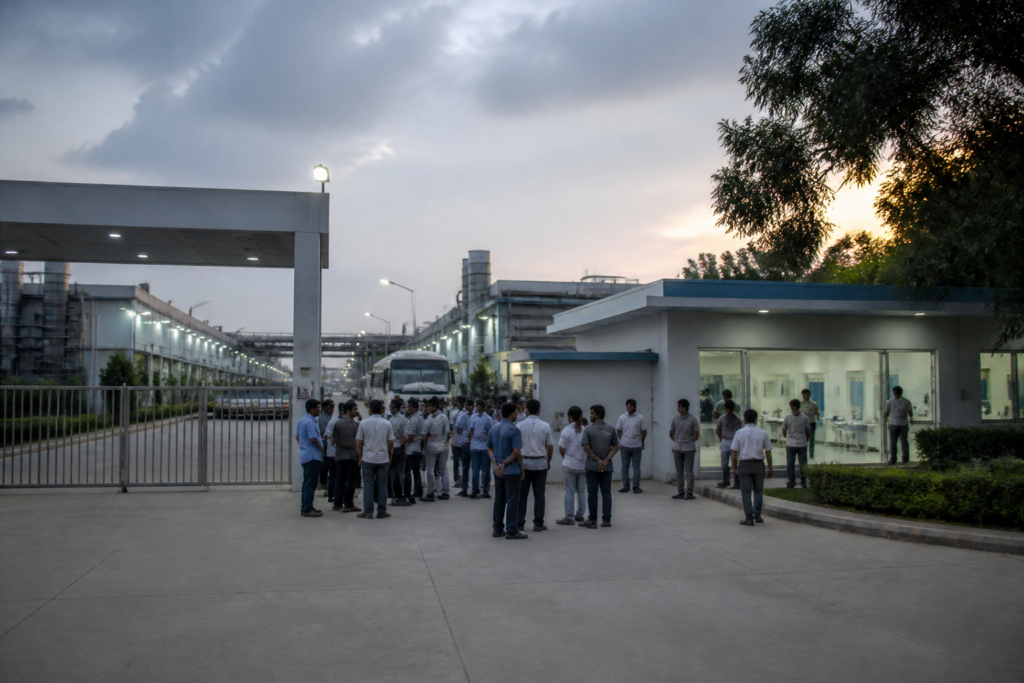
The death of 24-year-old Tata Electronics employee Sreemanthi at a hospital in Kolar, after she fell ill at the company’s Narasapur plant, has exposed a critical question about how medical emergencies are handled inside large industrial workplaces. Workers alleged that the company failed to shift her to a higher medical facility promptly, while police and factory officials began inquiries after an overnight protest.
The incident occurred at Tata Electronics and System Solutions’ plant in the Narasapur Industrial Area near Kolar, where nearly 30,000 employees work across three shifts, according to Narasimhamurthy, deputy director of the Department of Factories and Industrial Safety. Sreemanthi, who was from Andhra Pradesh’s Kurnool district and had reportedly worked at the company for three years, fell ill at about 8.30pm on Wednesday. She was taken to the factory’s Occupational Health Clinic, received preliminary medical attention and was allowed to rest for some time.
According to the report, she later complained of severe abdominal pain and was shifted to Jalappa Hospital in Kolar after midnight. She died at the hospital. The precise medical cause of death has not been established in the supplied material. Kolar superintendent of police Kannika Sikrival said three doctors at the factory clinic attended to Sreemanthi after she fell ill. Vemagal police have registered an unnatural death report, and further investigation is underway.
That sequence places the factory clinic at the centre of the inquiry. An occupational health clinic is the first point of medical contact for workers inside a large industrial facility, but the incident raises a separate question: what happens when a patient’s condition appears to exceed the clinic’s capacity? The available account does not establish what assessment was made, what treatment was provided, who authorised the decision to let Sreemanthi rest, or when the decision to move her to the hospital was taken. Those details are likely to be important to the police and departmental investigations.
Workers said Sreemanthi had called her family at around 10.30pm and told them she was sinking. They alleged that the authorities did not respond adequately or act promptly. Their questions focused on why she remained at the plant for several hours instead of being moved to a higher medical facility sooner. These are allegations by colleagues, not findings established by the investigation, but they identify the operational issue that has driven the protest: the time taken between the first complaint, clinical assessment, escalation and hospital transfer.
The distinction matters because a medical emergency inside an industrial campus is not managed only through clinical expertise. It also depends on communication between workers, supervisors, the occupational health team, management and an outside hospital. It requires a clear threshold for escalation and a documented chain of responsibility. The supplied report does not say whether such a protocol was followed at Narasapur, whether an ambulance was immediately available, or whether the clinic had the equipment and personnel required for the symptoms reported. Those questions remain unresolved.
The workers’ protest began late on Wednesday after news of Sreemanthi’s death and was suspended by Thursday afternoon. Employees raised slogans against the authorities and demanded a thorough inquiry into the medical assistance provided to their colleague. The protest was brought under control within a couple of hours after Sikrival and other senior police officials visited the site and spoke to workers. Officials assured the workers that action would be taken if anyone was found guilty of negligence.
That assurance establishes the immediate administrative response, but not the outcome. The police have registered an unnatural death report, while the deputy director of the Department of Factories and Industrial Safety visited the premises with labour and other departmental officials to hear the workers’ grievances. The inquiry will therefore involve more than determining the medical cause of death. It will also have to examine the conduct of the factory clinic, the response of supervisory personnel and the circumstances of the transfer to Jalappa Hospital.
The size of the plant adds an institutional dimension to the case. A workforce of nearly 30,000 employees across three shifts means that occupational healthcare is not a peripheral facility serving a small group of workers. It is part of the operating infrastructure of a major industrial workplace. The report does not provide the clinic’s staffing levels, patient load, ambulance arrangements, hospital tie-ups or emergency-response times, so no conclusion can yet be drawn about whether the system was adequately resourced. But the scale cited by the factories department makes those questions relevant to the inquiry.
Sreemanthi’s reported living arrangement also reflects the social geography of large industrial employment. She was staying in paying guest accommodation away from her home district in Andhra Pradesh. Workers in such facilities may live far from their families and depend heavily on the workplace during a medical emergency. In this case, the report says she spoke to her family by phone, while colleagues and factory officials were physically present at the plant. The workplace was therefore the setting in which the critical decisions about her care were made.
The case also has a history connected to labour relations at the same premises. The site was previously operated by Wistron, an iPhone manufacturer. In December 2020, violent worker protests led to extensive vandalism and losses reportedly estimated at nearly Rs 100 crore, after which the company decided to shut its operations. That earlier episode does not establish any connection with Sreemanthi’s death, and the supplied report makes no such claim. It does, however, show that the plant has previously become the site of serious conflict between workers and management. The latest protest was suspended after official intervention, but its demands again centred on trust, accountability and the treatment of workers inside the facility.
The institutional responsibilities are now distributed across several authorities. Vemagal police are handling the unnatural death report and further investigation. The Department of Factories and Industrial Safety has visited the premises and heard the grievances. Labour officials were also part of the visiting team. The company’s own occupational health system is under scrutiny because it provided the first medical response. Jalappa Hospital is relevant to the medical sequence because Sreemanthi was transferred there, although the supplied material does not report its findings or identify the cause of death.
This division of responsibility can make accountability difficult to follow unless the investigation establishes a clear timeline. A full account would need to identify when Sreemanthi first reported feeling unwell, what symptoms were recorded, which doctors examined her, what treatment was administered, when her condition was reassessed, who decided that she could rest, when the transfer was ordered and how long it took to reach the hospital. It would also need to distinguish between clinical decisions, managerial decisions and the actions of individual staff members.
The report confirms that officials have promised action if negligence is found, but it does not say what standards will be applied or when the inquiry will be completed. Nor does it establish whether any official has been suspended, whether the clinic’s procedures have been changed or whether the company has released a statement. Those gaps are significant because the public-interest question is not only whether one person was negligent. It is whether the system had a reliable method for recognising deterioration and transferring a worker before the situation became critical.
The Narasapur incident therefore remains both a death under investigation and a test of industrial governance. The available evidence confirms that a young worker fell ill at a large factory, received initial attention at its clinic, was transferred to a hospital after midnight, died there and was followed by a worker protest. It also confirms that police and factory-safety officials have begun examining the circumstances. What remains unconfirmed is the medical cause of death, the adequacy of the treatment provided and whether any delay amounted to negligence. The next substantive developments will depend on the police investigation, the factories department’s assessment and the findings of the medical authorities.


