

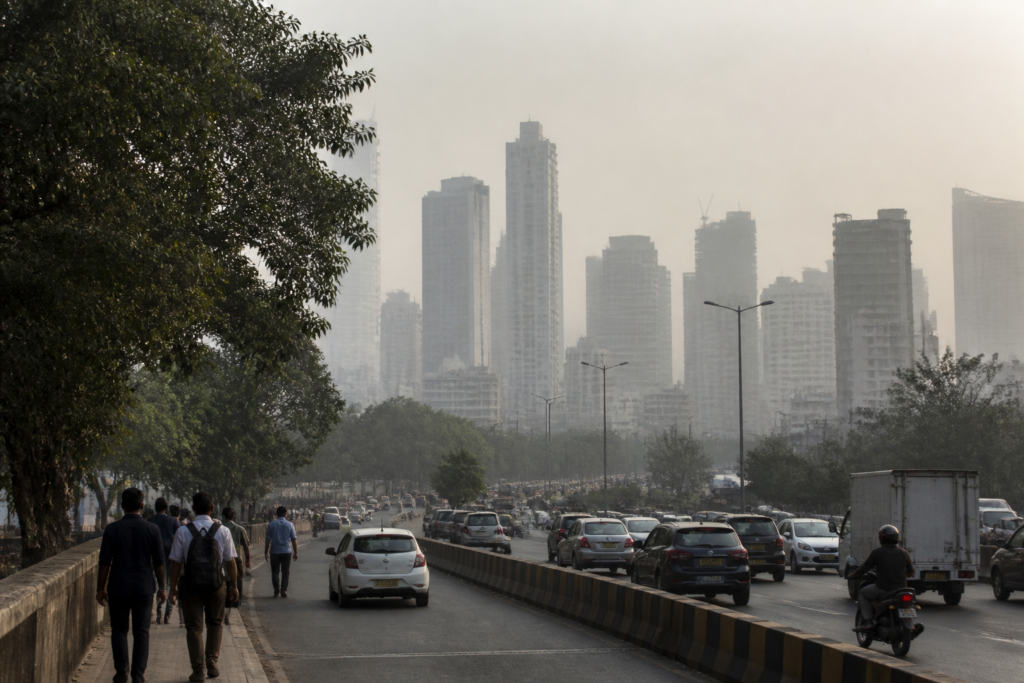
Mumbai air pollution has worsened amid unusually hot and humid weather, with the city recording an Air Quality Index (AQI) of 152 on Thursday and ranking as the most polluted city in India on the iQAir platform. Ground-level ozone was identified as the primary pollutant in the reading.
The iQAir assessment placed Mumbai fifth among 122 cities worldwide. Delhi was ranked sixth with an AQI of 151, while Kolkata was placed tenth with a reading of 124. The readings were recorded as the city experienced above-normal temperatures following a rain-deficient monsoon and the early withdrawal of seasonal rainfall.
Mumbai has recorded its hottest days in at least a decade on three occasions this month, with maximum temperatures reaching 4-5 degrees Celsius above normal on several days. Atmospheric scientist Gufran Beig, chair professor at the National Institute of Advanced Studies at the Indian Institute of Science, told The Indian Express that slower wind speeds and higher temperatures were restricting air circulation and allowing pollutants to settle in the lower atmosphere.
Beig attributed the conditions to an El Niño pattern, a climate phenomenon associated with the abnormal warming of surface waters in the central and eastern equatorial Pacific Ocean. Its effects on weather patterns vary across regions, but hot, sunny conditions can increase concentrations of ground-level ozone.
Ground-level ozone is different from the protective ozone layer in the upper atmosphere. It forms when nitrogen oxides and volatile organic compounds react in the presence of sunlight. Its concentration can rise during periods of heat and strong sunlight, making weather conditions an important factor in how pollution behaves within the city.
The Central Pollution Control Board’s dashboard presented a less severe picture. It recorded Mumbai’s AQI at 98, categorised as satisfactory, while 12 of the city’s 23 operational monitoring stations recorded satisfactory air quality. The difference between the iQAir and CPCB readings reflects the fact that the platforms use different monitoring networks and assessment methods.
Several CPCB stations, however, reported unhealthy conditions. Deonar recorded an AQI of 156, followed by Bandra Kurla Complex at 145 and Khindipada in Bhandup at 129. CPCB identified PM2.5 and PM10 as the major pollutants at these locations, in contrast to iQAir’s identification of ozone as Mumbai’s primary pollutant.
An official of the Maharashtra Pollution Control Board told The Indian Express that pollution from the burning of garbage or plastic waste at Deonar could spread to nearby areas rather than remain confined to the site. The official specifically cited Chembur and Kurla, where air quality can also be affected as polluted air moves across adjoining areas.
The readings place attention on the way Mumbai’s air quality is monitored and managed across neighbourhoods. A citywide AQI can conceal sharp local variations, particularly around waste-processing areas, traffic corridors and dense commercial districts. The monitoring data also shows that the pollutant driving poor air quality can differ between locations and measurement systems.
The Brihanmumbai Municipal Corporation has directed officials in all 26 wards to identify pollution hotspots and implement local measures. The immediate municipal response will therefore focus on ward-level identification of sources and action at affected locations, while air-quality agencies continue to track the city’s changing pollutant levels.


