

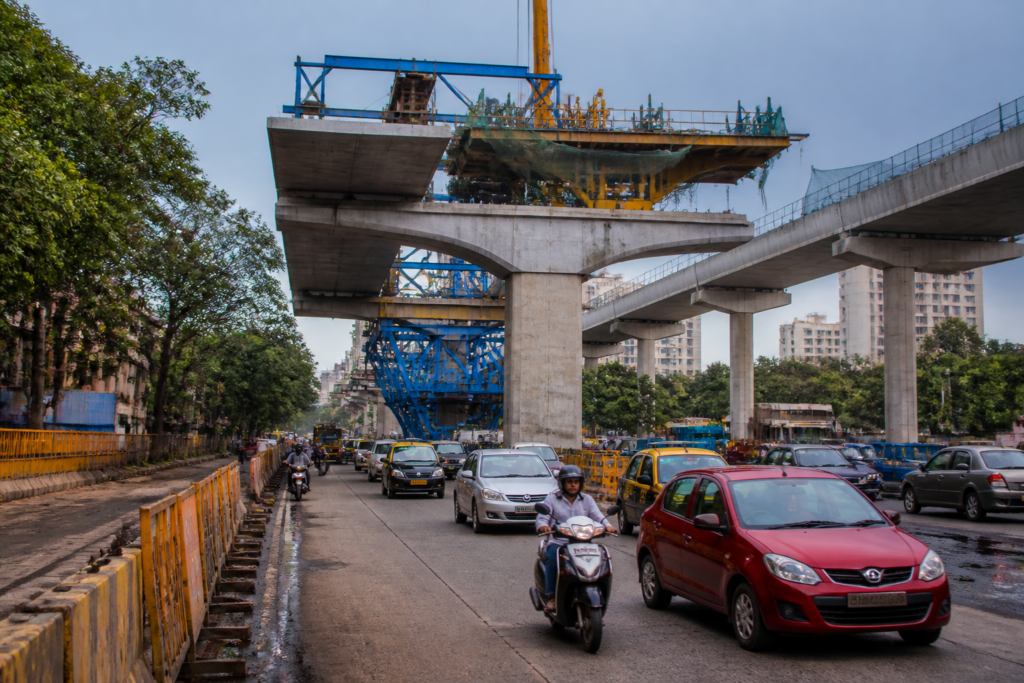
Mumbai’s Juhu flyover is being positioned as a major intervention in one of the western suburbs’ most congested road corridors, with the Brihanmumbai Municipal Corporation expecting it to reduce peak-hour travel time between the western suburbs and Juhu from about 45 minutes to 20 minutes. The project, now scheduled for commissioning by December 2027, is designed to bypass five traffic junctions rather than simply add another road link.
That distinction is central to understanding the project. The flyover is planned over the Juhu Vile Parle Development Scheme circle and will run from the end of the CD Barfiwala flyover to the Juhu Versova Link Road. By carrying vehicles above the junction-level network, the BMC expects to remove through traffic from several points where vehicles currently encounter signals and congestion. The stated objective is therefore not only to create additional road capacity, but to reduce the number of interruptions along an existing movement corridor.
The project was first rolled out by the BMC in 2022 as a response to traffic pressure in the JVPD area. Its current deadline is December 31, 2027, replacing an earlier deadline of March 31, 2028. The revised schedule indicates that the municipal corporation is working towards an earlier completion date, although the supplied information does not detail the contractual milestones, expenditure or progress achieved since construction began.
According to Abhijit Bangar, Additional Municipal Commissioner (Projects) at the BMC, peak-hour travel on the route currently takes about 45 minutes. “After the completion of the flyover, the travel time is expected to be reduced to about 20 minutes,” Bangar said. He added that the project would provide relief to road traffic in Juhu, Vile Parle West, Andheri West and Versova and make transport in the western suburbs more efficient.
The projected reduction of 25 minutes is the project’s most visible public promise. It also explains why the flyover is being presented as a corridor-level intervention rather than a local junction improvement. If the route performs as planned, commuters travelling between the western suburbs and Juhu would spend less time moving through the sequence of congested points that currently slows the journey.
But the promised travel-time saving depends on how the flyover connects with the roads at both ends. The project begins at the end of the CD Barfiwala flyover and terminates at the Juhu Versova Link Road, linking two important routes. It is also intended to bypass the JVPD circle and four other traffic junctions. The available project details do not establish whether congestion will be eliminated at the approach roads, but they show that the BMC is attempting to treat the corridor as a connected system rather than addressing only one intersection.
The engineering design reflects the complexity of building through an already developed urban area. The proposed structure will be 15.10 metres wide and will include the installation of girders under a metro station using special technology. It will also require the construction of a 72-metre-long bridge at the 90-feet junction and a long span with minimal pillars at Juhu Circle.
These elements are important because the flyover is not being built on an unoccupied alignment. The project must fit around an existing metro station, busy road junctions and underground drainage infrastructure. A structure with fewer pillars at Juhu Circle can help limit physical obstruction at the junction, while the use of special technology for girder installation under the metro station points to the coordination required between road and metro infrastructure.
Drain relocation is another major component. The project requires 600 mm and 900 mm diameter drains to be shifted over a distance of 400 metres. A 1,200 mm diameter drain will be relocated through microtunnelling. These works show that the flyover is also a utilities project. Its delivery depends not only on the construction of the elevated road, but on moving essential underground services without disrupting the functioning of the surrounding neighbourhood.
For residents and commuters, such work can create a difficult transition period even when the completed structure is expected to improve movement. The source material does not provide details of traffic diversions, construction-stage disruption or the number of daily users expected to benefit. It does, however, establish that the project is being delivered in a space where road traffic, metro infrastructure and drainage networks overlap.
## A corridor built around connections
The planned connection to the upcoming Versova-Bandra Sea Link adds another layer to the project. The flyover is intended to include an arm providing direct connectivity to the sea link, linking the local road network with a larger coastal transport route. The supplied information does not specify the design, length or construction timeline of this arm, nor does it state whether it forms part of the same completion package. Its inclusion nevertheless indicates that the flyover is being conceived as part of a wider network of connections.
This network logic is significant for a project located between several established western suburban destinations. Juhu, Vile Parle West, Andheri West and Versova are named by the BMC as the areas expected to receive traffic relief. The flyover’s potential reach therefore extends beyond the JVPD circle itself. Its stated purpose is to help vehicles pass through a series of junctions and connect with routes that serve a broader suburban area.
At the same time, the project’s performance will be judged at street level. A flyover can improve the movement of vehicles using the elevated route while leaving traffic conditions on surrounding roads unchanged or altered. The available report does not contain traffic counts or a junction-by-junction assessment, so it is not possible to establish from the supplied evidence how congestion will be distributed after opening. What is established is the BMC’s intended outcome: a shorter peak-hour journey on the route and improved traffic flow across the named western suburban areas.
The project also illustrates how municipal infrastructure schedules can change as technical and coordination requirements become clearer. In this case, the current deadline is December 2027, compared with the previous March 2028 deadline. The report does not explain the reason for the revised target. It does, however, provide a specific milestone against which implementation can be assessed: commissioning for vehicular use by December 2027.
That milestone matters because the project includes several components that must be completed in sequence or coordination. The main elevated structure, the bridge at the 90-feet junction, the long span at Juhu Circle, the metro-related girder installation and the drainage relocations are all part of the works described. The eventual connection to the Versova-Bandra Sea Link is also identified as a project objective. The BMC’s stated travel-time benefit will depend on how these elements function together after commissioning.
## The limits of the current evidence
The central claim in the project’s public case is straightforward: a journey that currently takes about 45 minutes during peak hours is expected to take about 20 minutes after completion. That is an estimate attributed to the BMC’s Additional Municipal Commissioner (Projects), not a measured post-completion result. The project has not yet been commissioned, and the supplied report provides no independent travel-time assessment or traffic simulation.
This does not invalidate the estimate, but it defines what can be concluded now. The flyover has a clear design purpose and a stated deadline. Its engineering scope is also identifiable, including its width, junction bypasses, bridge length, drain relocations and metro-related construction. The available evidence does not yet demonstrate how the completed corridor will perform under different traffic conditions or how quickly benefits will appear beyond the elevated structure.
The same distinction applies to the phrase “major relief”. It is the BMC’s description of the expected effect on Juhu, Vile Parle West, Andheri West and Versova. The areas are likely to be affected because the project links routes serving them, but the supplied material does not provide a quantified estimate of vehicles, commuters or traffic volume. Those measures would be needed to assess the scale of the benefit after opening.
The project’s next test is therefore implementation. The BMC must complete a flyover that passes through a dense and technically constrained urban setting, relocate multiple drains, work beneath a metro station and deliver a long span with minimal pillars at Juhu Circle. It must then commission the route by December 2027 if the current deadline is maintained.
Mumbai’s Juhu flyover is consequently more than a new elevated road. It is a test of whether a municipal project can connect road infrastructure, metro-adjacent construction and underground utilities into one functioning corridor. The evidence currently confirms the planned route, the engineering requirements, the revised deadline and the BMC’s expected travel-time reduction. Whether the 45-minute journey becomes a 20-minute one will depend on completion and operation of the full network, not merely the opening of the structure.


