

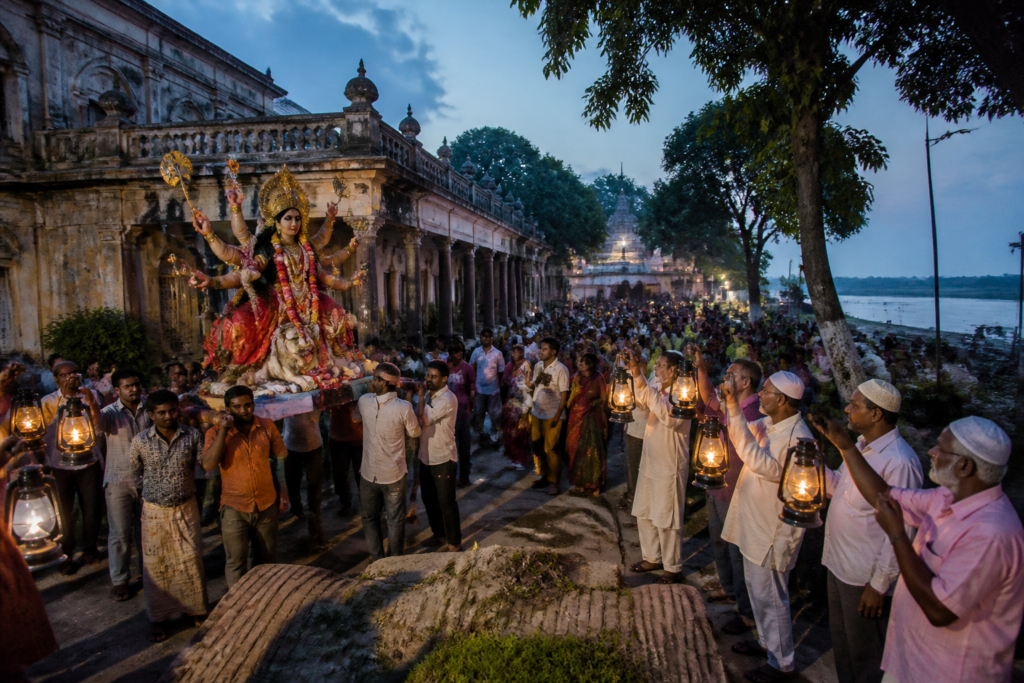
The continuing Durga Puja at Chanchal Rajbari in Malda is more than a surviving royal ritual. It is also a record of how a historic estate has been absorbed into the administrative life of a town, while residents, priests and a government-appointed Trust board keep its ceremonial identity intact.
The nearly 350-year-old tradition associated with the Chanchal palace continues at the Paharpur Chandi Mandap, around 1.5km from the Rajbari. The last king, Saratchandra Roychowdhury, had no descendants, and the palace is now managed by the Chanchal Rajbari Estate Trust. Much of the original property has been repurposed for public and institutional uses, including the Chanchal subdivisional court, the subdivisional headquarters, other administrative offices and Chanchal College. Only a small portion remains as the Rajbari itself.
That transformation places the puja within a familiar challenge for historic properties: the building may lose its original ownership and function, but its social meaning can continue through repeated public use. At Chanchal, the palace is no longer the centre of a functioning royal estate. Yet the annual ritual remains connected to the Thakurbari, the Chandi Mandap and the surrounding community, preserving a relationship between the site, the river and the town’s collective memory.
The tradition is linked in local accounts to an ancestor of King Saratchandra Roychowdhury recovering an ashtadhatu idol from Satighat on the Mahananda river. The eight-metal idol was installed in the Thakurbari adjoining the palace. According to the account preserved by the royal family and local residents, a divine instruction received in a dream led to the worship of the idol, known as Singhabahini Chandi, as Goddess Durga.
The historical account is inseparable from the ritual calendar. The ceremonies begin on Krishna Navami, 12 days before Saptami, when water is brought in copper pitchers from Satighat and the ceremonial pitcher is installed. This act marks the beginning of the Rajbarir Puja. Priests Achintya Mishra, Soumitra Chakraborty, Titu Bandyopadhyay and Surajit Banerjee conduct the worship, while verses from the Sri Sri Chandi are recited every evening.
The sequence continues through the main days of the festival. On Saptami morning, the ashtadhatu idol is carried in a procession from the Thakurbari to the Chandi Mandap, where it is placed beside the clay idol of the Goddess. Kumari Puja is performed on Maha Ashtami. Daily rituals continue until the evening of Dashami, making the celebration a sustained use of the site rather than a single ceremonial gathering.
The institutional arrangement behind the puja is modest but significant. Partha Chakraborty, secretary of the Chanchal Rajbari Estate Trust and teacher-in-charge of Chanchal Siddheswari Institution, said the Trust board allocated ₹9,000 for this year’s celebration. He also said residents extended their cooperation and that the rituals were conducted elaborately and with full faith regardless of the budget.
The figure illustrates the limited financial scale of the formal support compared with the cultural continuity attached to the event. The Trust board provides assistance, but the annual ritual also depends on residents, priests and local participation. In that sense, the puja is sustained through a combination of public institutional support and community stewardship rather than through the resources of a royal household.
This distinction matters because the physical estate has not remained intact. According to sources in the Chanchal Rajbari Estate Trust and local residents, a substantial portion of the palace property was sold in the past. The supplied account does not establish when the sales took place, the extent of the property transferred or the legal conditions attached to those transactions. It does, however, show that the historic complex has experienced a significant change in ownership and use.
The remaining palace buildings now perform administrative and educational functions. Courts, government offices and a college occupy spaces that were once associated with the royal household. Such reuse can keep a historic structure occupied and connected to everyday public life, but it can also reduce the visibility of the original estate as a coherent architectural and cultural unit. At Chanchal, the ritual sites preserve part of that continuity even as the larger property has fragmented.
The Paharpur Chandi Mandap has therefore become the principal setting for the royal family’s traditional worship. The palace may no longer support the ceremonial world that once surrounded it, but the Mandap remains active during the festival. The movement of the idol between the Thakurbari and the Mandap connects the surviving physical spaces through procession, prayer and participation.
The tradition also demonstrates that heritage is not maintained only through buildings. It survives through routes, objects, sounds and repeated acts. The water brought from Satighat, the copper pitchers, the ashtadhatu idol, the evening recitations and the Dashami procession all form part of the ritual geography. Together, they connect the Mahananda river, the palace precinct and the Chandi Mandap in a sequence that residents continue to recognise.
The community’s role is particularly visible during immersion. Local residents believe that the Goddess of the Chandi Mandap protects them. On Dashami evening, Muslims line up with lanterns to light the route as the idols leave the Chandi Mandap. They also walk in the procession, holding the lanterns high while bidding farewell to the Devi.
That participation gives the festival a civic dimension beyond the boundaries of the former royal family. The ritual originated in a palace setting, but its continuation now depends on a wider public. The procession is not described merely as a private ceremony managed by descendants or estate officials; it is a public event in which residents participate and different communities share responsibility for its passage through the town.
The Chanchal example also raises a larger governance question: what happens to historic estates when hereditary ownership ends? In this case, the answer has been a government-appointed Trust board, partial administrative reuse and continuing community involvement. The arrangement preserves the annual puja, but the available account does not indicate whether there is a broader conservation plan for the remaining palace structures, the Thakurbari, the Chandi Mandap or the historic route between them.
That absence is important because ritual continuity and architectural conservation are not identical. A festival can remain vibrant even when a property has been divided, repurposed or reduced. Conversely, a preserved building can lose its social meaning if the practices that connect residents to it disappear. Chanchal’s heritage survives most visibly because the ritual remains active, but the condition and future management of the larger estate remain less clear from the available information.
The case also shows why institutional responsibility cannot be separated from cultural memory. The Trust board’s financial allocation provides formal recognition, while residents supply participation and continuity. Government offices and educational facilities give parts of the palace a present-day function. Priests maintain the ritual sequence. Together, these actors have created an informal system in which the site remains relevant despite the disappearance of the royal household.
What is established is that the Durga Puja has continued for around 350 years, that the last king left no descendants, that the estate is managed by a government-appointed Trust board and that parts of the palace now house public institutions. It is also clear that the ritual remains anchored in the Thakurbari and Paharpur Chandi Mandap, with residents sustaining the celebration and participating in the immersion procession.
What remains less established is the full legal and physical status of the former estate, including the extent of past property sales and the conservation arrangements for the remaining structures. Those questions matter because the future of Chanchal’s heritage will depend not only on whether the annual puja continues, but also on how the buildings, routes and institutional responsibilities connected to it are managed.
For now, the Chanchal Rajbari Durga Puja offers a clear example of living heritage outlasting royal power. Its survival rests on a small formal grant, a government-appointed management structure, ritual specialists and the continuing participation of local residents. The next measure of its resilience will be whether that social continuity can remain connected to the historic spaces that gave the tradition its identity.


