

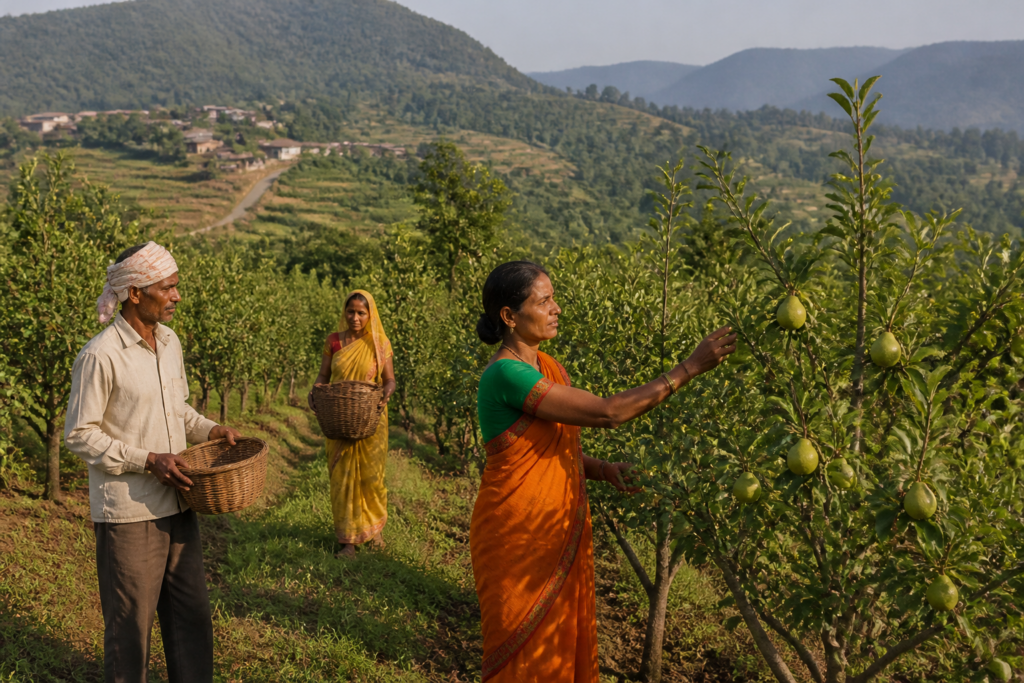
The rise of orchards among Chhattisgarh tribal farmers is changing more than the crop mix in the state’s northern districts. In Jashpur, Balrampur and Surajpur, families that have traditionally depended on farm incomes are planting pears, cashew, mango, litchi, guava, strawberries and even apples, while their produce is reaching markets in Delhi, Uttar Pradesh, Odisha, Jharkhand and West Bengal.
The shift, reported by the Times of India, is significant because it connects a remote, predominantly tribal region to wider food markets through a higher-value agricultural model. It also shows how income growth in rural districts depends not only on land ownership or crop selection, but on the less visible systems around farming: soil testing, scientific advice, irrigation, post-harvest handling and reliable market linkages.
The scale is most visible in Jashpur, where about 3,500 farmers are reported to be cultivating pears across roughly 3,500 acres in the Manora and Bagicha blocks. Orchards have spread across the hills of Sanna, Pandrapath, Kanwai and Mahua. Officials estimate the annual pear harvest at 1.75 lakh quintals, with income of between Rs 1 lakh and Rs 1.50 lakh per acre.
These figures are not presented as a uniform income guarantee. The source report notes that most orchards are still young and that several income figures are based on farmers’ own estimates. That distinction is important. Orchard economics develops over several years, and early gains can vary according to the age of trees, crop conditions, access to water, farm size and the ability to sell at remunerative prices. Nevertheless, the spread of orchards indicates that farmers see diversification as a viable alternative to depending on a narrow range of seasonal crops.
One example is Anju Lakra of Manora block, who sold fruit worth Rs 1.20 lakh last year and expects sales of Rs 2.5 lakh this year, according to the report. In Kerakona village, Anil Ekka grows pears on four to five acres and receives soil testing and advice from agricultural scientists. In Keradih, Prasanna Ekka earned about Rs 1 lakh from hybrid chilli cultivated among pear and litchi trees.
The combination of orchard crops and seasonal cultivation is an important feature of the transition. It allows farmers to use the space between young trees rather than wait for orchards to mature before generating returns. The reported chilli cultivation among pear and litchi trees suggests that horticulture is not necessarily replacing existing farming at once; in some cases, it is being layered onto the farm as a longer-term income strategy.
The district-level numbers show that this is not a single-village experiment. In Balrampur’s Shankargarh block, about 1,000 farmers are growing European pears. Mango and guava plantations cover around 1,000 acres in Rajpur block. In Surajpur, 500 tribal families in Pratappur and another 500 in Premnagar have taken up orchards.
Cashew is reported to be the most popular crop in Jashpur, with about 7,800 growers, most of them cultivating one-acre orchards. The district also has around 4,500 litchi growers and approximately 50 strawberry farmers. Apples, first planted in 2023, now cover about 410 acres. The range of crops matters because it distributes exposure across different harvest cycles and markets, although the supplied report does not establish how much income each crop generates or how consistently produce is sold.
The expansion of apples and European pears is particularly notable because it reflects an attempt to match local growing conditions with crops that can command better prices. The chief minister has said that diversification into horticulture and high-value crops can create additional income while making better use of the region’s natural conditions. The state government, he said, is committed to improved technology, scientific cultivation, irrigation and market linkages for tribal farmers.
This places public institutions at the centre of the orchard economy. Fruit cultivation requires more than distributing saplings. Farmers need technical support to select suitable varieties, maintain soil health, manage pests, plan irrigation and understand when crops will begin producing commercially. The report’s reference to regular soil testing and advice from agricultural scientists shows one part of that support structure, but it does not establish how widely such services are available across the districts.
Irrigation is equally important. Orchards represent a multi-year investment, and water stress can affect both young plants and mature fruit-bearing trees. The state’s stated commitment to irrigation therefore has implications beyond increasing acreage. It will influence whether orchard cultivation remains viable during difficult seasons and whether farmers can maintain output after the initial planting phase. The supplied material does not provide details of irrigation coverage, project funding or the specific agencies responsible for delivery.
Market access is the other crucial link. Produce from northern Chhattisgarh is reaching Delhi, Uttar Pradesh, Odisha, Jharkhand and West Bengal, indicating that the orchard system is already connected to markets beyond the region. That connection can improve returns, but it also creates logistical demands. Fruit is perishable, and the report does not provide information on cold storage, grading, packaging, transport costs or the share of final market prices received by growers.
This gap is central to understanding the transition. More production does not automatically translate into higher household income if farmers lack storage or bargaining power. The available figures show the reported value of produce or farm income in selected cases, but they do not show net returns after labour, inputs, transport and other costs. Nor do they establish whether the farmers sell directly, through traders, through cooperatives or through government-supported channels.
The scale of planting nevertheless indicates that the region is moving towards a more diverse rural production landscape. In Jashpur, the reported 3,500 pear farmers and 7,800 cashew growers represent a broad base rather than a handful of commercial farms. The presence of litchi, mango, guava, strawberry and apple cultivation adds further diversity. For tribal households, such diversification can potentially reduce dependence on one crop, but the report does not claim that orchard incomes have already transformed all participating families.
The wider urban connection is easy to miss because the farms are located in rural and hilly districts. Once produce travels to major markets, however, the orchard economy becomes part of an inter-city supply chain. Delhi and other northern and eastern markets depend on systems that begin with land preparation and crop care in places such as Manora, Bagicha, Shankargarh, Pratappur and Premnagar. Roads, transport services, wholesale markets, storage infrastructure and price information become as relevant to the farmer as agricultural extension.
This also means that the success of the model cannot be assessed only by measuring the number of acres planted. The more meaningful indicators would include the proportion of orchards reaching productive maturity, annual yields, farm-level net income, crop loss, access to irrigation, distance to markets and the stability of prices. None of these broader performance measures is provided in the report, so the current evidence should be read as an account of expansion and early opportunity rather than proof of a completed transformation.
The oil palm initiative in Jashpur adds another dimension. Under the National Mission on Edible Oils, about 43 hectares have been planted against a target of 100 hectares. Oil palm is distinct from the fruit orchards described elsewhere, but its inclusion shows that agricultural diversification is being pursued through multiple crop strategies and national programmes. The figures also show that implementation remains partial, with less than half of the stated target planted at the time covered by the report.
Institutionally, the orchard story therefore sits at the intersection of state policy and household decision-making. Farmers are choosing crops based on income expectations and local conditions, while government agencies are expected to provide technology, scientific guidance, irrigation and market connections. The model will depend on whether those responsibilities continue beyond the planting stage and whether farmers can access support when orchards begin producing at larger volumes.
The central urban question is how distant production regions are integrated into the markets and infrastructure of expanding cities. Northern Chhattisgarh’s orchards are not an isolated rural success story; they are part of a food network linking tribal farms to urban consumers and wholesale centres across several states. That network creates value through transport, aggregation, storage and retail, even though those downstream systems are not described in detail in the supplied material.
What the evidence confirms is a broadening horticulture base, substantial reported participation among tribal farmers and growing inter-state market access. What remains uncertain is the durability of incomes, the distribution of value along the supply chain and the infrastructure available to handle larger harvests. The next stage to watch is whether young orchards mature into stable, profitable enterprises, and whether public support keeps pace with the production that farmers are already putting into the ground.


