

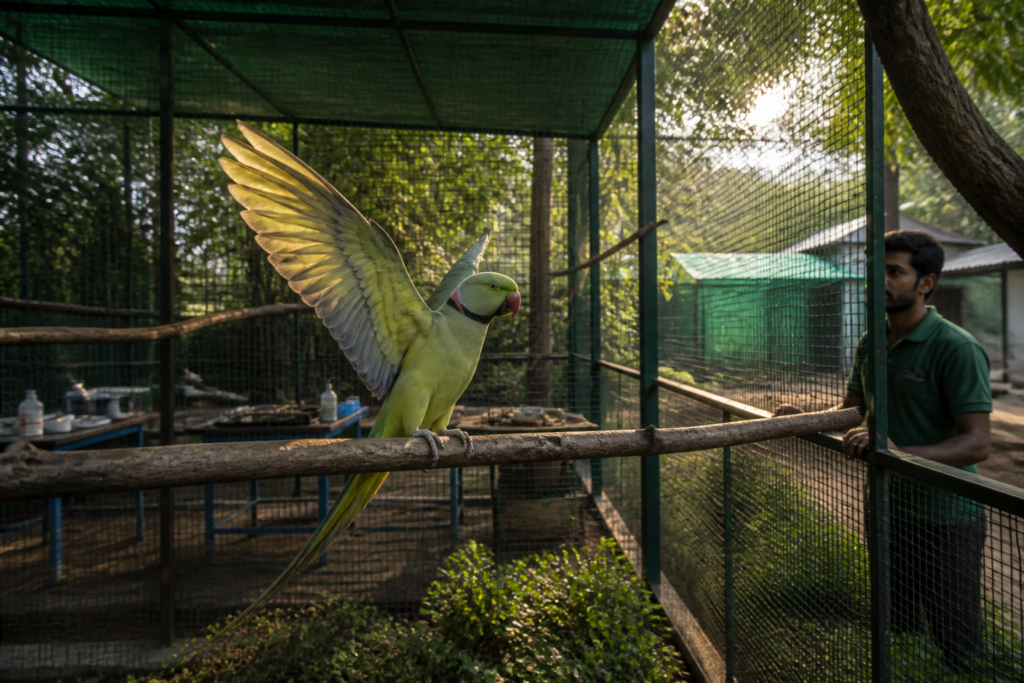
Coimbatore bird rescue work is revealing how quickly the city’s growth can turn ordinary urban infrastructure into a hazard for wildlife. At the Avian Recuperation Centre on Mettupalayam Road, injured and confiscated birds are treated, retrained to fly and, where possible, returned to native canopies. The operation, led by wetland ecologist Vinny R Peter and supported by volunteers, the Tamil Nadu forest department and veterinarians, also shows that urban wildlife conservation depends on more than emergency treatment.
The centre’s work begins after residents, officials or other members of the public report birds in distress. The cases described by The Times of India range from Alexandrine parakeets kept in captivity to peafowl injured by electrical wires. The facility also handles fractures, open trauma, dehydration among migratory birds and orphaned chicks. Its in-house diagnostic equipment, including X-ray units, allows the team to manage injuries that would otherwise require immediate specialised intervention.
That range of cases places the rescue centre at the intersection of several urban systems. Birds are affected by the way electrical infrastructure is installed and maintained, by the circulation of illegal manja threads, by the expansion of concrete surfaces and by the demand for wild animals as household possessions or attractions. The centre therefore functions not only as a treatment facility but also as a point where the consequences of urban activity become visible.
The reported scale of the operation is significant. Over the past 15 years, Animal Rescuers has rescued and sheltered more than 13,000 native and migratory birds, including the endangered Egyptian vulture. The figure, cited in the report, indicates a sustained stream of cases rather than an occasional response to unusual incidents. It also underlines the need for rehabilitation capacity after medical treatment, since a bird that survives an injury may still be unable to fly or feed independently.
That is why the recovery stage is central to the model described by Peter. Birds are placed in specialised flight enclosures to rebuild their stamina before release. For a rescued parakeet that has spent years in a small cage, survival cannot be measured only by whether a wound has healed. The bird must recover the physical ability to fly and the behavioural capacity to function outside human confinement.
Peter told The Times of India that Alexandrine parakeets can naturally fly up to 40 kilometres a day. The report describes birds whose wings and tail feathers were clipped, whose beaks were damaged and whose behaviour had been shaped by captivity. Some birds had learnt to mimic human sounds rather than follow the behaviours needed in the wild. One rescued bird reportedly reproduced the sound of a motorcycle exhaust, while another repeatedly called out the name “Meenu”.
These cases provide a direct view of the difference between ownership and care. A bird may appear healthy while being unable to survive in its natural environment. The problem is especially acute when protected wild species are treated as pets or used by roadside fortune-tellers. According to the report, public-awareness efforts have led some residents to voluntarily surrender caged birds after learning that possessing protected wild species violates wildlife laws.
The institutional structure behind the centre is equally important. Peter’s organisation works with frontline staff of the Tamil Nadu forest department and specialised veterinarians. This arrangement connects community-level reporting and volunteer labour with the state’s statutory role in wildlife protection. It also demonstrates that rescue operations require coordination across institutions: residents identify distress, volunteers transport or stabilise birds, veterinarians provide treatment and forest officials support legal and rehabilitation processes.
Such coordination is particularly important in urban areas, where a wildlife incident can quickly become a public-safety or administrative issue. A bird trapped near a transformer, injured on a high-voltage wire or caught in a thread may require access to infrastructure locations, technical assistance and decisions about rehabilitation. The source report does not provide details of a city-wide prevention protocol, but the cases described show that wildlife rescue is closely linked to how urban services are designed and managed.
The hazards identified in Coimbatore are not limited to one category of infrastructure. Exposed electrical transformers and high-voltage wires can cause burns. Manja threads can injure birds in flight. Concrete expansion reduces the natural spaces available to wildlife. Illegal captivity removes birds from the environments for which they are adapted. Each risk is created or intensified by human activity, but each also sits within a different administrative or behavioural domain.
That fragmentation can make prevention difficult. Wildlife officials may respond to a rescued bird, while electricity agencies control wires and transformers, civic authorities manage public spaces, schools shape environmental awareness and residents determine whether wild birds are captured or released. The rescue centre’s work fills an important gap after an incident has occurred, but the evidence in the report also raises a broader question: how much urban wildlife injury can be prevented before it reaches a recovery enclosure?
The centre’s education programme is an attempt to address that question at the community level. School visits and urban outreach campaigns focus on biodiversity, bird-friendly landscaping and the practice of placing water bowls during summer. The emphasis is not only on saving individual birds but on changing how residents understand their relationship with urban wildlife. The message described in the report is that wild birds are part of an ecosystem, not objects to be possessed.
This educational role matters because emergency rescue can treat symptoms without changing the conditions that produce them. A rescued parakeet may be rehabilitated, but new birds can continue to be trapped or confined if the demand for caged wildlife remains. A peafowl may recover from electrical burns, but similar incidents can continue if hazardous wires and equipment remain exposed. Awareness cannot substitute for institutional action, but it can reduce the number of cases that reach emergency services.
The reported use of flight enclosures also highlights a less visible requirement of wildlife conservation: space. Rescue organisations need areas for diagnosis, quarantine, recovery, exercise and release preparation. They need trained personnel, equipment and veterinary support. They also need a suitable destination for birds that are ready to return to the wild. These needs are easy to overlook when conservation is reduced to the moment of rescue.
Coimbatore’s experience, as presented through Peter’s work, therefore offers a useful lens on urban biodiversity. The city is not simply a background in which birds occasionally suffer accidents. Its buildings, wires, roads, consumer practices and public behaviour actively shape the risks faced by wildlife. The existence of a dedicated recuperation centre makes those risks visible, while the centre’s long-running caseload shows the scale of the response required.
The report does not establish how many birds are injured by each hazard, how many are successfully released or whether the city has a coordinated prevention strategy. Those questions remain important for assessing the effectiveness of urban wildlife protection. What is clear from the available evidence is that treatment, rehabilitation, law enforcement and public education are all necessary parts of the same chain.
For Coimbatore, the larger urban question is whether wildlife conservation will remain primarily a rescue response or become part of routine city planning and infrastructure management. The work led by Vinny R Peter has created a recovery pathway for thousands of birds. The continuing challenge is to ensure that fewer birds are forced to depend on it.


