

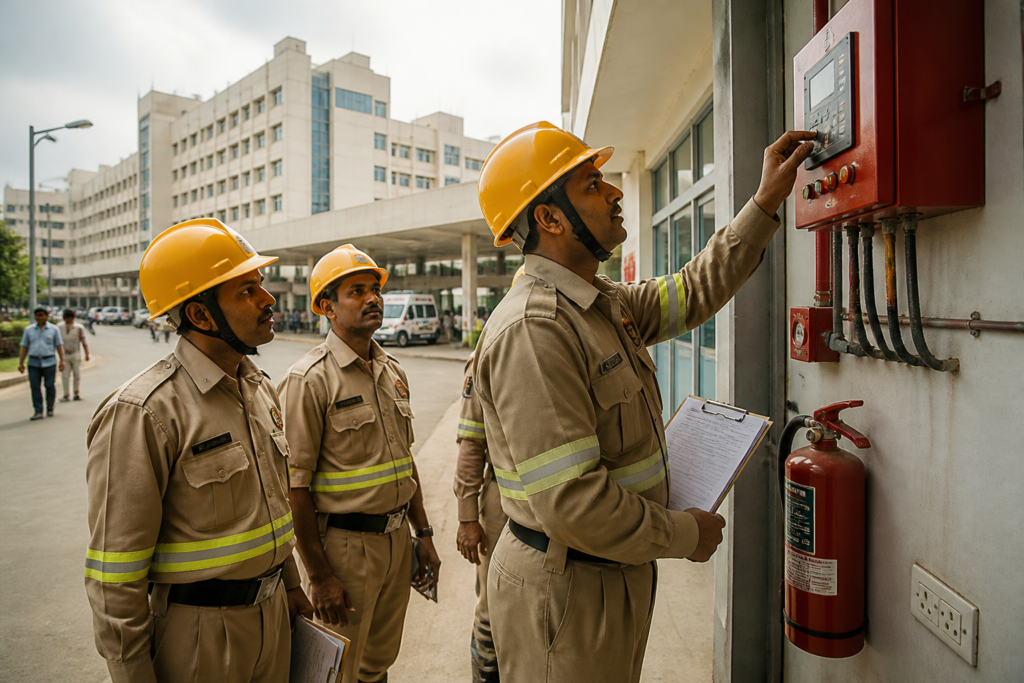
Odisha’s fire safety audit has found that 74% of 4,596 government and private buildings inspected across the state failed to meet mandatory safety standards, prompting the fire services department to issue 3,404 notices and order corrective action.
The month-long inspection drive, conducted between September 15 and October 14 by Odisha Fire and Emergency Services (OFES), found that only 1,192 buildings complied with the prescribed norms. The inspected properties included hospitals, shopping malls, residential apartments, educational institutions, business units, mercantile buildings and places of public assembly.
Officials identified multiple shortcomings that could affect the ability of occupants to escape and emergency teams to respond during a fire. These included expired or invalid fire safety certificates, inadequate escape routes, non-functional fire detection and alarm systems, insufficient firefighting equipment, electrical safety lapses and inadequate fire-protection infrastructure.
The audit also found that some premises lacked access routes for fire service vehicles and had weak emergency preparedness measures. These deficiencies are particularly significant in buildings with high footfall or vulnerable occupants, including hospitals, schools and large residential complexes.
Director General of OFES Sudhanshu Sarangi said the exercise was intended to improve compliance and preparedness rather than simply identify violations. “Our objective is not finding faults. The focus is on sensitising building owners and managers to urgently bridge the gaps identified during inspections,” Sarangi said.
He added that officials had identified fire-risk premises, assessed their compliance with prescribed norms and advised owners and managers to strengthen prevention and emergency response systems.
Inspector General of Police Uma Shankar Dash said the campaign, conducted under the banner of ‘Surakshit Odisha, Vikashit Odisha’, focused on identifying vulnerable establishments and ensuring that deficiencies were addressed without delay. The exercise included physical verification of fire and life-safety measures, awareness activities for stakeholders, digital monitoring and statutory action where required, Dash said.
The findings also draw attention to fire certification gaps in government healthcare facilities. In a written statement to the Odisha legislative assembly on September 28, Chief Minister Mohan Charan Majhi said that only 17 of 241 government healthcare institutions required to obtain fire safety certificates had valid certification.
The figures indicate that fire safety compliance remains an administrative challenge extending beyond individual building owners. Certification, inspection, maintenance of systems and access for emergency vehicles all require coordination between building managers, local authorities and fire services. The inspection results show that the presence of safety equipment alone does not establish compliance if alarms, escape routes or firefighting systems are not functional.
OFES officials said follow-up inspections and awareness drives would continue. The next phase will focus on corrective action by establishments that received notices and on improving preparedness against potential fire hazards across Odisha.


