

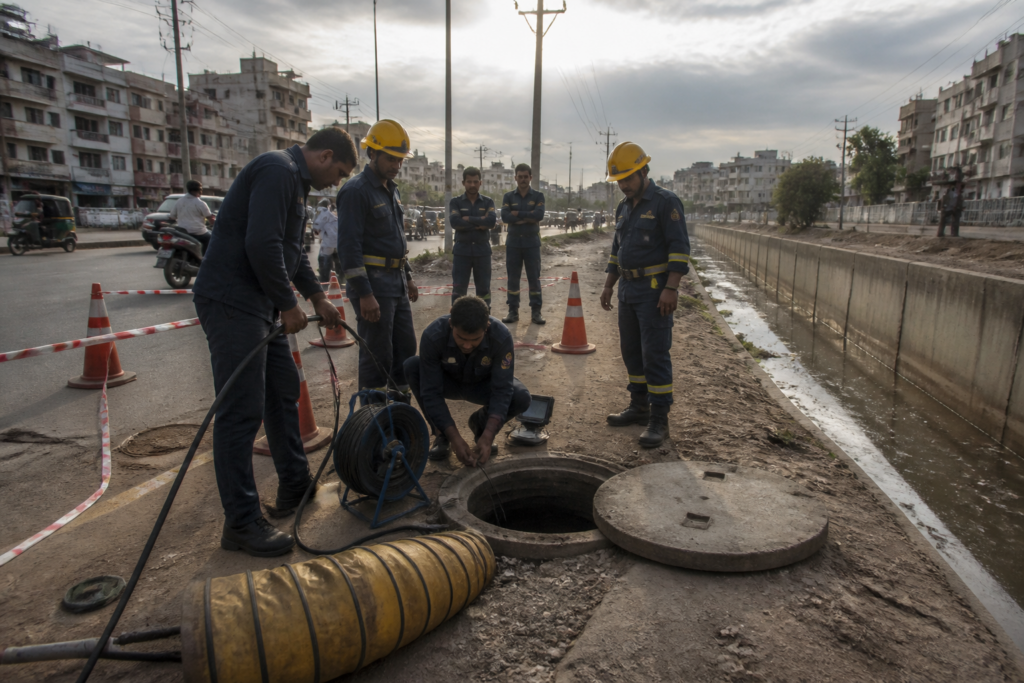
The disappearance of a 10-year-old visually impaired girl after she fell into a deep drainage line on Ahmedabad’s Narol–Pirana Road has exposed the risks created when major urban utility networks become difficult or dangerous even for trained rescue teams to access. Six days after the incident, the fire department was still searching the drainage line, manholes and the river, while the Ahmedabad Municipal Corporation’s standing committee directed officials to examine CCTV footage to trace the girl’s movements and determine what happened.
According to Gujarat Samachar – Ahmedabad, the girl fell into an approximately 40-foot-deep drainage line on 10 October. The report said that searches had continued without locating her by 15 October. The standing committee chairman said the river, a sewage treatment plant and manholes had been examined, but no trace had been found. The search was therefore not limited to the point of entry: it extended across connected parts of the drainage and water system.
That distinction is important because the incident illustrates how urban drainage is not simply a collection of local roadside openings. Large trunk lines connect multiple zones and carry flows across long distances. Once a person or object enters such a network, the search becomes a problem of water movement, access, visibility, worker safety and system knowledge. The supplied report identifies the line involved as a main trunk line receiving drainage from Ahmedabad’s south, east and north zones.
The operational difficulties described by fire department officials show the gap between the existence of underground infrastructure and the ability to safely intervene inside it. Water in the line was reportedly flowing at a high speed, preventing equipment lowered into the system from remaining in place. Officials also described hot gas and a strong odour emerging from the manholes, making it difficult for fire personnel to enter. The report further stated that chemically contaminated water was entering the line, creating additional hazards for rescue workers.
These conditions turn a drainage network into a confined-space emergency. A rescue operation inside such a system cannot be treated like a conventional search on open ground. Personnel must contend with moving water, restricted entry points, poor visibility, potentially hazardous gases and unknown chemical exposure. The report does not specify the technical equipment deployed, the number of personnel involved or whether the line was temporarily isolated. It does, however, make clear that the physical characteristics of the network constrained the operation.
The absence of the girl after six days also created uncertainty about the route she may have taken after entering the system. The standing committee chairman reportedly said that a body would generally surface within 24 hours in such circumstances, but that this had not happened. The possibility that she may have become trapped in mud was raised, although the report explicitly states that this was not confirmed. That uncertainty is central to the search: officials must investigate multiple possible outcomes without converting an unverified possibility into a conclusion.
The CCTV instruction adds a second layer to the response. CCTV footage can help establish the girl’s last known location, the direction in which she was moving and whether she reached the drainage line directly or through another point. It can also help officials map the incident against nearby roads, public infrastructure and access points. In a city where underground networks are difficult to observe directly, surface-level surveillance may become an important investigative tool. The supplied report does not state how many cameras are available, whether footage has been recovered or what it has shown.
The incident also raises questions about the relationship between drainage design and public safety. A trunk sewer may be essential to carrying wastewater across several municipal zones, but its scale and connectivity can make it hazardous when access points are exposed, unsecured or located near pedestrian movement. The report does not establish the precise design failure or identify the condition of the specific opening through which the girl fell. It therefore cannot support a conclusion about whether the incident resulted from an uncovered manhole, a damaged barrier, inadequate fencing or another cause. Those facts would require an official site assessment.
What the available account does establish is that the municipal system contains locations where rescue access is severely constrained. The fire department’s description of strong gas, heat, chemical-laced water and high flow points to a network that requires specialised risk controls. It also raises the institutional question of which agency maintains real-time information about the contents, flow conditions and hazards within major drainage lines. The report does not identify the responsible department or describe the coordination procedure between the municipal corporation, the fire department, the sewage treatment plant and industrial regulators.
The reported possibility of chemical discharge introduces a wider governance concern, but it remains unproven. The article says the trunk line receives wastewater from areas containing industrial units and that sources suspected illegal connections or tanker-based dumping by some industrial operations. It also refers to possible discharge from industrial areas in Naroda, Behrampura, Vatva and Narol. These claims are attributed to sources and are not supported in the supplied material by inspection findings, laboratory results, enforcement records or an official confirmation. They should therefore be treated as allegations requiring investigation, not as an established cause of the rescue difficulties.
If industrial or tanker waste is entering a municipal drainage network, the issue would extend beyond this individual incident. It would involve the monitoring of industrial effluent, the separation of hazardous and domestic wastewater, tanker tracking, enforcement against illegal connections and worker protection during maintenance or rescue. But the current evidence only establishes that officials and sources raised the possibility. It does not establish who discharged any material, when it happened or whether such discharge caused the reported conditions in the line.
The institutional response now has two connected components. The immediate component is the continuing search by the fire department across the drainage line, manholes, river and sewage treatment plant. The second is the investigation using CCTV, which the standing committee chairman directed officials to undertake. Together, these indicate that the response is combining physical search operations with reconstruction of the girl’s movements. The report does not provide a confirmed recovery, a final search perimeter or a formal incident review.
For Ahmedabad, the larger urban question is whether the city’s drainage infrastructure is being managed only as a wastewater conveyance system or also as a public-safety system. The difference matters. A network carrying flows from three municipal zones requires routine mapping, controlled access, hazard identification and clear emergency protocols. The supplied report does not say whether such a consolidated system exists. It does show that when an emergency occurs, responders may face conditions that prevent them from entering or stabilising the network.
The incident also demonstrates why underground infrastructure is often invisible in normal city reporting until it fails. Roads, manholes and treatment plants appear as separate locations on the surface, but hydraulically they may form one connected system. A search that begins on the Narol–Pirana Road can therefore extend to a river and a sewage treatment plant. For residents, that connectivity is rarely visible; for municipal agencies, it is essential to emergency planning.
The available evidence confirms that a child remained untraced six days after entering a deep drainage line, that fire personnel faced high flow, hot gas and chemically contaminated water, and that the standing committee ordered a CCTV-based inquiry. It does not confirm the girl’s location, the cause of the fall, the source of the chemical contamination or whether illegal discharge occurred. The next important developments are the outcome of the search, the findings from CCTV footage, any official site or safety review and any documented investigation into the reported wastewater hazards.


