

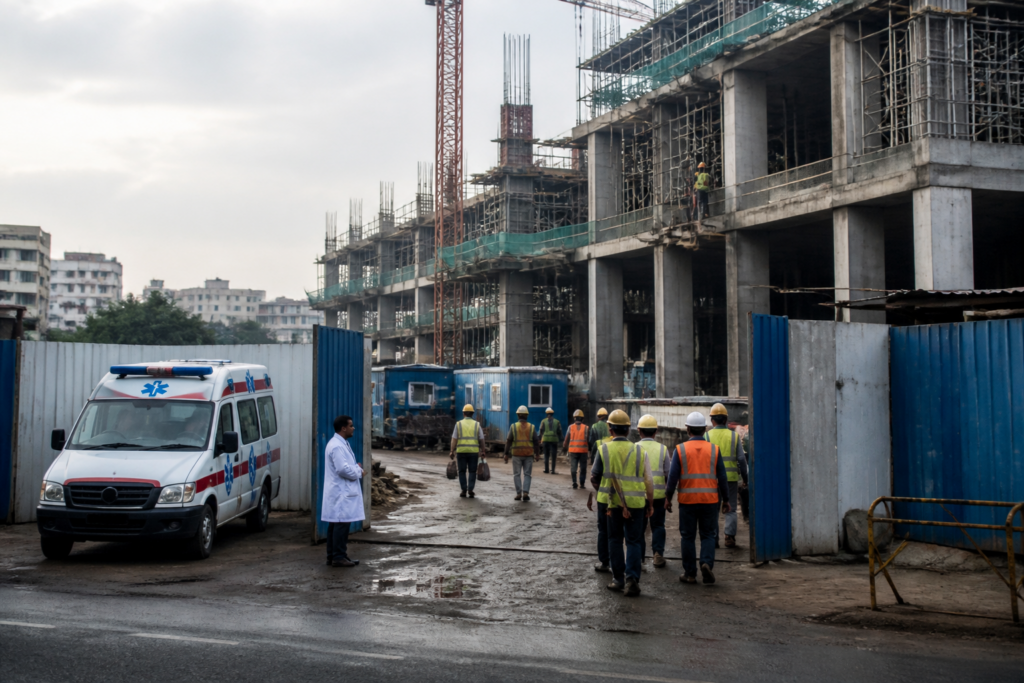
Kolkata construction sites employing 200 or more workers will have to keep a doctor and an ambulance on the premises under a directive issued by the West Bengal labour department. The department has also announced surprise inspections and legal action against developers found violating safety requirements.
State labour minister Arjun Singh conveyed the government’s position at a recent meeting with the Confederation of Real Estate Developers’ Associations of India (CREDAI), according to the Times of India. The directive seeks to strengthen safety and emergency-response arrangements at large construction projects under the Building and Other Construction Workers rules.
Singh said the department would conduct surprise visits to construction sites. “We will conduct surprise visits and if we come across violations, action will be taken as per law,” he said. The directorate of factories under the labour department can initiate legal action in cases of non-compliance.
The requirement applies to sites with at least 200 labourers, making worker strength the threshold for the mandatory medical and ambulance provision. The directive places responsibility on real estate developers to ensure that immediate medical assistance is available at major sites when an accident or other emergency occurs.
The announcement adds an enforcement component to construction-site safety rules in Kolkata and West Bengal. Rather than relying only on post-incident responses, the proposed inspections will allow authorities to check whether large sites have the required medical support in place while work is under way.
The move received support from representatives of the real estate sector. Siddharth Pansari, former president of CREDAI Bengal, Kolkata, said the industry had “a collective responsibility to ensure the safety, dignity and well-being of the workers”. Rakesh Gupta, chairman of a realty group, said the arrangement would enable immediate intervention in the event of a mishap.
The labour department’s inspections and the action taken in cases of violation will determine how the directive is implemented across large construction projects. Developers will have to comply with the stated requirement as the department begins its enforcement drive.


