

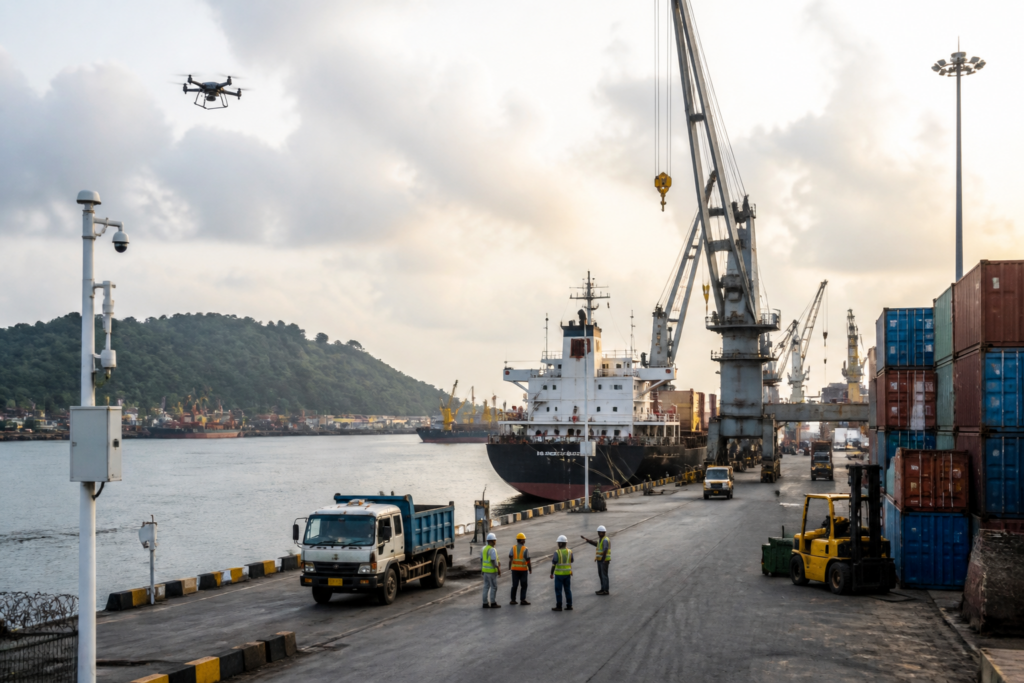
Mormugao Port Authority’s private 5G authorisation is more than a connectivity upgrade. It is an early test of whether India’s ports can build secure, tightly controlled digital networks capable of supporting automated logistics, connected equipment and real-time operational monitoring without depending entirely on commercial cellular infrastructure.
The Department of Telecommunications granted Mormugao Port Authority, or MPA, captive non-public network authorisation under the Telecommunication Act, 2023, for 20 years. MPA describes itself as the first government autonomous body and the first major port in India to secure such authorisation for a private 5G network. The authorisation was granted in September, according to the report.
The distinction matters because a private 5G network is designed for a defined site or organisation rather than general public use. At a port, that site can include cargo-handling areas, warehouses, berths, control rooms, roads, security zones and industrial equipment. The network would be managed around the operational requirements of the port, allowing the authority to control access, connected devices and the movement of operational data within its premises.
MPA chairperson N Vinodkumar said the proposed network would reduce the port’s reliance on commercial cellular networks and provide data isolation and digital security for sensitive logistics and operational processes. That objective places the initiative within a wider shift in infrastructure management: ports are increasingly being treated not only as physical gateways for cargo, but also as data-intensive operating environments.
A modern port brings together several systems that need to communicate reliably. Cargo tracking, equipment monitoring, surveillance, access control and infrastructure management can involve different devices and operational teams. The report says MPA is examining private 5G applications including smart port operations, automated logistics, cargo tracking, drone-based surveillance and smart sensors. The proposed network could also connect digital systems used to monitor and manage maritime operations.
The immediate significance is therefore not that Mormugao Port has already become a fully automated facility. The supplied information does not establish that such a system is operational. Instead, it shows that the port has entered the planning and testing phase of a network intended to support these functions. MPA has hired a consultancy agency to prepare a detailed project report and issued a request for information to identify suitable system integrators and original equipment manufacturers. Proof-of-concept trials are under way, port officials said.
That sequence reveals the institutional mechanics behind the announcement. The licence is an enabling step, not the final delivery of a working private 5G system. The detailed project report is expected to define the network architecture, operational requirements and implementation approach. The request for information is intended to help the authority understand the available technology and identify companies capable of supplying and integrating the system. Proof-of-concept trials can then test whether proposed applications work reliably in the port’s industrial environment.
This distinction is important for public-sector technology projects. A network can be technically available without automatically improving cargo movement, safety or productivity. Its value depends on what is connected to it, how operational teams use the information, and whether the port can integrate new devices with existing digital systems. The current stage described by MPA is focused on establishing that foundation.
The proposed use of private 5G also reflects the physical conditions of port operations. Ports are large industrial sites where equipment, vehicles, cargo, workers and security systems operate simultaneously. A network intended for such an environment must support reliable communication across operational areas and provide sufficient control over connected devices. MPA officials said the proposed network would offer high-speed connectivity, low latency and reliable communication within the port area.
Low latency is relevant where information needs to move quickly between sensors, control systems and operators. Potential examples identified in the report include real-time monitoring of port activities and assets, drone-based surveillance and smart sensors. However, the supplied material does not specify which applications will be deployed first, the number of devices to be connected, the network’s geographic coverage or the expected project cost. Those details are likely to emerge through the detailed project report and subsequent procurement process.
The security argument is equally central. MPA’s stated aim is to isolate sensitive data from public commercial networks and exercise greater control over network management. Port operations involve logistics information, infrastructure activity and security-sensitive processes. A dedicated network can create a more controlled communications environment, but the authorisation alone does not establish the final cybersecurity design or its performance. Those questions will depend on the system architecture, access controls, equipment standards, monitoring arrangements and operating procedures selected during implementation.
The regulatory basis is also significant. MPA’s authorisation has been granted under the Telecommunication Act, 2023, and is valid for 20 years. That duration gives the port a long operating horizon for a network that may involve substantial investment in equipment, software, integration and maintenance. It also means that the project will need to remain adaptable as port systems, connected devices and communications technology change over time.
The move aligns with the Union ports ministry’s stated focus on digitisation, process optimisation and improved operational efficiency across the maritime sector. Mormugao’s initiative therefore sits at the intersection of national port policy and local implementation. The ministry may define the broader direction, but MPA will have to translate that direction into a site-specific network serving its own operational environment.
This division of responsibility creates a practical governance challenge. A port authority may procure the network, but the benefits will depend on coordination between its operations, information technology, security, engineering and procurement functions. System integrators and equipment manufacturers will also influence how interoperable the final system is. If different devices and digital platforms cannot exchange information effectively, a high-speed network could remain an isolated technical asset rather than become part of a functioning port-management system.
The available evidence does not yet provide performance data against which the project can be judged. There are no stated figures in the supplied report for turnaround time, cargo-handling efficiency, equipment downtime, network coverage, investment, emissions or employment effects. Nor does it identify a delivery deadline for the full network. This limits what can currently be claimed about the project’s impact. At this stage, the strongest evidence concerns institutional intent, regulatory authorisation and the early procurement and testing process.
That absence of operating data is not a weakness unique to Mormugao. It is a recurring issue in infrastructure digitisation, where announcements often describe the technologies that may be introduced before setting out the indicators that will demonstrate whether they have improved public or operational outcomes. For a port, those indicators could eventually include the reliability of connected systems, the time required to track cargo, the performance of automated equipment and the reduction of communication failures. None of those outcomes has yet been established for this project.
The port’s private 5G plan also raises a broader question about the meaning of a smart port. Digitisation is sometimes presented as a collection of sensors, cameras and connected machines. In practice, it is an institutional process involving data ownership, decision-making authority, procurement standards, workforce capabilities and maintenance responsibilities. The network is the communications layer, but the urban and economic value of the system will depend on how that layer is connected to port operations.
For Mormugao, the next decisive stage is the conversion of authorisation into a tested and measurable implementation. The detailed project report, the request for information, the proof-of-concept trials and the eventual selection of system integrators and equipment manufacturers will reveal whether the initiative can move from a technology proposition to an operational system. They will also clarify which port functions receive priority and how the authority plans to manage the network over its 20-year authorisation period.
What is established so far is that Mormugao Port Authority has secured long-term regulatory approval and begun preparing a private 5G project. What remains open is the scale, cost, deployment schedule and measurable operational effect of the network. Those details will determine whether the initiative becomes a replicable model for India’s ports or remains an early experiment in infrastructure digitisation.


