

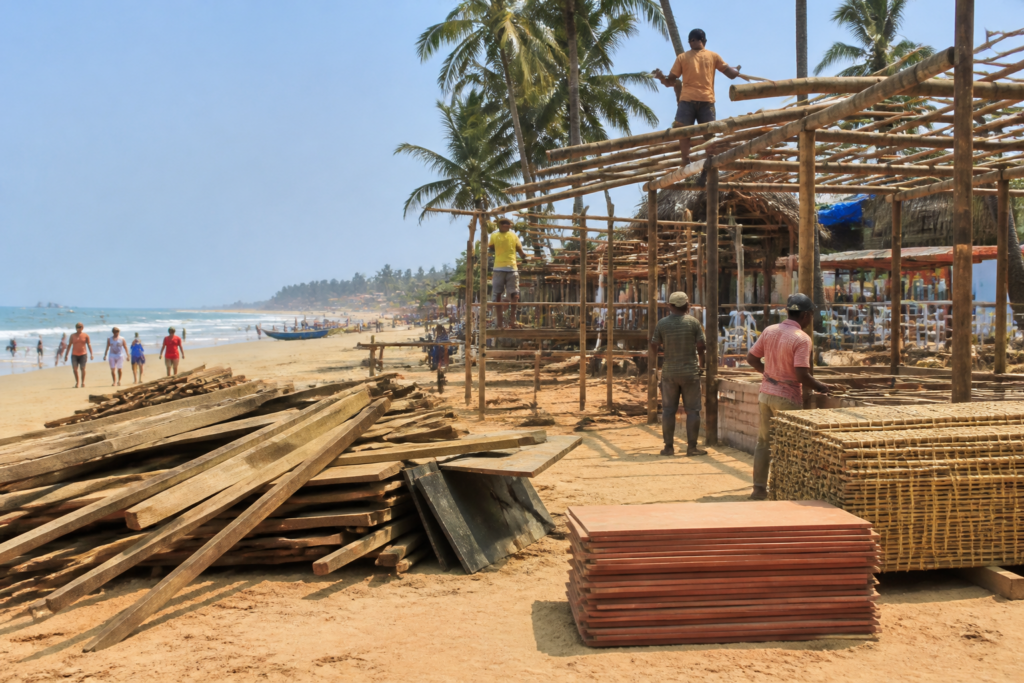
Goa beach shacks in the Calangute-Candolim belt have opened slowly this season, with around 80% still under construction and operators reporting weak early footfalls, even as concerns over the prohibited practice of subletting licences return.
Only a handful of shacks had opened for tourists by the Gandhi Jayanti weekend, according to stakeholders cited by the Times of India. Veteran Candolim shack owner Seby D’Souza said he and a few other operators began serving visitors on October 2, but construction activity across the beach belt remained slow.
“People are going very slow in building their shacks probably because the crowd is low. It’s the heat and the high air fares from Delhi, Mumbai, which is keeping people away,” D’Souza said.
Operators said some shacks could open after Dussehra, while the season is expected by stakeholders to gain momentum around Diwali in early November. The hot weather has also affected construction schedules. One shack owner said workers found it difficult to continue building during the afternoon and often took a break because of the heat.
The slow start is significant for a coastal tourism economy that has traditionally depended on seasonal demand, including visitors arriving on charter flights. Around 260 charter flights are expected this season, compared with 189 charter arrivals last season that brought 40,336 tourists, according to the report.
Shack operators in Calangute and Candolim have historically relied heavily on charter tourists. However, an operator said the number of charter visitors had gradually declined over the past decade, prompting businesses to focus more on domestic tourists from India’s major cities.
The changing visitor mix has also intensified questions about the financial viability and administration of the shack system. Stakeholders said some licence holders were seeking interested parties from Delhi, Mumbai and other metropolitan cities to operate their shacks through subletting, despite a prohibition by the tourism department.
Manuel Cardozo, president of the Traditional Shack Owners Association, alleged that the practice had continued for years. He said some licence holders obtained permissions after paying the required fee but did not construct or operate the shacks themselves. Others, he said, built the structures and then rented them out for amounts running into a few lakh rupees, with prices depending on location.
“Running beach shacks is not lucrative enough for most shack operators, so they sub-let,” Cardozo said. He claimed that some licence holders did not build their own shacks and instead transferred the operating opportunity for around Rs 3-4 lakh.
The allegation raises an administrative question beyond the delayed opening of individual businesses: whether the licence system is reaching the operators it is intended to regulate. Cardozo said almost 150 shacks were identified for subletting last season through QR-payment records. Although notices were reportedly issued proposing licence cancellations, he said no further action followed.
The Tourism Department’s prohibition on subletting means that the opening of the season will be accompanied by scrutiny of who holds each licence, who operates the shack and how payments are being collected. The report does not establish whether any licence has been cancelled this season or whether fresh enforcement measures have been announced.
For now, operators are waiting for cooler weather, higher visitor numbers and the expected rise in domestic tourism around Diwali. The immediate milestones are the completion of remaining shack construction and the department’s response to allegations that licences continue to be commercially transferred despite the ban.


