

Kerala road safety concerns came into sharp focus in the assembly after PWD minister P K Basheer said that half of the road accident deaths reported in the state between 2021 and 2026 occurred on national highways. He attributed crashes mainly to speeding and traffic rule violations, while also acknowledging that deficiencies in road infrastructure contribute to accidents.
Basheer was responding to questions from legislators when he said construction-related shortcomings could not be treated as the sole reason for road deaths. However, he added that infrastructure gaps remained among the contributing factors, placing responsibility for highway safety across road users, enforcement agencies and road authorities.
The minister said joint inspections are conducted at locations where accidents occur frequently. These inspections involve the police, the Motor Vehicles Department and the relevant road agencies. Their purpose is to identify the causes of crashes and recommend corrective measures for specific locations.
According to Basheer, the condition of a site, its past accident history and existing risks are reviewed before estimates are prepared for road restoration. The assessment is intended to ensure that safety provisions are included in restoration work rather than treated as a separate intervention after construction or repairs are completed.
Scientific studies are also being conducted by the National Transportation Planning and Research Centre, or Natpac, to identify major accident-prone stretches as black spots. The studies are intended to support the introduction of safety measures on stretches where repeated crashes indicate a high level of risk.
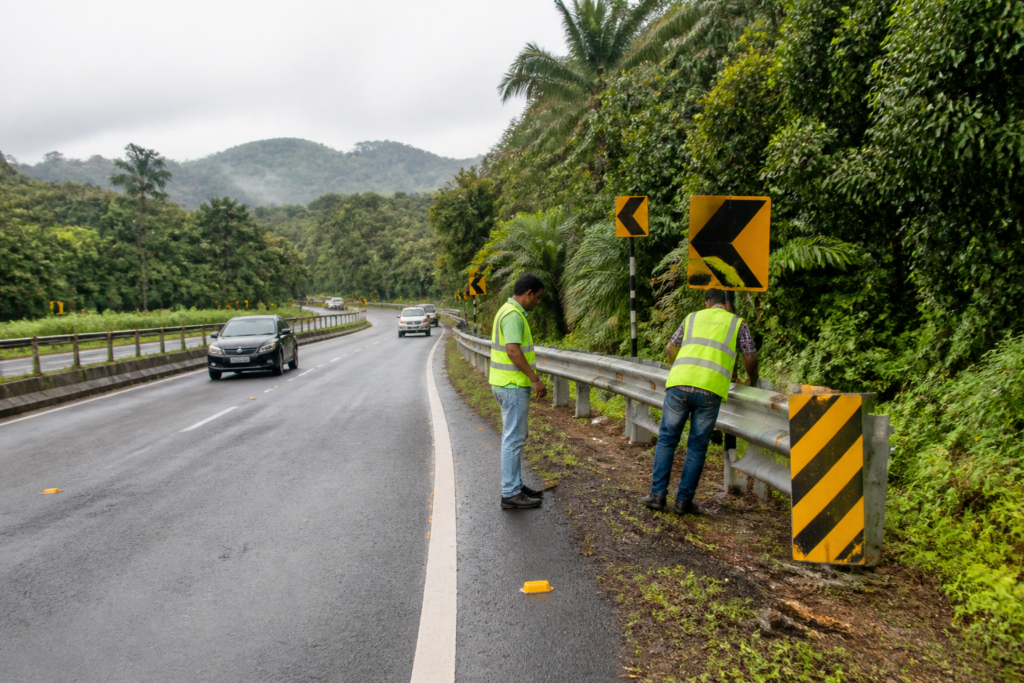
On national highways, both temporary and permanent remedies are being planned and implemented at hazardous black spots, Basheer said. The measures listed by the minister include solar blinkers, rumble strips, speed humps, reflective road signs, road markings and road studs. These interventions are intended to improve visibility, alert drivers to changes in road conditions and encourage lower speeds at high-risk locations.
The minister also said safety measures are being introduced at dangerous curves and medians. These include metal crash barriers and wire rope barriers, which are designed to reduce the consequences of vehicles leaving their lanes or colliding with roadside and median infrastructure.
The statement indicates that the state’s highway safety response is being organised through a combination of enforcement, engineering assessments and site-specific interventions. It also places accident-prone locations at the centre of the process, with inspections, black-spot studies and restoration estimates being used to determine the measures required at individual sites.
Basheer did not provide a location-wise breakdown of the deaths or specify the number of black spots identified through the Natpac studies in the statement reported by the Times of India. The next steps include continuing joint inspections, completing scientific assessments and implementing temporary or permanent safety measures at hazardous stretches.


