

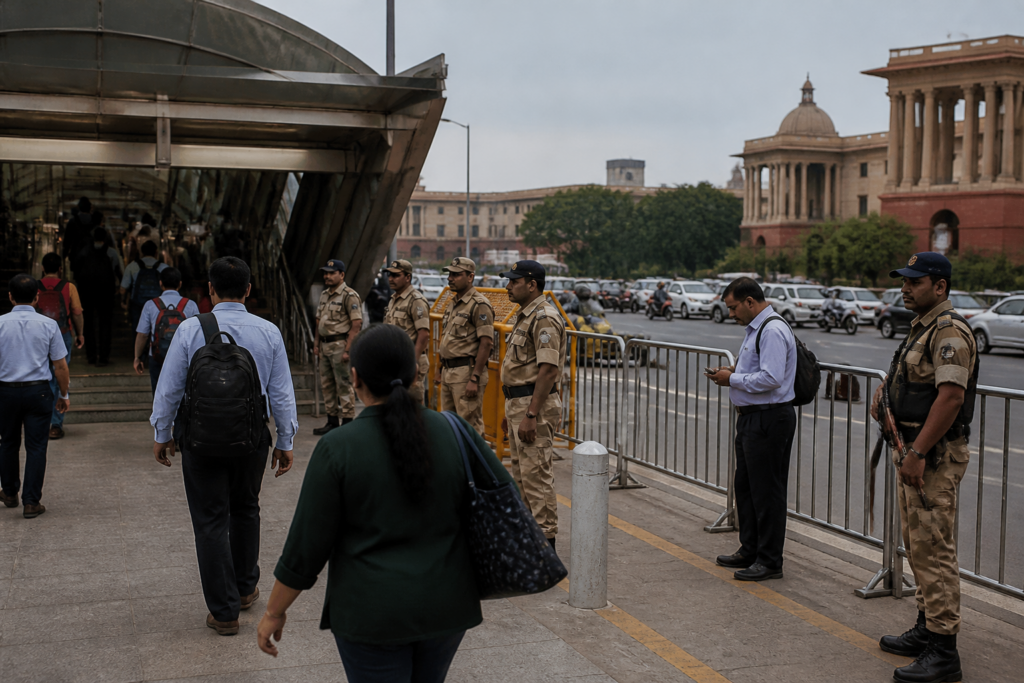
Delhi Police’s affidavit to the Supreme Court on measures taken during planned protests on 10 October offers a detailed view of how the capital’s security system manages public movement. The account places Delhi Metro restrictions, road diversions, mobile internet limits and preventive legal orders within one operational framework, showing how public-order decisions can quickly reshape access to transport and central-city institutions.
The affidavit, filed by Police Commissioner Anurag Kumar, stated that the police had taken the necessary security and law-and-order measures in compliance with the court’s directions. It said that no one had been illegally detained, that lawyers, journalists and other professionals were not prevented from carrying out their duties, and that action was taken only against people accused of violating orders issued under Section 163 of the Bharatiya Nagarik Suraksha Sanhita.
The document is important not only for its specific claims about detention. It also records the administrative chain through which a protest risk was converted into restrictions on a city’s transport network, roads and communications. The police said the measures were considered necessary because Delhi contains important government institutions, protected routes for VIP movement, visits by foreign dignitaries and other large events requiring heightened security.
### Delhi Metro restrictions and the management of access
According to the affidavit, Delhi Police sent the Delhi Metro Rail Corporation a proposal at 9 pm on 9 October to keep entry and exit gates closed at 45 metro stations from that time until 6 pm on 10 October. The proposal cited the possibility of crowds moving towards sensitive areas and the risk of disruption to law and order. The police also requested a reduction in train frequency.
The restriction was therefore not described as a general shutdown of the metro system. It was presented as a targeted operational measure affecting access to stations in and around areas considered sensitive. The affidavit also said the police later wrote to DMRC to restore normal metro operations from 10 pm on 10 October. It added that the Supreme Court’s direction concerning the metro had already been implemented.
This distinction matters for understanding how urban transport is governed during exceptional situations. A metro system may continue operating while its public usefulness is reduced through controlled station access, altered frequency or restrictions around particular locations. For passengers, the practical effect can extend beyond the stations that are closed: journeys may require longer interchange routes, additional walking, alternative modes or changes in timing.
The supplied affidavit does not provide the number of passengers affected, the individual station list, the duration of each station closure or the extent of the reduction in train frequency. Those omissions limit any assessment of the measure’s transport impact. What it does establish is that the police treated the metro network as part of the city’s security perimeter rather than only as a passenger service.
### Roads, diversions and the cost of preventive planning
Traffic diversions were implemented from 6 am on 10 and 11 October at several major roads and intersections, the affidavit said. The public was advised to plan journeys in advance, avoid non-essential travel and monitor traffic updates. To support traffic management, 88 diversion flex signs were installed.
The use of physical signs indicates that the traffic response was planned in advance rather than being limited to on-the-spot intervention. But it also shows the complexity of managing a central-city security operation in a place where government buildings, protest sites, judicial premises and major movement corridors overlap.
The affidavit does not state how long each diversion remained in effect, which routes experienced the greatest congestion or whether public transport services other than the metro were adjusted. It consequently cannot establish whether the diversions reduced disruption overall or shifted congestion and inconvenience to neighbouring roads. These are central questions for evaluating urban security planning, but they remain outside the evidence supplied in the report.
The police account does, however, show that mobility management formed a major part of the response. Security planning was not confined to barricades or personnel deployment. It involved changing the movement of trains, vehicles and pedestrians, while asking residents to modify their own travel behaviour.
### Mobile internet restrictions and urban communication
The police clarified in the affidavit that internet services were not completely suspended. It said restrictions were imposed only on mobile internet services under the applicable rules, and that the situation was being reviewed continuously.
That distinction separates mobile data access from a total communications shutdown, but it still has direct urban consequences. Mobile internet is used not only for social media or live updates but also for navigation, ride-hailing, digital payments, work communication and access to public information. In a city experiencing road diversions and station restrictions, limiting mobile data can affect the ability of residents to respond to rapidly changing travel conditions.
The report does not identify the geographical area covered by the mobile internet restrictions, the exact period for which they remained in place or the notification under which they were imposed. It also does not provide information on the number of users affected. The affidavit’s statement that the restrictions were reviewed continuously establishes the police position on oversight, but not the outcome of that review or its effect on residents.
This is where the episode raises a broader governance issue. Emergency restrictions are often assessed through the immediate objective of preventing disorder. Urban residents experience them through a wider system of dependencies: transport access, road information, communication networks and the ability to reach workplaces or professional obligations. A security measure can therefore have effects beyond the location where a protest is expected.
### Detention claims and the role of legal orders
The affidavit said that no one was illegally detained and that people were not stopped from performing their duties as lawyers, journalists or other professionals. It stated that action was taken only against those who violated orders issued under Section 163 of the Bharatiya Nagarik Suraksha Sanhita.
The police also said that notices relating to Section 163 were displayed in designated areas. Notices around the Supreme Court complex were reviewed and removed where necessary. These details point to the importance of communicating restrictions at the location where they are enforced. The affidavit presents notice boards as part of the legal and operational framework through which residents were expected to understand the limits on movement or assembly.
The supplied report does not include the text of the court’s directions, the police notification, the number of people detained or the number of cases registered. It therefore cannot independently establish how the restrictions were applied in individual instances. The relevant fact available here is that the police placed its account of detention, professional access and preventive action before the Supreme Court through an affidavit.
### What the episode reveals about Delhi’s urban system
The 10 October operation demonstrates how closely linked Delhi’s transport infrastructure and governance machinery are during a security response. The police coordinated with DMRC, managed major roads, placed diversion signage, regulated mobile internet services and monitored access to sensitive areas. Each action belonged to a different administrative domain, but all were activated around the same public-order concern.
This coordination can help authorities respond quickly when large gatherings are expected around government and judicial institutions. It can also make the city’s everyday systems less predictable for residents, particularly when information about closures, diversions or service changes is incomplete or changes during the day. The affidavit records the official rationale for the measures, while leaving the broader question of proportionality and public impact for further examination.
The episode also highlights the limited information normally available to citizens about exceptional urban restrictions. The police account includes the number of affected metro stations and diversion signs, but not the full station list, passenger impact, congestion data or detailed boundaries of mobile internet restrictions. Without those details, public evaluation depends largely on the authority’s description of necessity and compliance.
The evidence currently confirms that Delhi Police planned for protests on 10 October by seeking access restrictions at 45 metro stations, requesting lower train frequency, implementing road diversions on 10 and 11 October, placing 88 diversion signs and restricting mobile internet services rather than all internet access. It also confirms the police’s claim that illegal detention did not occur and that professional duties were not obstructed. The next point to monitor is how the Supreme Court assesses the affidavit and whether further directions clarify the limits, documentation and public communication required when Delhi’s core transport and communication systems are altered for security reasons.


