

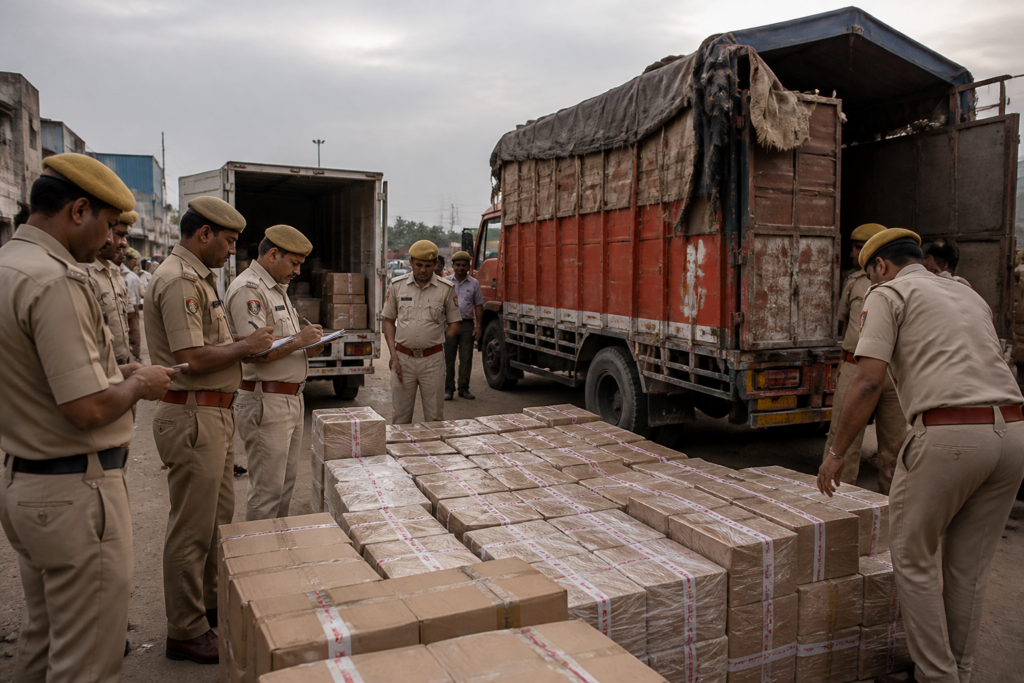
The seizure of more than 2.5 tonnes of illegal firecrackers in Delhi has moved attention beyond the recovered consignments to the supply chain that brought them into the city. Two police operations on October 13 led to five arrests, but the details released by the Delhi Police also show how enforcement must track movement, storage and delivery across multiple points rather than focus only on retail sellers.
The Crime Branch recovered 2,260 kg of firecrackers from two commercial vehicles near Carnival Resort in Alipur. The material was packed in 87 parcels and was being transported towards Delhi. Police said the consignments had been procured from Rakesh Sood & Sons in Kurali, Punjab, for delivery to recipients in the Capital. One vehicle carried 1,350 kg and the other 910 kg.
Four people were arrested in that operation: drivers Lovekush, 24, and Chandan Kumar Bhagat, 35, and helpers Vikas, 18, and Raja Yadav, 19. According to a senior police officer quoted in the report, interrogation indicated that one consignment had been loaded by a person identified as Sandeep Bansal and the other by Rahul. Both consignments were allegedly intended for delivery at Sanjay Gandhi Transport Nagar.
A separate operation in Bhalswa Dairy resulted in the seizure of another 338.5 kg and the arrest of Rahul, 29. The Anti-Auto Theft Squad intercepted him near Yadav Chowk and recovered three boxes from a plastic sack. A subsequent search of his residence led to the recovery of additional firecrackers.
Taken together, the seizures total more than 2.5 tonnes. The two cases also describe different points in the distribution chain: bulk movement through commercial vehicles in one instance, and smaller-scale transport and residential storage in the other. That distinction matters for enforcement because illegal material can enter the city through organised consignments before being divided into smaller quantities for local movement.
The police response, as described by officials, is directed at tracing the networks operating in Delhi and identifying the suppliers and other individuals involved. The cases were registered under Sections 223(b) and 288 of the Bharatiya Nyaya Sanhita and Section 9B of the Explosives Act. The investigation is continuing, and police have said they are working to establish the involvement of additional people.
The locations in the report indicate the geographic spread of the enforcement problem. Alipur served as the interception point for two vehicles carrying material towards the city, while the second operation took place in Bhalswa Dairy. The intended destination named by the police, Sanjay Gandhi Transport Nagar, is a major logistics area. The reported route places firecracker enforcement within the same transport and storage systems that move goods into and across the Capital.
This is also why seizures alone provide only a partial picture. Recovering 2,260 kg from two vehicles removes a substantial quantity from circulation, but the police account indicates that the larger investigation concerns who ordered the material, who loaded it, who was to receive it and how it would have been distributed. The second seizure, involving material found during an interception and a residential search, points to another layer of the chain after goods have entered neighbourhood-level circulation.
The case therefore combines two administrative tasks. The first is immediate public-safety enforcement: intercepting vehicles, searching premises and taking possession of potentially hazardous material. The second is network investigation: connecting drivers, helpers, loaders, suppliers, recipients and storage locations. The police statement suggests that the second task is now central to the investigation.
The report does not establish how long the consignments had been in transit, how many recipients were involved, or whether the two operations were connected. It also does not disclose the intended quantities for individual recipients beyond the two vehicles and the material recovered in Bhalswa Dairy. Those details remain part of the investigation, according to the police account.
The sourcing details nevertheless show that the issue extends beyond Delhi’s municipal boundary. The consignments seized in Alipur were reportedly procured from Kurali in Punjab, while their intended delivery point was in Delhi. Any sustained enforcement effort would therefore involve coordination across the source location, transport routes, entry points, logistics hubs and neighbourhood destinations. The report does not specify whether such coordination has been initiated or what further action has been taken against the named supplier.
The legal sections cited by the police establish the basis on which the cases have been registered, but the supplied report does not describe the charges in detail, the next court proceedings or the status of the arrested persons. Those are important milestones because the seizure is only the beginning of the enforcement process. The investigation must still determine responsibility across the supply chain and establish the evidentiary links between the recovered material and those named by the police.
There is also a significant information gap around the regulatory context. The report says Delhi Police have intensified efforts to restrict the sale and supply of illegal firecrackers ahead of the festive season, but it does not specify the particular restrictions applicable to the seized products, the authorisations required for sale or storage, or the agencies responsible for inspecting traders and warehouses. It therefore supports a clear account of enforcement activity, but not a complete assessment of the wider compliance system.
The numbers in the two operations offer the strongest evidence available. Of the total quantity recovered, 2,260 kg came from the two commercial vehicles and 338.5 kg from the Bhalswa Dairy operation. The first seizure involved four arrests and 87 parcels; the second involved one arrest, three boxes recovered during interception and additional material found at a residence. These figures show that the police were dealing with both bulk transport and smaller local storage, although they do not reveal the total scale of the market.
That limitation is important. A seizure figure is a measure of enforcement output, not a direct measure of the quantity circulating in the city. The supplied report does not provide comparable figures from earlier years, the number of inspections carried out, the number of cases registered during previous festive seasons or the volume of legal and illegal firecrackers sold in Delhi. It is therefore not possible from this account to determine whether illegal supply is increasing, declining or remaining stable.
What the evidence does show is a chain that crosses operational boundaries. Crime Branch personnel handled the Alipur recovery, while the Anti-Auto Theft Squad conducted the Bhalswa Dairy interception. The cases involved transport vehicles, a logistics destination, a residential premises and a supplier outside Delhi. This makes the enforcement question institutional as well as criminal: multiple police units and jurisdictions may need to share information to connect separate seizures into a single picture.
For residents, the immediate relevance lies in the removal of illegal firecrackers before they reach the point of sale or use. The report does not quantify any effect on air quality, noise or fire risk, and no such impacts can be inferred from the seizure alone. Its public-interest value instead rests on showing how material that police describe as illegal was being moved and stored, and how authorities are attempting to interrupt that process.
The next stage will determine whether the operations produce more than isolated recoveries. Delhi Police have said their investigation is focused on identifying suppliers, tracing distribution networks and establishing the involvement of other individuals. Those steps will clarify whether the five arrests are linked to a wider chain and whether the material recovered in the two operations can be connected to common sources or recipients. Until those findings emerge, the confirmed facts are the seizures, the arrests, the locations, the quantities and the cases registered.


