

Funskool’s plan to reach a ₹400 crore topline in FY27 is more than a company growth target. It offers a view into how India’s toy manufacturing sector is trying to move from domestic production to export-oriented industrial scale, even as its share of global toy exports remains only about 0.5 per cent.
The Chennai-based company, wholly owned by tyre manufacturer MRF, expects a 20 per cent increase over the ₹329 crore it posted in the previous financial year. Exports account for around 70 per cent of its business, and the company sells private-label and own-brand toys to more than 63 countries. Its expansion is being driven by licensing, manufacturing and distribution arrangements with global brands including Simba Toys of Germany, Molto of Spain, Buffalo Games of the United States and Sanrio of Japan.
That combination of export dependence, global partnerships and domestic manufacturing investment places Funskool within a larger industrial question: can Indian toy companies build the capacity, distribution networks and product capabilities needed to take a larger share of a market still dominated by China?
### Funskool’s export-led model
K A Shabir, Funskool’s chief executive officer, said at a media roundtable that the company’s export businesses grew by 30 per cent in the first half of the year. He cautioned that the toy business is cyclical and that the company may not repeat the same pace in the second half, but said Funskool remained confident of delivering healthy double-digit growth for the year.
The company’s geographical exposure is concentrated in two major markets. The United States, including other countries in the Americas, contributes roughly 44 per cent of Funskool’s export business, while Europe accounts for about 40 per cent. The remaining share comes from other parts of the world.
This distribution gives the company access to established consumer markets, but it also makes its performance dependent on international logistics, input costs and the purchasing cycles of overseas markets. The company has said geopolitical issues have increased both input and logistics costs. For an export-oriented manufacturer, those pressures affect not only the price of finished products but also the reliability and timing of supply.
The business is therefore not based only on selling a single Indian toy brand abroad. Funskool combines its own products with private-label manufacturing and arrangements involving international brands. The model allows the company to participate in different parts of the value chain, from making products for partners to developing and distributing its own toys.
### Capacity investment connects exports to industrial infrastructure
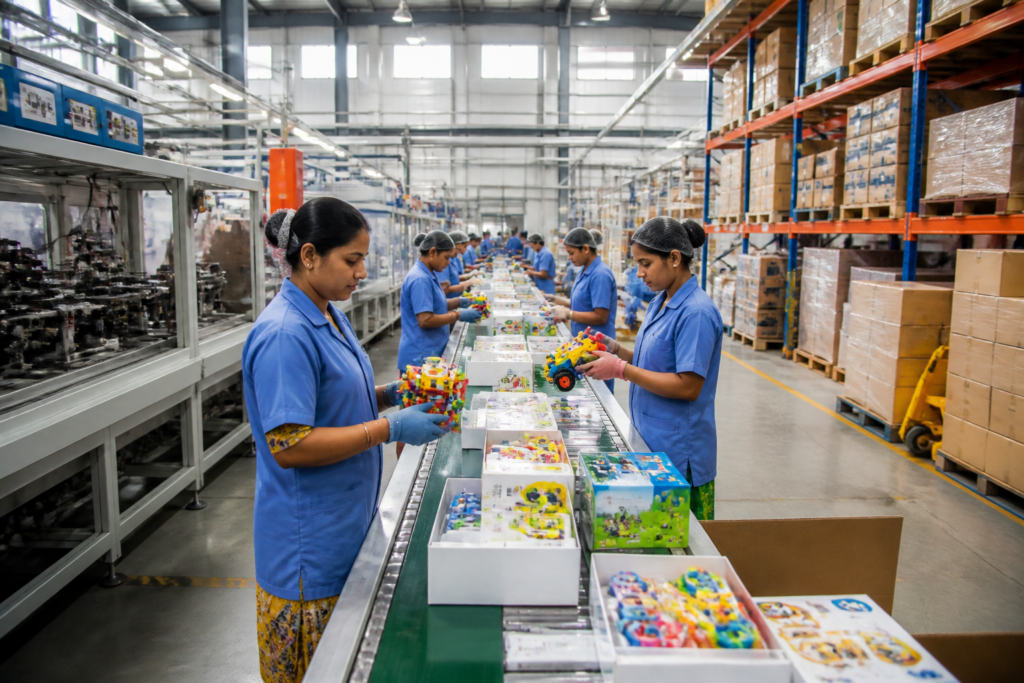
Funskool plans to invest roughly ₹30 crore to expand capacity next year. It currently operates two manufacturing facilities, located in Ranipet near Chennai and Goa. The proposed investment indicates that the company’s export ambition is tied to physical production capacity rather than only to new marketing or licensing agreements.
Ranipet’s presence in the company’s manufacturing network is significant for the Chennai region’s industrial geography. Funskool is headquartered in Chennai, while one of its facilities is located in Ranipet and another in Goa. The report does not specify the amount of capacity to be added, the products that will receive the investment or the number of jobs expected to be created. It does, however, establish that expansion will require additional manufacturing capability.
That distinction matters because export growth can be limited by the ability to produce consistently at the required scale. A company may secure demand through international distribution or brand partnerships, but it still needs factories, quality control, logistics and working systems capable of meeting that demand. Funskool’s planned investment suggests that capacity is becoming a central part of its growth strategy.
India’s toy production is estimated by the industry at an annual capacity of 400 million units. Yet the country’s share of global toy exports is roughly 0.5 per cent, compared with China’s estimated 70-80 per cent. The contrast points to a gap between the ability to produce toys and the ability to compete at global export scale.
The available figures do not explain the entire gap. They do show that production capacity alone has not translated into a comparable position in international trade. Export networks, product design, licensing relationships, compliance requirements, cost structures and logistics all influence whether manufacturing capacity can become sustained global business.
### A manufacturing sector still building its market position
Funskool’s own-brand products contribute roughly 30 per cent of its business. The balance is connected to exports and other business arrangements, including private-label activity and products linked to international partners. This split illustrates the different routes available to an Indian toy manufacturer seeking growth.
Own brands can create greater control over product identity and long-term market positioning, but they also require investment in design, consumer awareness and distribution. Private-label and partner-led production can provide access to established channels and overseas demand, although the manufacturer may have less control over the final brand relationship.
Funskool is also developing STEM toys and science kits that combine science, technology, engineering and mathematics with hands-on play. The company describes these products as tools for building problem-solving and critical-thinking skills. The move places product development alongside manufacturing and exports as another part of its strategy.
The report does not provide revenue projections for the STEM range or identify when the products will reach the market. It does establish that the company is attempting to extend its portfolio beyond conventional toy categories and respond to demand for products connected to learning and practical engagement.
### Distribution is changing the route to the consumer
E-commerce and quick commerce now contribute nearly half of Funskool’s business, according to Shabir. This is an important shift in the way a toy manufacturer reaches consumers in India. Instead of depending entirely on physical retail distribution, the company is using digital marketplaces and rapid-delivery networks as a major part of its sales system.
For manufacturers, such channels can reduce the distance between production and consumer demand. They can also create pressure for faster replenishment, wider product availability and more responsive inventory planning. The supplied report does not provide a breakdown of e-commerce and quick-commerce sales or distinguish between domestic and export revenue in these channels. It does show that digital distribution has become a substantial part of Funskool’s business.
The development also connects manufacturing decisions to urban consumption patterns. E-commerce and quick commerce depend on warehouses, delivery networks and dense consumer markets. While the company’s factories are located in Ranipet and Goa, a significant part of its customer access is mediated through digitally enabled distribution systems. The manufacturing business is therefore linked to both industrial locations and urban retail infrastructure.
### The larger export question
Funskool’s target is set against a sharp imbalance in global toy trade. India is estimated to have annual toy production capacity of 400 million units, but its global export share remains around 0.5 per cent. China’s estimated share of 70-80 per cent provides the comparison used in the report.
These figures suggest that India’s challenge is not simply to make more toys. It is to convert production into globally competitive, repeatable and commercially connected manufacturing. Funskool’s export network across more than 63 countries and its partnerships with brands in Germany, Spain, the United States and Japan represent one company-level response to that challenge.
The planned ₹30 crore capacity expansion is another response, but its eventual significance will depend on how effectively additional production is connected to demand. The company’s stated growth plan combines factory investment, international partnerships, own-brand development and digital distribution. Each part addresses a different constraint: capacity, access to markets, product ownership and consumer reach.
The report does not establish whether Funskool’s planned investment will alter India’s national export share or how the company’s capacity compares with competitors. It also does not provide details of the investment timeline, financing structure or expected output increase. Those remain important gaps in assessing the scale of the expansion.
What the evidence confirms is that Funskool is pursuing growth through an export-heavy model at a time when India’s toy manufacturing sector has significant production capacity but a small global export presence. Its factories in Ranipet and Goa, proposed investment, international partnerships and growing reliance on digital commerce show how manufacturing, logistics and market access are being combined within one business strategy. The next milestones will be the execution of the capacity expansion, the performance of exports through the rest of FY27 and the development of its STEM toy and science-kit portfolio.


