

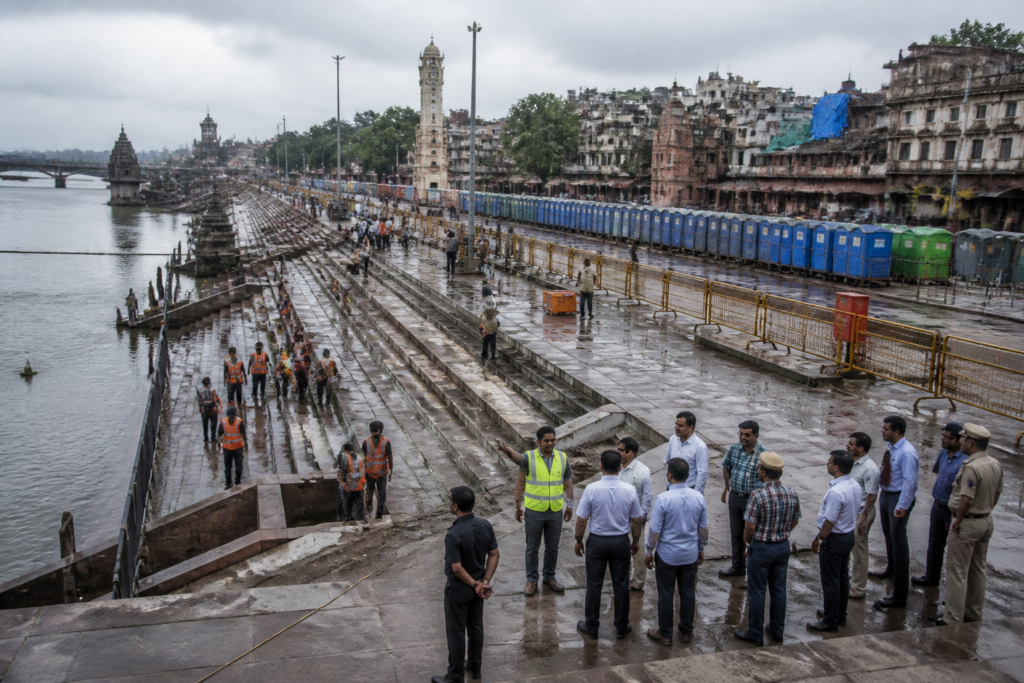
Crowd control, water management and public safety have become the administration’s immediate priorities for the Simhastha Kumbh Mela 2027 in Nashik and Trimbakeshwar, with authorities preparing for pilgrim gatherings estimated to be four to five times larger than previous editions.
District guardian minister and Kumbh Mela minister Girish Mahajan said rigorous crowd-management, sanitation and safety measures were being planned to prevent accidents at the festival’s busiest religious locations. He said the administration was undertaking advanced micro-management because Nashik’s Ramkund and Trimbakeshwar’s Kushavarta Teerth are expected to face heavy congestion during the event.
Mahajan made the remarks after performing the Dhwaja Stambh Pujan at Kushavarta Teerth in Trimbakeshwar on Thursday. The site is currently closed to pilgrims because development work is underway. The Dhwajarohan, or flag-hoisting ceremony, is scheduled for October 31 at Ramkund in Nashik and Kushavarta Teerth in Trimbakeshwar. Seers from the Vaishnav sect will gather at Ramkund, while seers from the Shaiv sect will assemble at Kushavarta for the Kumbh Mela scheduled in August and September 2027.
The administration has invited President Droupadi Murmu, the chief minister, cabinet ministers and other dignitaries to the ceremonies. The planned religious gatherings will require authorities to coordinate movement, sanitation and access around two sites that already experience intense visitor pressure during major events.
Water security is another central concern because preparations are taking place amid prevailing drought conditions. Mahajan said the administration would ensure that the festival did not face a water shortage, while also limiting waste. At Trimbakeshwar, water used for bathing is planned to be recycled and reused, according to the minister.
Mahajan said the timing of the Simhastha Kumbh Mela, during the peak monsoon months and roughly three months after the rains begin, meant that water scarcity or reservation issues were not expected to affect the event. He nevertheless said authorities were planning for judicious water use.
Infrastructure work is also underway across the two locations. The projects include roads, ghats and civic amenities required to support the expected influx of pilgrims. With the first holy bath scheduled for August, the administration is targeting completion of the works by June or July.
Land and property acquisitions have begun as part of the preparations, with compensation being provided to facilitate the required works. The acquisitions, road and ghat construction, and expansion of civic amenities will determine how effectively the festival areas can absorb large crowds while maintaining access and basic services.
The administration’s stated focus places crowd movement, water reuse and construction deadlines at the centre of preparations. The immediate milestones are the October 31 flag-hoisting ceremonies and the targeted completion of major infrastructure and civic works before the first holy bath in August 2027.


