

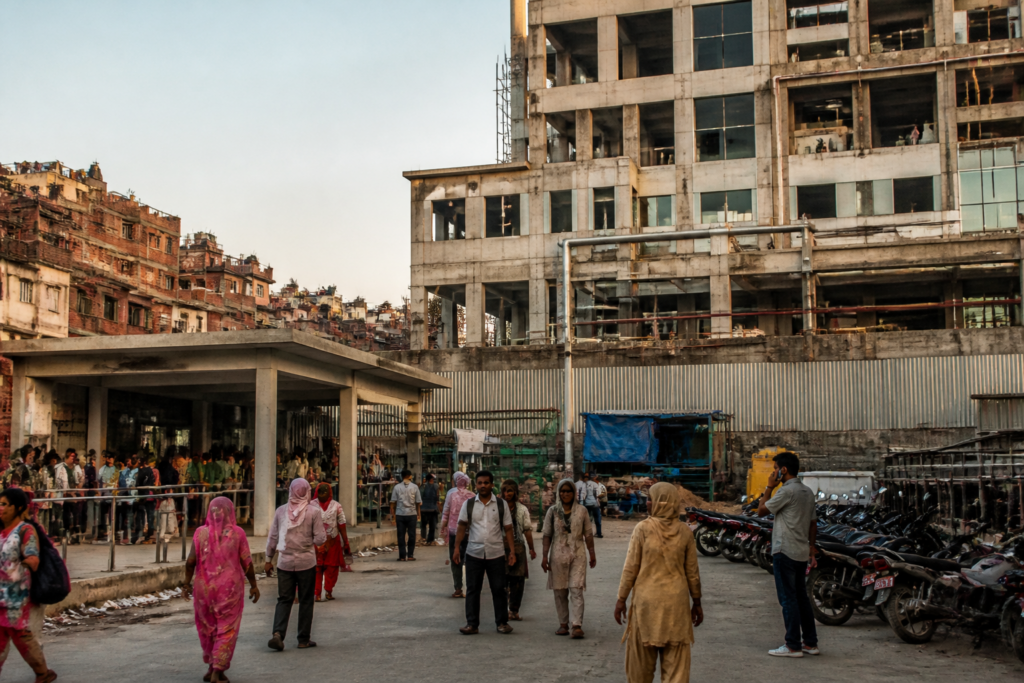
The stalled Pt Deendayal Upadhyay Hospital expansion in Jaipur is no longer simply a delayed construction project. Five years after land was cleared for a Rs 52-crore superspecialty block, the walled city’s only government multispecialty hospital remains crowded, short of critical diagnostic and emergency services, and dependent on an unfinished building that was supposed to absorb rising demand.
The expansion was conceived as a response to a basic urban problem: a dense historic city and its surrounding settlements were relying on a hospital whose available space and service capacity were already under pressure. The new facility was intended to serve residents of Jaipur’s walled city, Shahpura town and settlements along Delhi Road. Its delayed delivery has left the original hospital carrying the patient load without the infrastructure promised to support it.
The project also carries an unusual institutional history. In 2021, a temple, a mazaar and a government school building were demolished to create the site for the expansion. The superspecialty block is being developed by Jaipur Smart City Limited on 5,998 square metres of land. The demolition created a visible public cost before the replacement facility was ready, turning the project into a test of whether urban redevelopment can convert sacrificed public and community space into functioning public infrastructure.
That conversion remains incomplete. The expansion missed its October 2024 deadline and, according to the report, is still far from operational. A site inspection found substantial civil work pending. Modular operation theatres had not been started, while electrical and firefighting systems remained unfinished. Air-conditioning, false ceilings, floor tiling, internal and external painting and sanitary fittings were also incomplete or stalled. The medical gas pipeline, essential for a superspecialty hospital and its operating theatres, was still pending.
These are not cosmetic deficiencies that can be resolved by opening the building early. They are interconnected systems required for a hospital to operate safely. A structure can appear substantially built while remaining unusable if power, fire protection, medical gases, sanitation, ventilation and operating-room infrastructure are not commissioned. In this case, the physical delay has translated into a service delay: the hospital has gained neither the promised space nor the clinical capacity associated with the expansion.
The hospital superintendent, Dr Leeneshwar Harshvardhan, described the operational constraint directly: “We do not have space. We are managing the functioning of the hospital in limited space. A new building is coming up, but it is yet to be completed.” His statement captures the central implementation gap. The public system is continuing to provide care, but it is doing so within an estate that has not expanded in line with the project’s original purpose.
The existing hospital operates on 7,189 square metres, with a built-up area of 1,12,165 square feet across a basement, ground floor and three upper floors. It has 303 beds, nearly half of them earmarked for maternal care. The available figures indicate that the pressure is not occasional. The hospital recorded 49.7 lakh outpatient department visits in 2025. From January 1 to September 30 this year, it recorded 3.8 lakh OPD visits, according to the report.
The two figures describe a facility serving a very large outpatient population while operating with a fixed bed base and limited room for circulation, diagnostics and emergency functions. The source does not establish whether the figures use identical counting methods or how much of the patient load comes from the wider catchment area. It does, however, show that demand is substantial and that the hospital’s capacity problem is not confined to the number of beds.
Crowding is particularly visible in maternal care. With maternal footfall rising, the hospital has begun issuing antenatal check-up slots one day in advance to manage the number of patients. The arrangement is an operational response to congestion, not a substitute for additional clinical space. It may help organise attendance, but it also shows how an incomplete expansion shifts the burden of capacity management onto patients and hospital staff.
The missing services further reveal the difference between a hospital building and a functioning health facility. The hospital still lacks a CT scanner, MRI, blood bank and trauma emergency unit. It operates only a blood storage centre because of space constraints. These gaps affect the hospital’s ability to provide diagnosis, emergency response and treatment within one campus. Patients and attendants may consequently face additional transfers or delays, although the supplied report does not quantify those outcomes.
Parking is another part of the capacity problem. The limited parking space is reserved for staff, leaving patients’ attendants without adequate accommodation for vehicles. In a crowded urban hospital, parking is not merely a convenience issue. It is linked to how people reach emergency and outpatient services, how attendants remain near patients, and how the surrounding streets absorb hospital-related movement. The report does not provide traffic or parking utilisation data, but it establishes that the existing arrangement is inadequate for users.
The project’s institutional structure adds another layer to the delay. Jaipur Smart City Limited is developing the extension, while the hospital is responsible for delivering public medical services within the existing facility. The source does not identify the precise reasons for the missed deadline, the revised completion schedule, the contractor’s status, or the funding releases. That absence is important because the building’s incomplete components suggest that the problem extends beyond a single finishing activity.
For public infrastructure, completion is not the same as construction progress. A hospital expansion must move through several linked stages: civil works, installation of specialised systems, procurement and commissioning of equipment, staffing, regulatory readiness and integration with the existing hospital. The report documents unfinished work in several of these physical systems, but it does not establish the status of equipment procurement, staffing plans or operational approvals. Until those elements are aligned, the usable capacity created by the project remains uncertain.
The choice of site also underlines the consequences of sequencing. A school building, temple and shrine were demolished in 2021 to make the expansion possible. The new hospital block was therefore not being built on an unused parcel with no public history. The land had to be cleared of existing uses, and that decision created an expectation that a larger and more capable public facility would follow. Five years later, the gap between clearance and delivery is central to the project’s public significance.
The case raises a broader question about how cities measure infrastructure delivery. A project may be announced with a budget and a deadline, but residents experience it only when the facility opens and performs. For a hospital, that means functioning operating theatres, diagnostics, emergency care, fire safety, medical gases, sanitation and adequate circulation. A partially completed structure cannot relieve an overcrowded hospital, regardless of the money already committed or the area already built.
It also demonstrates why urban capacity should be assessed through demand and service access rather than land and floor area alone. The existing hospital has a substantial built-up area, but the report describes congested OPDs, long waits and overstretched services. The absence of a CT scanner, MRI, blood bank and trauma emergency unit means that the facility’s effective capacity is lower than its physical footprint might suggest. The expansion was expected to address this mismatch; its delay has preserved it.
The available evidence does not establish whether the project budget has increased, whether the October 2024 deadline has been formally revised, or when the facility will become operational. It also does not identify responsibility for each unfinished component. Those are the next facts required to understand whether the delay reflects procurement problems, contractor performance, design changes, coordination failures or another cause. Without that information, the scale of the implementation failure can be documented, but its precise administrative explanation remains unresolved.
What is clear is that Jaipur’s hospital expansion has moved from a construction schedule into a question of urban service reliability. The city cleared land, committed a stated project cost and promised additional capacity, but the existing hospital is still managing demand within its old limits. The immediate milestones to watch are completion of the civil and building systems, installation of medical gases and modular operation theatres, delivery of diagnostic and emergency capacity, and the official timeline for commissioning the new block. Until those steps are completed, the promised expansion remains unavailable to the patients it was designed to serve.


