

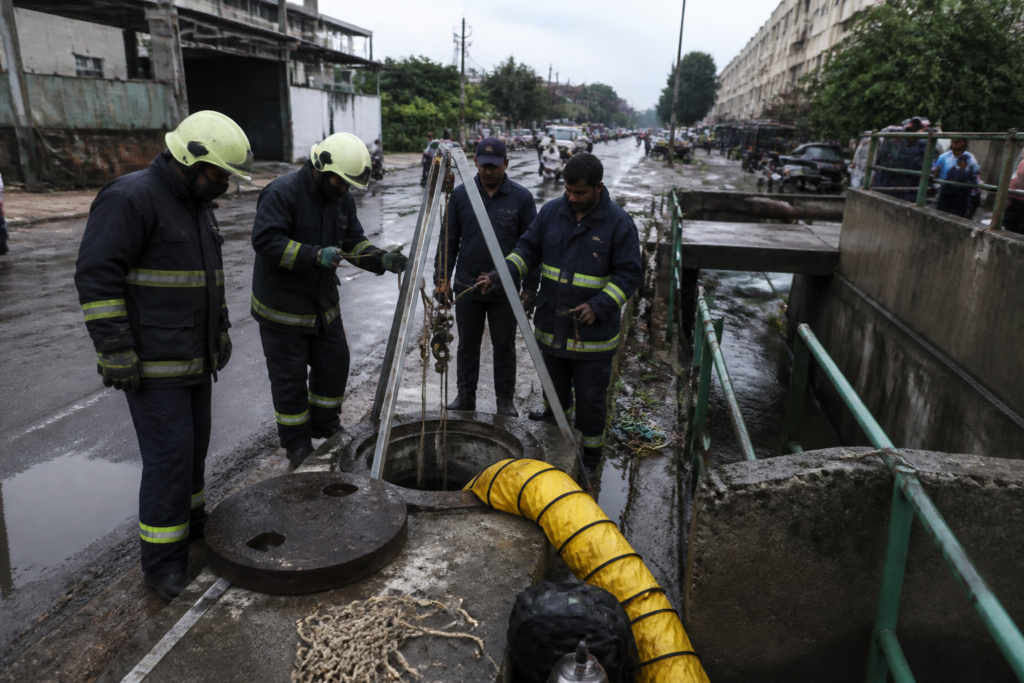
The search for a 10-year-old visually impaired girl who fell into a deep drainage line along Ahmedabad’s Narol–Pirana Road on October 10 has continued without a confirmed trace, according to a report by Gujarat Samachar – Ahmedabad. The case is not only an emergency response story. It reveals how drainage networks, industrial wastewater, manholes and municipal safety systems converge in parts of the city—and how difficult those systems become to inspect when they carry fast-moving, chemically contaminated water and hazardous gases.
The girl was reported to have fallen into a drainage line approximately 40 feet deep. By the sixth day, fire department teams had searched the drainage line, manholes and the river without locating her. At a standing committee meeting on October 15, the committee chairperson instructed officials to use CCTV footage as part of the investigation. The report said the search had also covered a sewage treatment plant, although no trace had been found.
The supplied account contains an important uncertainty. The chairperson said that a body would generally reach the water surface within 24 hours, but that this had not happened in this case. The report therefore mentioned the possibility that the girl may have become trapped in mud. That possibility was not confirmed, and the search operation remained under way. The distinction matters: the location of the child and the circumstances after the fall had not been established at the time of publication.
What the rescue operation reveals
The immediate difficulty is physical access. Fire department officials said the drainage line carries a heavy flow, making it difficult for equipment lowered into the line to remain in place. Strong-smelling hot gas was also reportedly emerging from the manholes, preventing personnel from entering safely. The line was further described as carrying chemically contaminated water, adding another hazard to an already unstable rescue environment.
These details show why a drainage network cannot be treated as a single underground pipe. It is simultaneously a water-conveyance system, a confined workplace, a potential route for industrial discharge and, in this case, a difficult search environment. Once a person enters such a system, conventional rescue methods can be constrained by flow speed, visibility, toxic or irritating gases, temperature and the structural condition of the line.
The case also raises a basic public-safety question: how are access points to deep drainage infrastructure secured in places where people can come into contact with them? The report does not establish whether the fall occurred through an open manhole, an unprotected opening or another access point. That fact remains important to the accountability question and would require confirmation from the municipal authorities or the investigation.
The CCTV instruction is therefore significant, but not merely as a search tactic. Footage from roads, nearby properties and public facilities could help establish the girl’s movements before the incident, identify the precise point of entry and clarify whether the drainage opening was visible, barricaded or otherwise controlled. It could also help reconstruct the timing of the event, which is essential when search teams are dealing with moving water and a connected network.
A drainage network with multiple risks
According to the report, the line is a main trunk line receiving sewage from Ahmedabad’s southern, eastern and northern zones. These zones contain industrial units. Sources cited in the report alleged that some industries may be releasing chemically contaminated water into the drainage network through illegal connections. The report also cited a possibility that tankers may be emptying chemical water into the line, particularly late at night or in the early morning.
Those claims were not established through an official inspection or enforcement order in the supplied material. They must therefore remain allegations rather than facts. The report associated the suspected activity with industrial areas around Naroda, Behrampura, Vatva and Narol, but it did not identify a specific company, tanker operator or confirmed discharge point.
Even as an unconfirmed claim, the allegation points to the institutional complexity behind the rescue operation. A municipal drainage system may be designed to convey domestic sewage, but its risks change substantially if industrial effluent enters the same network. The authority responsible for operating the sewer line may not be the only institution needed to investigate the hazard. Industrial regulation, environmental monitoring, tanker movement, municipal enforcement and emergency response can all become relevant.
The report’s account suggests that this overlap has direct consequences for emergency work. Fire personnel are not only navigating a deep and fast-moving line; they are reportedly confronting hot gas, strong odours and chemically contaminated water. The operational challenge is therefore linked to the quality of what enters the drainage system. A rescue team can be equipped for confined-space work, but its ability to operate still depends on knowing the contents and behaviour of the water and gases inside the line.
The governance gap behind the incident
The standing committee’s intervention indicates that the matter has reached Ahmedabad’s municipal decision-making structure. The instruction to examine CCTV footage adds an investigative track to the physical search. However, the supplied report does not state which agency is leading the overall investigation, whether the drainage line has been mapped in full, whether all connected manholes have been sealed or inspected, or whether industrial discharge testing has begun.
Those unanswered questions are central to understanding the incident. A search in a connected trunk line cannot depend only on repeated physical entry attempts. It requires an accurate network map, a record of flow directions, access to operating controls, information about connected treatment facilities and a coordinated chain of responsibility. The source report confirms that the river, sewage treatment plant, drainage line and manholes have been examined, but it does not provide a complete account of the search protocol or the points still pending.
The case also shows the limitations of treating manholes and drainage corridors as back-of-house infrastructure. They are largely invisible during normal city operations, yet they can become sites of public danger when openings are exposed, when road edges are poorly protected or when nearby residents lack information about the network beneath them. The report does not determine whether a design or maintenance failure caused the fall, but the depth of the line and the difficulty of reaching it make access control a critical question for the authorities.
The wastewater dimension requires similar caution. The possibility of illegal industrial connections or tanker dumping should not be converted into a conclusion without sampling, tracing and enforcement records. But if chemically contaminated water is entering the trunk line, the response would extend beyond this single search. It would concern worker safety, treatment performance, network integrity and compliance by industrial units connected to the city’s drainage system.
What remains established—and what does not
The established facts in the supplied report are limited but serious: a 10-year-old girl fell into a roughly 40-foot-deep drainage line on the Narol–Pirana Road on October 10; she had not been found by the time of the October 15 report; fire department teams searched the drainage line, manholes, the river and a sewage treatment plant; and the standing committee chairperson directed officials to examine CCTV footage.
The report also records operational hazards described by fire officials, including heavy flow, equipment being displaced by the water, hot gas, strong odours and chemically contaminated water. These conditions help explain why the search has been difficult, but they do not establish the source of the chemical contamination or prove that an illegal discharge caused the incident.
The most important information still pending concerns the child’s location, the exact point and circumstances of the fall, the condition of the drainage access point, and the findings of any official examination of the water and gases. The next stage of reporting should distinguish clearly between rescue updates, municipal findings and source-based allegations about industrial discharge.
For Ahmedabad, the larger urban question is whether underground infrastructure is being managed as a connected public system or as a set of separate departmental responsibilities. The case places emergency response, drainage design, industrial regulation, CCTV-based investigation and municipal oversight in the same frame. Until the search establishes what happened and the authorities clarify the condition and management of the drainage network, the incident remains both a missing-person emergency and a warning about the risks hidden beneath the city’s roads.


