

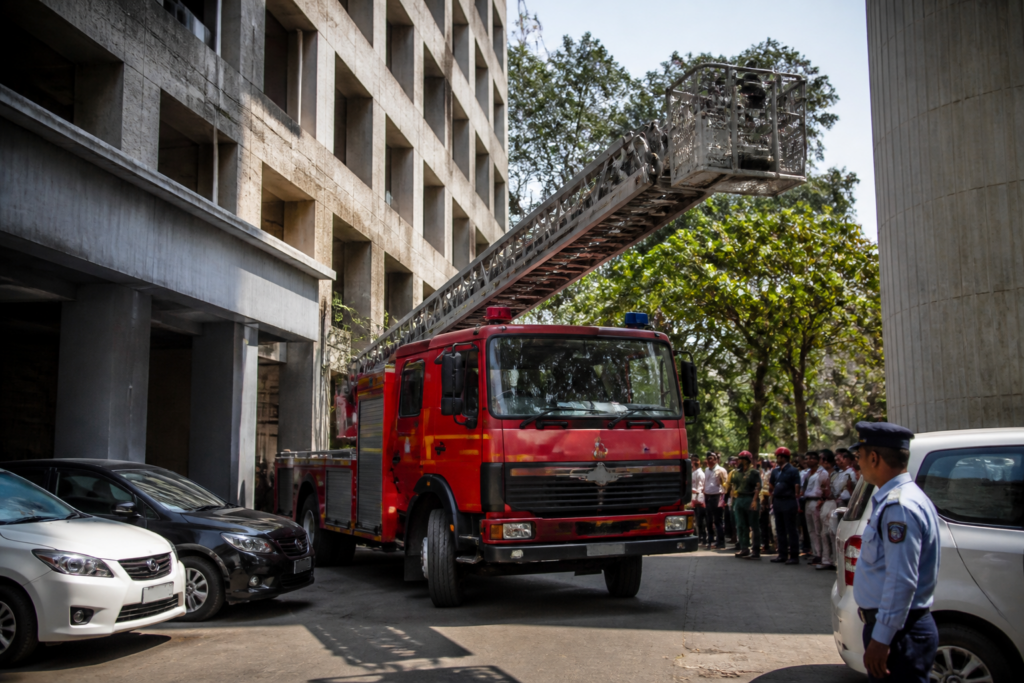
A mock drill at Pune Municipal Corporation headquarters has exposed serious gaps in the building’s emergency-response system, including blocked access for large fire engines, an obstructed rescue lift, misplaced emergency-door keys and unsafe crowd behaviour. The exercise was conducted on Tuesday to test the civic administration’s preparedness for a possible bomb blast and fires in and around the headquarters.
The drill was intended to assess how quickly the municipal corporation, fire brigade, security personnel and other staff could respond to an emergency and evacuate people from the building. Instead, the exercise revealed several operational and planning weaknesses that could delay rescue efforts during a real incident.
One of the first problems emerged when fire brigade vehicles entered the headquarters premises through the side near Cafe Ramsar. Smaller vehicles were able to move inside, but the larger vehicles faced difficulty near the parking area. When the fire brigade attempted to turn a vehicle fitted with a snorkel ladder towards the building, there was insufficient space to manoeuvre.
The vehicle had to be moved forward and backwards three or four times before it could be turned. The delay was estimated at nearly one to one-and-a-half minutes. In an actual emergency, such a delay could affect the evacuation of people trapped inside a building and the deployment of firefighting equipment.
A separate technical problem was found with the special rescue lift, referred to in the report as the ‘Banko lift’. The lift is intended to help rescue ill, injured or trapped people from higher floors, including the fourth and fifth floors. During the demonstration, an electrical or cable wire installed across the lift’s path prevented it from moving normally and left it stuck.
The rescue team then had to reach a specific window and demonstrate the evacuation from there. The incident highlighted how new electrical or communication connections, if not coordinated with emergency infrastructure, can interfere with rescue systems inside a public building.
Another delay occurred during the simulated blast on the second floor. Security guards and staff attempted to evacuate people from other floors, but time was lost while personnel searched for the keys to emergency doors. The keys were not found at the designated location. Emergency-door keys, the report noted, should be kept at a clearly identified and common access point so that staff can use them immediately during a crisis.
Ganesh Sonune, head of the Pune Municipal Corporation’s disaster management cell, said the parking area would be closed immediately to create sufficient space for the large fire brigade vehicle. He also said measures would be taken to remove obstructing cables, improve the arrangement of keys and strengthen safety provisions for citizens.
The drill also exposed a public-safety challenge outside the building. Despite repeated appeals to people gathered on the lawn in front of the headquarters to move away and avoid crowding the area, many continued to remain there. Officials said such crowding could have caused significant casualties if the simulated blast had been real, while also obstructing emergency operations.
The civic administration is expected to focus on parking control, removal of obstacles from rescue routes, improved maintenance of emergency equipment, centralised key storage and public awareness after the exercise. The mock drill has therefore served not only as a test of response time, but also as a check on whether the building’s everyday management supports emergency access when it is most needed.


