

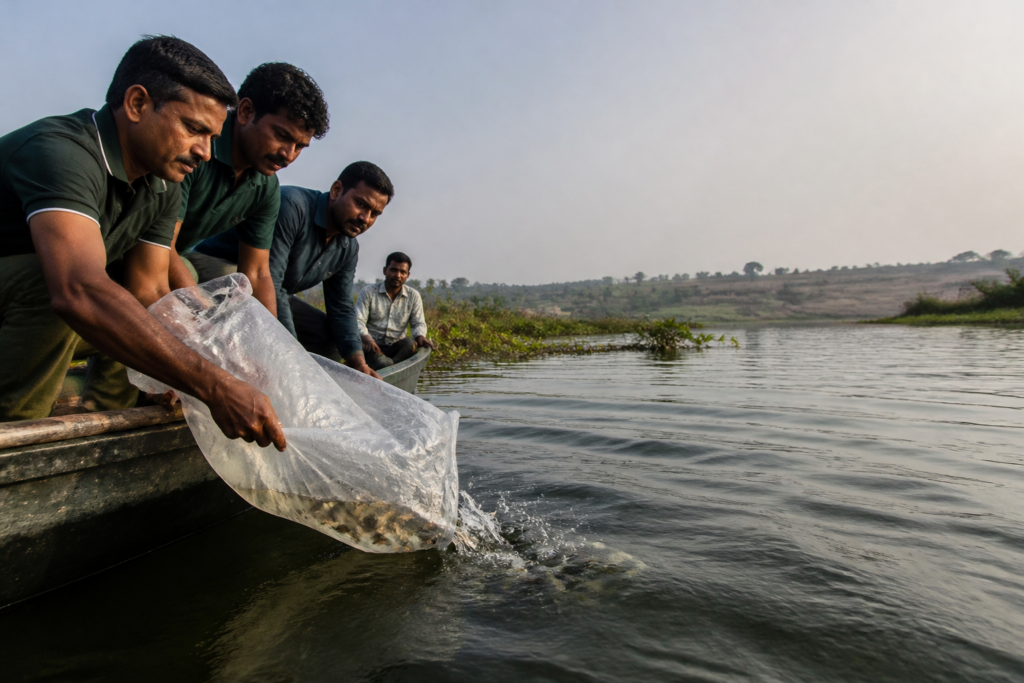
A restoration programme to revive rare and locally extinct fish species and aquatic plants in Maharashtra’s Ujani reservoir will begin on Saturday, with the Deccan mahseer set to be reintroduced into the water system after disappearing from the dam during the 1990s.
The initiative is being undertaken by the Bombay Natural History Society (BNHS) under its Wetland Environment Restoration and Fisheries Development Programme. Along with the Deccan mahseer, fish seed of native species such as bobari, kavadas, rohu, catla and mrigal will be stocked in Ujani, according to information provided by Dr Unmesh Katwate, head of the programme.
The Deccan mahseer, known as the “tiger of the river”, is regarded as a key native freshwater fish in the region. The report said the species had almost disappeared from Ujani and other rivers and reservoirs during the 1990s. It is currently found in the Hiranyakeshi river near Amboli and in Tata Power’s reservoir at Lonavala.
Tata Power has been working on the conservation of mahseer for around 50 years and will provide the mahseer seed for the Ujani restoration programme. BNHS has also achieved what the report described as the country’s first successful breeding of bobari and kavadas, while some native kavadas fish have been collected from a river for the initiative.
The restoration plan follows concerns over rising pollution in Ujani and the use of small-mesh nets for commercial fishing. According to the report, these pressures have placed the reservoir’s fish resources at serious risk. Around 35 to 40 native fish species, along with major carp species, have become rare or locally extinct, while aquatic plants have also disappeared.
The loss of fish and aquatic vegetation has affected the reservoir’s biological chain, the report said. Aquatic plants provide habitat and support the functioning of wetland ecosystems, while the decline of native fish can affect both biodiversity and the livelihoods linked to inland fisheries. The supplied report does not provide a detailed assessment of the present fish population, pollution levels or the programme’s restoration targets.
The launch is expected to be attended by Maharashtra Agriculture Minister Dattatray Bharane, BNHS director Kishor Rithe, H. C. Jehangir of Jehangir Hospital, Tata’s biodiversity department head Vivek Vishwasrao, Cipla Foundation’s India head Anurag Mishra and regional deputy commissioner Vijay Shikhare, among others.
Ujani Dam is a major water body in the Bhigwan region, and its ecological condition has implications beyond fish stocking. The reported programme combines species breeding, the reintroduction of native fish and the restoration of aquatic plants, making it broader than a single-species conservation effort. Its progress will depend on the survival of released fish, the recovery of aquatic vegetation and the ability to address the pollution and fishing practices identified in the report.
The restoration launch is scheduled for Saturday, when the first phase of the fish and aquatic-plant revival programme is expected to be formally initiated at Ujani.


