

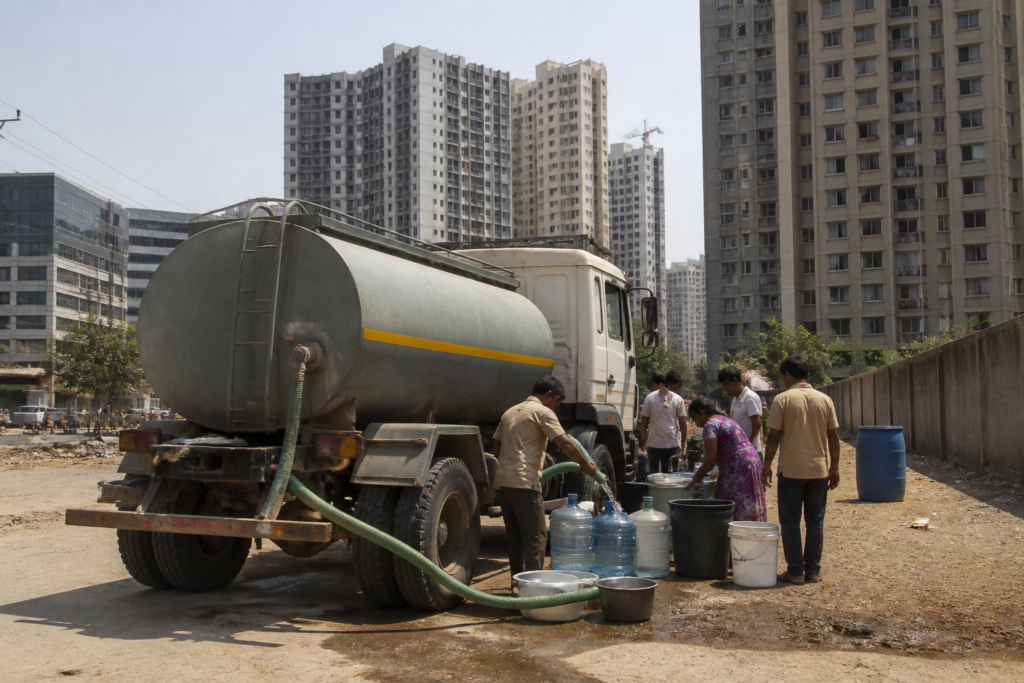
Hyderabad’s water tanker demand has reached summer-like levels in October, exposing how heavily large parts of the city now depend on emergency supply when groundwater and reservoir resources weaken. Hyderabad Metropolitan Water Supply and Sewerage Board (HMWSSB) bookings rose to 62,565 in October, up 233% from 18,806 during the same month last year, according to data accessed by Telangana Today.
The immediate concern is not only the size of the increase, but its timing. Tanker demand typically rises between March and July-end, while the period after the monsoon usually provides some relief. This year, HMWSSB officials said, that seasonal pattern has broken down. Daily bookings have reached between 5,000 and 8,000, compared with the usual off-season range of 800 to 1,500 a day.
That shift turns a familiar summer service into an indicator of a wider urban water problem. A tanker is often treated as a short-term delivery mechanism, but sustained tanker dependence shows that the formal network, local groundwater sources and bulk water storage are not operating as a sufficiently reliable combined system for many neighbourhoods. The October figures suggest that the pressure is appearing before the normal summer demand cycle has even begun.
The most affected areas include residential and technology corridors such as Gachibowli, Madhapur and Kondapur. These locations contain large apartment complexes and high-rise developments whose water requirements cannot easily be met by individual borewells once local aquifers decline. The report says more than 20,000 localised borewells across Hyderabad and Cyberabad have dried up, particularly in high-rise IT corridors.
The geography of the surge is significant. HMWSSB booking data shows the sharpest increases in Boduppal, where demand rose 2,132%, followed by LB Nagar at 1,284%, Manikonda at 769% and Durgam Cheruvu at 606%. Meerpet recorded a 515% increase, while demand rose 302% in Kapra and Uppal, 295% in Asifnagar, 284% in Rajendranagar, 252% in Hafeezpet and 185% in Kukatpally.
These figures do not describe a single water-stressed pocket. They show a citywide service burden with especially severe pressure in areas where rapid construction, high-density housing and commercial activity have increased demand. The different rates of increase also indicate that water stress is unevenly distributed. Some localities may be reaching the limits of groundwater availability earlier, while others remain more dependent on the municipal network or have not yet recorded the same level of tanker demand.
The institutional warning is equally important. HMWSSB officials said a severe rainfall deficit and falling groundwater tables had contributed to the crisis. They also expressed concern about declining storage in the Singur and Manjeera reservoirs, which are among the critical sources for the city’s water system. The board’s technical and operational teams are managing tanker bookings while monitoring the wider supply network, but officials fear the situation may become difficult to manage from November.
A senior HMWSSB official described the change as a move from February’s winter monsoon conditions directly into peak-summer panic. Other senior engineering officials said they had not seen a comparable October tanker-demand situation during their years of managing the city’s water supply. Their comments point to a disruption in the expected seasonal buffer: the months when demand would normally ease are no longer providing reliable relief.
The service implications are already visible. HMWSSB currently aims to deliver tankers within 24 hours of booking. Officials expect waiting times to increase to 48 hours or more if demand continues to rise. For apartment complexes and households without functioning borewells, that delay is not a minor inconvenience. It affects storage planning, daily consumption and the ability of residents and facility managers to maintain basic water availability.
The booking figures also reveal the administrative complexity of responding through tankers. Each request must be received, scheduled, allocated and delivered, while vehicles and filling points must serve a large and geographically dispersed demand. When daily requests rise from as many as 1,500 in the off-season to 5,000-8,000, the challenge is not simply finding additional water. It is also managing a rapidly expanding logistics system without allowing delivery delays to compound the shortage.
This is where tanker dependence becomes a governance issue. The water board is responsible for maintaining the supply system and managing emergency deliveries, but the underlying pressures extend beyond tanker operations. Groundwater extraction, reservoir storage, rainfall patterns, high-rise water demand and the scale of urban expansion interact across different institutions and time periods. A tanker can bridge a supply gap, but it does not restore a depleted borewell or increase reservoir storage.
The concentration of pressure in high-rise IT corridors makes the planning question sharper. Large residential developments require dependable water for common facilities and thousands of residents. When local borewells fail, buildings become more reliant on HMWSSB deliveries. That dependence can grow quickly because the demand of a single complex is concentrated and continuous, unlike the smaller, more distributed withdrawals of individual low-rise households.
The data supplied in the report does not establish the exact contribution of each factor to the October surge. It records the increase in tanker bookings, identifies dried-up borewells and links the situation to rainfall deficit and declining reservoir levels. It does not provide a detailed ward-level account of municipal supply interruptions, per-capita consumption, reservoir storage volumes or the number of tankers available to HMWSSB. Those gaps matter because tanker demand measures emergency need, but does not by itself explain every cause of that need.
Even with those limitations, the scale and timing of the increase are clear. October bookings were more than three times last year’s total for the same month, and daily demand is several times higher than the usual off-season range. The warning from HMWSSB officials therefore concerns both current capacity and the possibility that the system is entering its historically difficult period with less groundwater and reservoir resilience than expected.
Hyderabad’s water challenge is consequently not just a question of whether tankers can be delivered faster. It is a question of how the city plans and services growth when the sources that supplement the formal network become unreliable. The current episode links household access, apartment development, groundwater management, reservoir dependence and municipal logistics in one pressure chain.
What the evidence confirms is an unusually early and geographically broad rise in demand, with the sharpest increases in several residential and growth corridors. What remains uncertain from the available data is how long the surge will last, how reservoir storage will change, and whether HMWSSB can maintain 24-hour delivery as demand rises. The next important indicators are tanker waiting times, November booking levels, groundwater conditions and the status of Singur and Manjeera reservoir storage.


