

A new study describing seven of Earth’s 16 planetary vital signs as being at record extremes has moved climate change further from the language of future risk and towards a question of present urban management. The findings cover greenhouse gas concentrations, temperatures, oceans, ice, Earth’s energy balance and wildfires, while also tracking the human activities driving those changes. For cities, the significance lies not only in rising global temperatures but in the pressure that accelerating climate disruption places on energy systems, food supply, land, infrastructure and public safety.
Published in the journal BioScience, the study says Earth’s climate system is moving deeper into “uncharted territory”. Its authors reported that concentrations of carbon dioxide, methane and nitrous oxide all reached record levels again in 2026. Fossil fuel consumption rose by 0.9 per cent in 2025, while oil, coal and gas consumption each reached record highs. Annual energy-related carbon dioxide emissions crossed 41 gigatonnes for the first time, according to the researchers.
These figures describe a global system, but cities are where the consequences of that system are organised and experienced. Urban areas concentrate buildings, transport networks, electricity demand, industry, food consumption and economic activity. They also concentrate exposure: when heat intensifies, power demand rises; when storms become more severe, transport, drainage and electricity networks can fail together; when food systems become unstable, urban households face the economic effects even if production takes place far away.
The study’s most important message is therefore not simply that climate indicators are worsening. It is that the conditions under which cities plan infrastructure are changing faster than many long-lived assets can be redesigned or replaced. Roads, water systems, power networks, housing and public facilities are typically built for decades of use. A climate system moving at a faster rate can make historical assumptions about rainfall, heat, energy demand and ecological stability less reliable.
The researchers estimate that the rate of global warming accelerated from about 0.05 degrees Celsius per decade between 1880 and 1970 to approximately 0.36 degrees Celsius per decade between 2010 and 2024. They said that, at current rates, global temperatures could reach 2 degrees Celsius above pre-industrial levels before 2050.
That acceleration changes the scale of the planning challenge. A city’s climate response cannot be limited to reducing emissions from individual buildings or adding isolated protective works after a disaster. The evidence presented in the study links climate risk to the energy system, food production, land-use change and economic growth. Urban adaptation consequently becomes an issue of coordinating multiple systems rather than managing a single environmental department.
The study also highlights the danger of climate tipping elements. It says the Amazon rainforest is becoming increasingly vulnerable and that the combined effects of warming and deforestation could push it past an irreversible threshold at between 1.5 degrees Celsius and 1.9 degrees Celsius of warming. The report does not establish a direct timeline for such a shift, but its inclusion of the risk shows why climate policy is increasingly concerned with thresholds and feedbacks rather than only annual changes in temperature.
For urban administrations, the implication is that climate resilience must be treated as a continuing capacity rather than a one-time project. A road, drainage system or electricity network may function under the conditions used in its original design, yet become more vulnerable as heat, storms, flooding or wildfire risks intensify. The study’s evidence does not provide city-level projections or prescribe specific engineering standards. It does, however, establish that the wider climate system is changing rapidly enough to challenge the stability assumed by conventional planning.
Energy is central to that challenge. Cities require electricity for homes, offices, hospitals, transport, water pumping, cooling and communications. At the same time, higher temperatures can increase cooling demand, while storms and other extreme events can threaten electricity infrastructure. The researchers point to distributed solar as one measure that can reduce the risk of storm-related grid failure while increasing energy security. This is presented in the study as a potential co-benefit of emissions reduction and adaptation, not as a substitute for broader changes in the energy system.
There are also signs of structural change in electricity generation. Low-carbon sources supplied roughly 43 per cent of global electricity generation in 2025, and solar and wind energy consumption grew by approximately 18 per cent. The authors said renewable energy sources, including solar, wind, hydropower and other renewables, surpassed coal globally in 2025 for the first time in more than a century of coal-dominated electricity generation.
That milestone is significant but does not erase the deterioration recorded elsewhere. The same study reports record fossil fuel use and energy-related emissions alongside the growth of renewable energy. This suggests that the transition is expanding without yet reducing the overall pressure on the climate system at the speed required to stabilise it. In urban terms, cleaner electricity can improve the emissions profile of buildings and transport, but rising demand and continued fossil fuel use can offset those gains.
The contrast also exposes a central governance problem. Climate action is often divided between mitigation, which focuses on emissions, and adaptation, which focuses on protection from impacts. The study argues that emissions cuts must now be accompanied by rapid adaptation and “fast-track” measures that reduce near-term risks while producing additional benefits. That approach connects climate policy to decisions about land, infrastructure, public health, energy access and food security.
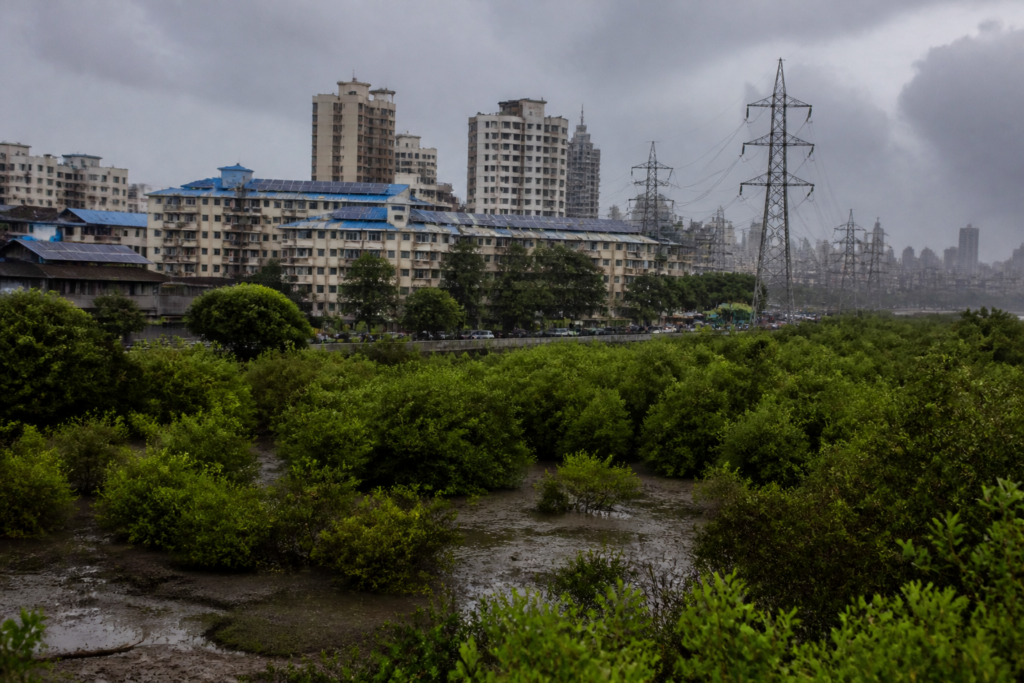
Mangrove restoration is one example cited by the researchers. Mangroves can protect against storm surges while also increasing carbon sequestration. The measure sits across several administrative responsibilities: coastal protection, ecological restoration, land management and climate planning. Its inclusion in the study illustrates why urban resilience cannot be reduced to concrete barriers or emergency response alone. Natural systems can form part of the infrastructure that protects settlements, provided their role is recognised in planning and supported over time.
The authors also identify dietary change as a measure that could reduce the risk of climate-related food-system instability while increasing soil carbon and reducing pressure on biodiversity. Distributed solar is cited as another measure that can combine climate and energy-security benefits. These proposals connect household behaviour, land use and infrastructure investment to the same planetary trends measured in the study.
The data also points to a difficult relationship between scale and speed. Solar and wind energy consumption grew by approximately 18 per cent, and low-carbon sources reached about 43 per cent of global electricity generation. Yet the researchers conclude that progress remains far below the scale and speed needed to stabilise the climate system. The urban question is therefore not whether change is occurring, but whether institutions can expand it quickly enough while protecting residents from risks already present.
This matters because urban systems are interdependent. Electricity supports water supply and cooling. Transport depends on reliable energy and weather-resistant infrastructure. Food prices are affected by conditions in distant production regions. Coastal settlements depend on both engineered protection and natural buffers. A failure in one system can increase pressure on another, particularly during extreme events. The study’s framework, which tracks climate indicators together with energy use, food production, economic growth and land-use change, reflects that interdependence.
The evidence does not establish how any particular Indian city will be affected, nor does it rank local risks. It also does not provide a city-by-city investment plan, implementation timetable or estimate of adaptation costs. Those limitations are important. Global indicators cannot by themselves determine the design of a drainage network, the location of a housing project or the reliability of a local power grid.
What they can do is define the direction in which urban decision-making must operate. The findings show record greenhouse gas concentrations, rising fossil fuel use, accelerating warming and growing risks to ecological systems. They also show that renewable energy is expanding and that measures such as mangrove restoration, plant-based diets and distributed solar can deliver more than one public benefit. The unresolved issue is whether these positive shifts can outpace the forces pushing the climate system into more dangerous territory.
For cities, the next stage of the climate debate is therefore less about recognising that change is occurring and more about aligning infrastructure, energy, land and governance decisions with the speed of that change. The study confirms that the planetary baseline is moving. How urban institutions respond will determine whether adaptation remains reactive or becomes part of the way cities are planned and operated.


