

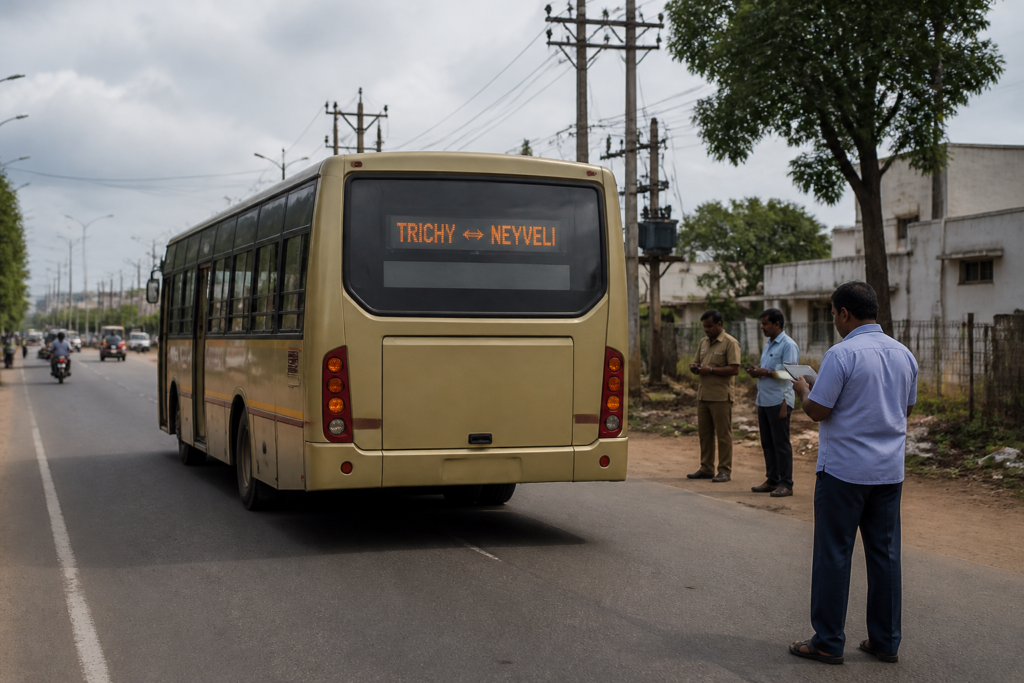
The suspension of five Tamil Nadu State Transport Corporation (TNSTC) employees after objectionable political slogans appeared on a government bus display is more than a disciplinary episode. It exposes a difficult operational question for public transport systems: when a passenger-facing digital device is allegedly tampered with, who is responsible for detecting the breach, securing the equipment and protecting the credibility of the service?
The incident involved Route 241 bus TN 32 N 5013, which was travelling from Trichy to Neyveli on October 13. Unauthorised text appeared on the rear digital route board. TNSTC’s Villupuram division subsequently suspended two drivers and three conductors for one week, while issuing a warning circular across the division directing employees to monitor the displays and prevent similar lapses.
The corporation’s account, as reported by the Times of India, presents two separate but connected findings. First, the crew members told officials that they had not uploaded the objectionable content. Second, a technical inspection found that the digital display’s motherboard was not securely locked, while its Wi-Fi mode had been deactivated. The device could accept text updates through software or USB pen drives.
That combination is central to understanding the incident. The reported evidence does not establish that the five employees inserted the slogans. Instead, it indicates a possible unauthorised intervention in a system that was capable of receiving content through more than one route. The corporation nevertheless held the crew accountable for failing to notice and prevent the breach, treating the lapse as negligence rather than as proof that they had authored the message.
This distinction matters because public transport technology is not limited to ticketing machines or control-room systems. A digital route board is visible to passengers, pedestrians and other road users. It communicates the identity and destination of a public service and, in this case, became the channel through which objectionable political content was displayed. The device therefore sits at the intersection of transport operations, public communication and basic equipment security.
### The accountability problem inside a moving service
The disciplinary action reveals how responsibility is being allocated within the transport corporation. According to the report, the officials’ inquiry found that the drivers and conductors had not uploaded the content. Yet management concluded that they should have noticed and prevented the unauthorised display. The workers were therefore held responsible for supervision and operational vigilance, even though the technical pathway through which the content entered the system remained the subject of suspicion.
This creates a layered accountability model. The crew is responsible for observing the equipment during the journey. The technical system and its access controls are a separate responsibility. The manufacturer or technician may be involved when the equipment is inspected or repaired. The corporation’s divisional management is responsible for setting procedures and ensuring that those procedures are followed. The incident shows what happens when these responsibilities overlap but are not clearly separated in practice.
The reported technical findings make the equipment itself significant. LED Geo technicians found that the motherboard inside the digital board unit was not securely locked. The report also says the display could be updated through software or USB pen drives, although Wi-Fi mode had been deactivated. These details suggest that disabling one access method did not eliminate all possible routes for changing the display. The source report does not establish how the text was inserted, who inserted it or whether the alleged passenger access was confirmed.
That uncertainty is not a minor detail. It is the difference between identifying a security failure and identifying an individual offender. TNSTC officials suspected that a passenger may have accessed and tampered with the display unit, but the supplied report does not state that a passenger was identified or that the suspicion was independently confirmed. The corporation’s action has therefore focused on the visible operational failure: the crew did not detect or prevent the display breach.
### A public information system with weak boundaries
Digital route boards are designed to make public transport easier to use. They help identify vehicles and communicate route information while buses operate across cities and between urban centres. Their usefulness depends on the accuracy and integrity of what they display. Once the system accepts unauthorised content, the board can no longer be treated simply as a passive sign. It becomes an operational information system requiring access controls, physical protection and monitoring.
The Cuddalore incident, as reported, points to a weakness in the boundary between the passenger area and the equipment that controls the public message. A motherboard that is not securely locked raises a physical-access concern. The ability to update content through software or a USB pen drive raises a process concern. The fact that the crew was expected to notice the problem raises a supervision concern. Each issue may belong to a different part of the organisation, but passengers experience them as one failure.
The response described by TNSTC combines individual discipline with a division-wide warning. The five crew members—drivers A P Chithirai Selvan and P Paranthaman, and conductors Senthilamarai Kannan, R Venkatesan and E Manikandan—were placed on temporary suspension for one week. Managing director of the Villupuram division S Sreedharan also issued a circular instructing employees to ensure strict monitoring and prevent similar technical tampering or lapses.
The circular is important because it moves the response beyond the single bus. It indicates that the corporation views the event as a risk that may recur across the division, rather than as an isolated act limited to Route 241. However, the supplied report does not specify whether the circular introduced new inspection procedures, changed access permissions, required equipment redesign or established a formal incident-reporting system.
### What the incident does—and does not—show
The confirmed account supports three conclusions. An unauthorised message appeared on a TNSTC bus display. A technical inspection found that the display unit’s motherboard was not securely locked and that the system could receive updates through software or USB drives. The corporation held the crew accountable for failing to identify or prevent the breach and suspended five employees.
The account does not establish several other points. It does not identify the person who placed the content on the display. It does not show that the crew members uploaded the message. It does not explain whether the bus was inspected before the journey, whether the display had previously shown signs of tampering or whether access to the USB and software update functions was logged. It also does not say whether similar vulnerabilities were found on other buses.
These limits matter for public-sector accountability. Disciplinary action can address an immediate lapse, but it does not by itself reveal whether the system that allowed the lapse has been repaired. If the physical lock, software controls and update procedures remain unchanged, the warning to staff may not resolve the underlying vulnerability. Conversely, if new controls are introduced, the report does not yet provide details of them.
The incident also demonstrates why assigning responsibility only after a failure can be complicated. Drivers and conductors are the people closest to the equipment during service, but they may not be trained or authorised to inspect the internal hardware of a digital display. They can observe what appears on the board, but the technical reason for an unexpected message may not be visible to them. The corporation’s decision indicates that it nevertheless expects operational staff to act as the first line of defence.
### The larger urban governance question
Public transport agencies increasingly rely on devices that combine physical hardware, software and communications functions. In this case, a route board mounted on a bus could be updated through software or a USB pen drive, and its internal components required inspection by manufacturer technicians. That means the daily operation of a bus depends partly on systems that sit outside traditional driving and conducting duties.
The governance challenge is to make that dependency manageable. A transport corporation needs to know who can change passenger-facing content, how those changes are authorised, whether the system records them and what staff should do when the display behaves unexpectedly. It also needs a clear division between technical maintenance and frontline supervision. The reported incident shows the consequences when the public sees the failure first, while the organisation reconstructs responsibility afterwards.
For passengers, the immediate concern is the reliability and dignity of public service communication. A route display that carries unauthorised slogans can confuse passengers, undermine confidence in the operator and turn public infrastructure into a vehicle for content unrelated to the service. The report does not indicate that the bus route was disrupted or that passengers faced a safety incident, but it does show that a basic information channel was compromised.
The next steps announced in the report are the temporary suspension of the five crew members, the divisional warning circular and continued attention to preventing technical tampering or staff lapses. What remains to be established is whether TNSTC will document the access pathway, secure the display hardware, review update permissions and determine whether other vehicles have the same exposure. Those details will decide whether the response remains a disciplinary action or becomes a broader improvement in public transport technology governance.


