

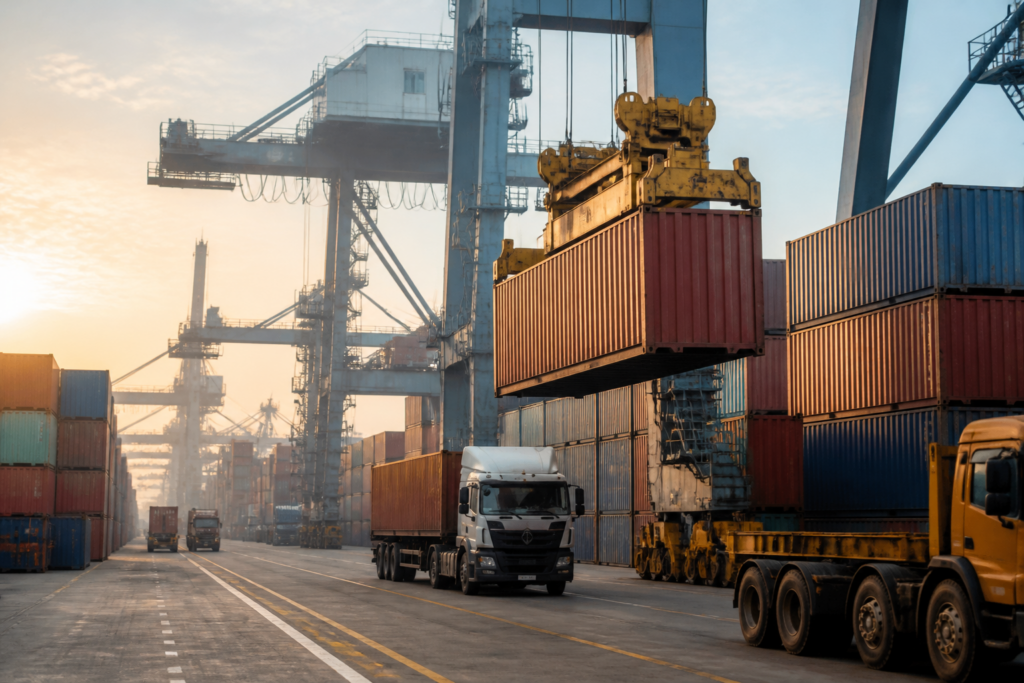
India’s merchandise exports rose 23.04% year-on-year to $44.40 billion in September 2026, while the merchandise trade deficit narrowed from a year earlier, according to data released by the Ministry of Commerce and Industry on Thursday. The increase was supported by higher shipments of electronics, petroleum products, engineering goods, chemicals and agricultural products.
Merchandise imports increased to $74.61 billion in September from $69.08 billion a year earlier. As a result, the merchandise trade deficit stood at $30.21 billion, lower than the $33 billion recorded in September last year. The September deficit was, however, higher than the $26.86 billion reported in August, when merchandise exports stood at $43.81 billion and imports at $70.67 billion.
Overall exports, including merchandise and services, rose 10.99% to an estimated $80.75 billion in September from $72.76 billion a year earlier. Overall imports increased to $94.05 billion from $86.93 billion, while the combined trade deficit narrowed to $13.30 billion from $14.17 billion.
Commerce Secretary Rajesh Agrawal said merchandise shipments were driving the growth. “If you look at merchandise exports in September, they are at $44.40 billion, which is 23.04 per cent higher than last September,” he said during a press briefing, according to ANI.
The ministry said export growth accelerated in the second quarter of the current financial year. Overall exports grew 15.84% in July-September, compared with 11.84% in the first quarter. The ministry’s presentation showed overall exports at an estimated $242.6 billion in the second quarter, compared with $233.6 billion in April-June. The July-September figure was the highest recorded for a second quarter, according to the presentation.
The latest figures also reflect the pressures affecting India’s import bill. Global energy prices remain a factor, with Brent crude futures above $100 a barrel amid conflict-related disruption and attacks around the Strait of Hormuz, the report said. Higher energy costs can affect transport, manufacturing and household prices because petroleum remains a significant component of India’s import requirements.
The United States remained India’s largest merchandise export destination during the first half of the financial year, despite tariff-related disruptions. India’s merchandise exports to the US rose 11.1% to $50.81 billion during April-September 2026, from $45.73 billion a year earlier. Imports from the US increased 26% to $32.33 billion from $25.66 billion, narrowing India’s merchandise trade surplus with the country to $18.48 billion from $20.07 billion.
India is also seeking to diversify export markets through trade agreements. A trade deal with New Zealand is scheduled to take effect next week, while the trade pact with Britain is already in force. A broader agreement with the European Union is moving towards implementation, according to the report.
Agrawal said negotiations for a proposed India-US trade agreement were progressing and that both sides were working towards concluding it at the earliest. He said the agreement would depend on finalisation of the broader US tariff framework, with parallel work underway under Section 301. The next milestones are the implementation of the New Zealand agreement and further movement on the India-US and India-European Union trade arrangements.


