

Rajasthan’s industrial growth is being driven by solar energy, textiles, education and the availability of workers outside the state’s largest cities, according to business leaders speaking at Aaj Tak’s Panchayat Aaj Tak Rajasthan programme. Their comments point to a shift in how the state is positioning itself: not only as a tourism destination or a location for established industrial clusters, but as a possible base for new manufacturing and technology-led activity.
The claims made at the programme are significant for the state’s urban system because industrial expansion does not happen in isolation from cities. It depends on land, electricity, roads, skills, housing, local services and the speed at which government agencies resolve operational problems. The discussion therefore raised a question wider than whether Rajasthan can attract more factories: can its cities and smaller industrial centres provide the infrastructure and administrative capacity needed to support that growth?
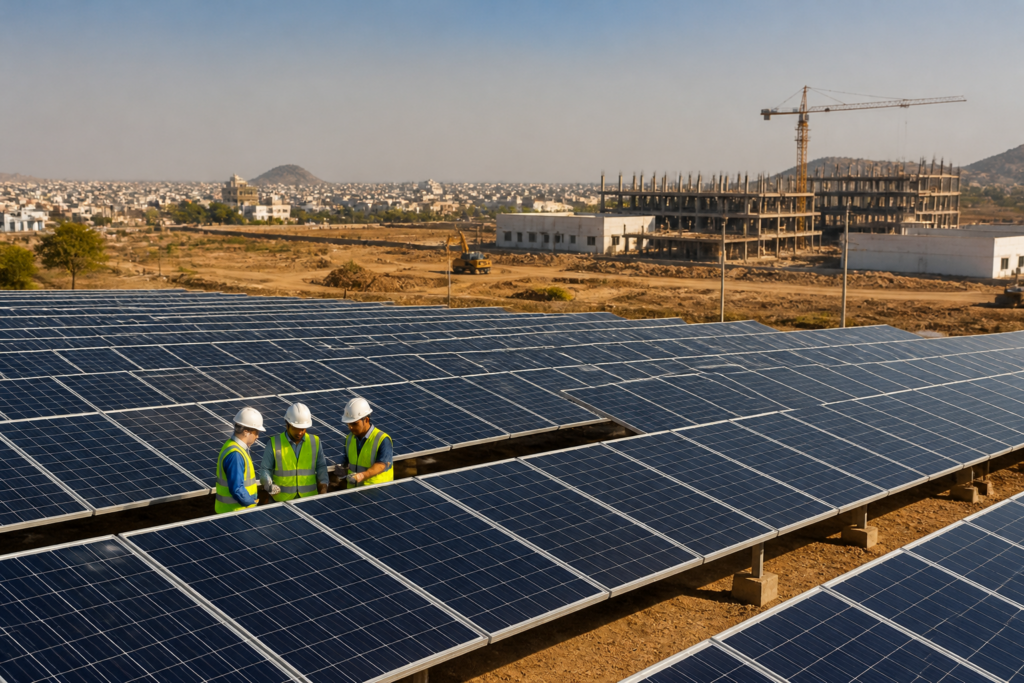
Ravi Verma, senior executive vice-president at Avaada Group, said the company had already installed 2,000 megawatts in Rajasthan and that work on another 2,000 megawatts was progressing. He said the company’s workforce was entirely young and that solar projects, many of which are located in rural areas, offered substantial employment opportunities. According to Verma, local residents were being employed in these projects.
The solar industry is especially relevant to Rajasthan’s spatial development because large projects are not necessarily concentrated in major urban centres. Their economic effects can extend into rural and semi-urban areas through construction activity, operations, maintenance and local employment. However, the statements supplied for this report do not establish the number of jobs created, the duration of those jobs, the local share of procurement or the infrastructure demands generated by the projects. Those details will determine how far industrial investment translates into broad-based regional development.
Verma also linked Rajasthan’s prospects to improvements in education and policy. He said policies were becoming more favourable and that the state could emerge as a better option for industry in the coming years. The comments reflect a common investment proposition: that industrial location is shaped not only by subsidies or land, but also by the availability of workers and the quality of the surrounding business environment.
Puneet Talesara, founder and chief executive officer of ONEPWS Private Limited, argued that companies could no longer attribute business difficulties simply to a lack of facilities. He said the government could support businesses through subsidies and assistance, but could not run them. He also said that digital work had reduced the importance of location for some businesses and placed greater responsibility on companies to create an effective working environment.
That argument has implications for Rajasthan’s urban hierarchy. Digital connectivity can allow some firms and workers to operate from locations outside the largest commercial centres, but it does not remove the need for physical infrastructure. Manufacturing requires reliable power, transport access, serviced land, worker housing and links to suppliers and markets. The supplied discussion does not provide data on these factors, but it makes clear that the business community sees the quality of local facilities and problem-solving capacity as central to industrial competitiveness.
Talesara described tourism and Bhilwara’s industrial base as two established strengths of Rajasthan, while identifying Kota as an education hub. He also pointed to solar-panel manufacturing and new technology as areas where the state could attract investment. These sectors have different urban requirements. Education-led growth depends on housing, public transport and social infrastructure for students and workers. Textile and garment manufacturing depends heavily on labour access, logistics and industrial estates. Renewable-energy projects require land, grid connections and transport links to sites that may be far from established cities.
The contrast between large urban markets and emerging industrial locations was highlighted by Mudeet Samdariya, director of Surya Jyoti Cotex. He said Ahmedabad and Surat were facing a shortage of workers, while Rajasthan had greater labour availability. His company, he said, could provide limited training to local residents in the areas where it established plants, allowing them to find employment closer to home.
This is one of the more consequential claims in the discussion because it connects industrial investment with the geography of employment. If factories can recruit and train people locally, workers may not need to migrate to distant cities for jobs. That could reduce pressure on household relocation and create new economic activity in smaller towns. But the evidence supplied does not show whether local training programmes are operating at scale, what wages are being offered, or whether workers have access to transport, rental housing and other services near the plants.
Samdariya said the textile sector was gradually expanding across several districts and that the Rajasthan government was providing incentives. He also argued that cooperation between the government and private industry could make the sector’s goals easier to achieve. The statement places implementation, rather than policy announcements alone, at the centre of Rajasthan’s industrial challenge. Incentives may influence where companies invest, but the eventual performance of industrial locations will also depend on how quickly approvals, utilities and local infrastructure are delivered.
Gaurav Kumar, founder and chief executive officer of LeadRx Technologies, said many people who had left Rajasthan had done so decades ago and that factories were now being established within the state. He said Rajasthan was offering better facilities than several other states and argued that it should no longer be described as a “BIMARU” state. He also acknowledged that population size affected industrial growth and referred to Rajasthan’s population as approximately 8.5 crore.
The population reference is important because industrial growth must be assessed against the scale of the labour market and the demand for urban services. A large population can provide a substantial workforce and consumer base, but it also increases the need for reliable public infrastructure. The programme did not provide comparative data on employment, industrial output, migration, urbanisation or service delivery, so the broader claim about Rajasthan’s relative position cannot be independently measured from the supplied material alone.
The speakers’ emphasis on Jaipur and Alwar also points to the importance of a multi-city development strategy. Participants argued that cities such as Alwar should be developed on the lines of Jaipur, while warning that policy formulation alone would not be enough. They said the speed at which problems are resolved would influence how industry views a location.
This is an institutional issue as much as an economic one. Industrial investors interact with multiple agencies responsible for land, power, roads, water, pollution control, labour and local permissions. Delays in any one of these systems can increase project costs or weaken the advantage created by incentives. The discussion did not identify specific delays, agencies or approval timelines, but it clearly identified administrative responsiveness as a factor that business leaders consider when evaluating locations.
The emerging picture is therefore mixed. Rajasthan has assets that industry leaders consider attractive: solar potential, local labour availability, a developing education ecosystem, existing textile activity and policy incentives. The state also has a network of cities and districts that could absorb new industrial activity beyond Jaipur. Yet the success of this model will depend on whether investment is matched by the physical and administrative systems required to support it.
The central urban question is not simply whether Rajasthan can attract factories. It is whether industrial expansion can produce stronger regional economies without creating poorly serviced settlements around new plants, or shifting the burden of growth onto cities that lack adequate housing, transport and civic capacity. The programme’s participants identified local employment and faster problem resolution as priorities, but the supplied report does not establish how these outcomes will be measured.
For now, the discussion confirms that Rajasthan’s industrial proposition is broadening beyond tourism and established clusters. Solar energy, garments, education and technology are being presented by industry representatives as linked opportunities. The developments to monitor are the scale of new investment, the number and quality of local jobs, the delivery of industrial infrastructure, the performance of incentives and the ability of cities such as Alwar and other district centres to manage growth. Those indicators will show whether the state’s industrial momentum becomes a durable urban and regional transformation.


