

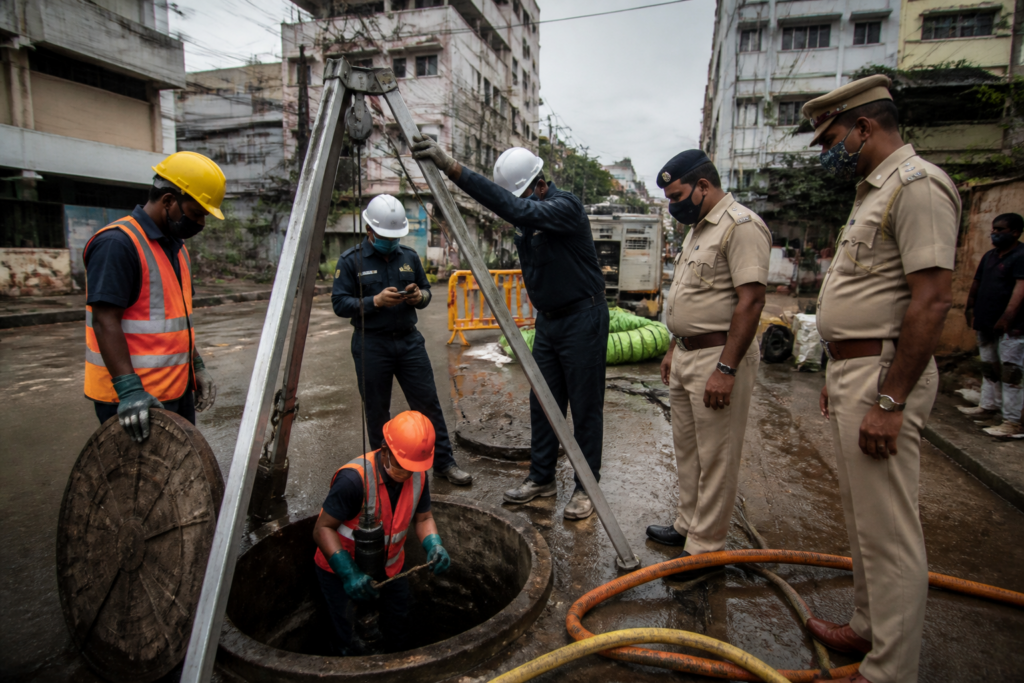
Six sanitary workers have died in suspected toxic-gas incidents in Tamil Nadu over the past 10 days, prompting the Tamil Nadu Untouchability Eradication Front (TNUEF) to demand specialised sanitation engineering departments in higher education institutions.
The latest incidents occurred in Chennai on October 12, when three workers died and another was hospitalised in two separate accidents. The incidents involved workers repairing a stormwater drainage pump in Kodungaiyur and cleaning a sewage tank in Pallikaranai.
Asmath Basha, 38, from Periya Hasthinapuram in Arcot, Ranipet, and Naveenkumar, 34, from West Tambaram, died after inhaling toxic gas while repairing a faulty electric motor in a 20-foot-deep well constructed for a stormwater drain pump in Kodungaiyur, under the Perambur constituency. Sewage that had entered the rainwater collection structure from nearby drains is suspected to have generated the gas.
In Pallikaranai, Kesavan, 29, from Nelli village in Chengalpattu district, died after inhaling toxic gas while cleaning a sewage tank at a house on Veerasamy Street. Rajesh, 49, a resident of the same locality who was working with him, was hospitalised at a private facility.
The deaths followed another incident on October 2 in Gandhi Nagar, Senthurai, where three workers died while constructing a septic tank. The deceased were identified as Ramachandran from Senthurai in Ariyalur district, and Bhaskar and Dinakaran from Tiruvarur.
The incidents highlight the continuing exposure of sanitation workers to confined spaces, sewage-related gases and hazardous maintenance work. The latest report does not specify whether safety equipment, gas detection devices, ventilation systems or formal confined-space procedures were available at the locations.
TNUEF state president T Chellakannu and general secretary P Sugandhi said specialised training and modern technological interventions were necessary to prevent workers from being exposed to toxic gases and unsafe working conditions. The organisation has urged the state government to establish sanitation engineering departments in higher education institutions to build technical capacity around sanitation work.
The organisation also demanded compensation of Rs 30 lakh for each family of the four workers who died in the Pallikaranai and Ariyalur incidents. It sought government employment for one member of each affected family, citing a Supreme Court ruling. The report said a case under the appropriate legal provisions was registered only after TNUEF and Communist Party of India (Marxist) leaders protested.
The deaths have placed attention on how sanitation and drainage work is organised across homes, local infrastructure and public facilities. While the incidents occurred at different locations, the reported circumstances involved wells, sewage tanks and septic-tank construction—spaces where toxic gases can accumulate and where workers may require specialised training and equipment.
TNUEF’s demand now places the focus on the state government’s response, including whether sanitation engineering education, technical training and modern intervention systems will be introduced through higher education institutions. The organisation’s compensation and employment demands also remain pending, according to the report.


