

The dispute over Ulsoor Lake restoration is no longer only about whether the lake should be desilted. It is about how a major urban waterbody project defines scientific excavation, proves that work is complete and demonstrates that spending on ecological infrastructure is not being displaced by public-facing amenities.
The Bangalore East City Corporation (BECC), in a clarification filed with the Karnataka Lokayukta, has defended the ongoing rejuvenation project after a complaint by R Rajagopalan, convenor of Bengaluru Coalition, questioned the adequacy of desilting and the project’s disclosures. BECC said excavation depths were based on a geotechnical investigation conducted by the Department of Civil Engineering at the University Visvesvaraya College of Engineering (UVCE), Bangalore University.
Rajagopalan’s complaint had questioned why desilting was limited to 0.6 metres in parts of the lake despite the long gap since the work was last undertaken. It argued that long-term silt accumulation should be calculated and that a Detailed Project Report for complete removal was needed if Ulsoor Lake was to regain its original water-holding capacity and function more effectively as a flood-mitigation and groundwater-recharge zone.
BECC’s response presents a different technical interpretation. According to the corporation, UVCE examined four representative locations using boreholes, soil sampling, Standard Penetration Tests and laboratory analysis. The purpose was to determine the nature and thickness of accumulated silt and identify the original lake-bed strata.
The central finding, as described by BECC, was that sediment had not accumulated uniformly. The wetland and sedimentation pond areas contained deeper deposits, while the main tank had comparatively shallower accumulation. On that basis, the corporation said a single excavation depth across the entire lake would not be technically appropriate.
BECC stated that UVCE recommended a practical desilting depth of approximately 1.50 metres under dry conditions for the wetland and sedimentation pond areas. For the main tank, the recommended depth was approximately 0.60 to 0.80 metres under dry conditions. The final excavation depth, it said, would be determined on site according to the thickness and characteristics of the deposited sediment and the point at which the original lake bed is encountered.
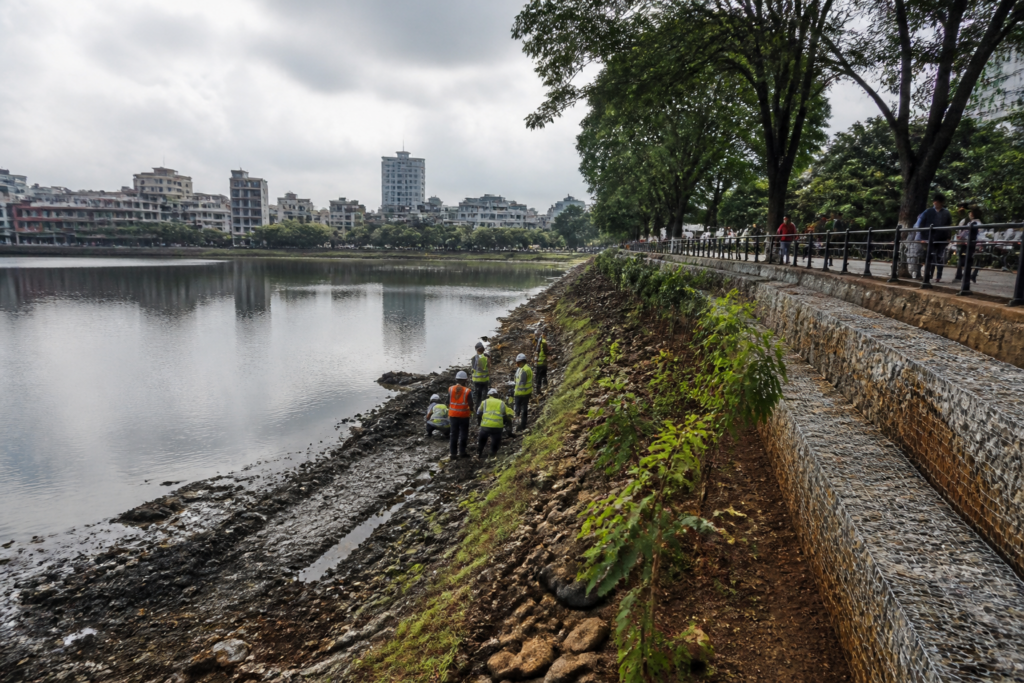
This distinction matters because desilting is not simply a question of removing as much material as possible. BECC cautioned that excavation below the natural lake-bed strata could affect the stability and natural characteristics of the lake bed. Its stated objective is to remove accumulated sediment, restore storage capacity and improve hydraulic performance without unnecessary excavation.
The disagreement therefore turns partly on what counts as adequate evidence. The corporation has referred to a scientific investigation and a site-specific method. The complainant has alleged that BECC has made broad claims without providing sufficient supporting evidence. The supplied report does not establish whether the complete geotechnical study, borehole records, laboratory results, excavation measurements or a public progress register have been disclosed in full.
That disclosure question is important for urban waterbody projects because the physical result is difficult for citizens to assess from the lake edge. A visitor may see a cleared surface, strengthened bund or landscaped walkway, but cannot easily determine whether the intended sediment volume was removed, whether the original lake bed was reached or whether inlet and outlet constraints remain unresolved. Technical documentation is therefore central to public accountability, not an administrative afterthought.
The scale of the Ulsoor project adds to the significance of the dispute. BECC has taken up the rejuvenation at a total cost of Rs 107 crore. According to its clarification, the project combines scientific desilting of the main lake, wetland and sedimentation pond with trash barriers, submersible aerators, real-time water-quality monitoring, bund strengthening, slope stabilisation, inlet regulation and improvements to the stormwater-drain system.
These components indicate that the project is being presented as a waterbody and urban drainage intervention rather than only a beautification exercise. The lake’s performance depends on how water enters, is stored, circulates and leaves the system. Desilting can increase effective storage where sediment has reduced capacity, but it cannot by itself resolve poorly functioning inlets, blocked outlets or weaknesses in the surrounding stormwater network.
Rajagopalan has alleged that problems with the inlets and outlets persist and that pre-monsoon desilting was delayed, allowing the monsoon to mask incomplete work. These remain allegations in the supplied report. BECC’s clarification, as reported, does not resolve them with independently published measurements or a detailed account of the current status of every inlet and outlet.
The project also illustrates the institutional complexity of lake restoration in Bengaluru. BECC said the rejuvenation was taken up in phases and technically examined and approved by the Karnataka Tank Conservation and Development Authority (KTCDA). The KTCDA Technical Committee reportedly reviewed the Detailed Project Report and ordered the removal of components considered incompatible with conservation and buffer-zone rules, including a circular staircase and a basketball court.
That review suggests that the project’s scope was not fixed entirely as a public-amenity scheme. At the same time, BECC said the plan includes rebuilding the Kalyani, a pedestrian bridge, landscaping, seating, observation decks, play areas, outdoor fitness facilities, a boating jetty, lighting and improved walkways. The corporation has justified these facilities by stating that Ulsoor Lake attracts more than 1,000 visitors daily.
The policy challenge is to distinguish facilities that support public access and safety from works that consume project funds without improving the lake’s ecological or hydraulic performance. BECC has rejected the allegation that the spending is skewed towards ornamental or vanity works. Its position is that the project combines restoration, hydraulic improvements, ecological protection, structural safety and essential public facilities.
The available material does not provide a component-wise cost breakdown, making it difficult to independently assess that claim. It also does not state how much sediment is expected to be removed, how much has already been excavated, what storage-capacity increase is targeted or which performance indicators will be used after completion. Those gaps do not prove that the project is failing, but they explain why competing interpretations have emerged.
The protection of existing trees is another part of the corporation’s defence. BECC said all trees along the lake-bund slopes have been preserved. It also said gabion structures and reinforced cement concrete walls were installed to stabilise slopes, prevent erosion and reduce the risk of trees falling. Rajagopalan, however, alleged that the corporation had repeated the gabion-wall approach used at Sankey Lake without implementing nature-based solutions.
This disagreement reflects a wider tension in urban waterbody work. Structural interventions can address immediate slope stability and erosion risks, while ecological restoration may require attention to wetland functioning, natural edges, sediment movement and habitat conditions. The supplied report does not contain enough evidence to determine which approach is technically superior at Ulsoor or whether the project combines both approaches in a measurable way.
Real-time water-quality monitoring and submersible aerators are intended to address the lake’s ongoing environmental performance rather than only its appearance. But the presence of equipment is not the same as demonstrated improvement. A meaningful public assessment would require baseline and post-intervention readings, the parameters being monitored, the frequency of publication and the agency responsible for responding when water quality deteriorates. The report confirms BECC’s stated provision for monitoring but does not provide those operational details.
The same principle applies to flood mitigation and groundwater recharge. These functions depend on the lake’s storage, inflow and outflow systems, surrounding drainage conditions and the protection of areas that allow water to interact with the ground. Rajagopalan’s complaint linked complete desilting to those functions, while BECC has framed site-specific excavation and hydraulic improvements as the appropriate route. The evidence supplied does not establish the project’s eventual performance against either objective.
Ulsoor Lake’s case thus exposes a recurring problem in urban infrastructure: the public is often shown the project’s visible elements while the decisive measures remain buried in technical studies, contracts and site records. For restoration work, the most important outputs may be sediment quantities, storage capacity, inlet performance, water-quality trends and ecological conditions. Walkways and lighting are easier to photograph, but they cannot substitute for those outcomes.
The immediate institutional issue is not simply whether BECC or the complainant is correct. It is whether the project can make its technical basis and implementation progress independently understandable. The corporation’s explanation supplies a rationale for varying excavation depths and identifies the agencies involved in technical review. The complaint highlights the need for evidence on completed work, disclosures, inlet-outlet performance and restoration methods. Both sets of questions are relevant to public scrutiny.
The next stage of the Ulsoor project will therefore be judged by records as much as by visible construction. The key facts to monitor are the final excavation depths across the lake’s different zones, the sediment removed, the condition of the original lake-bed strata, the functioning of inlets and outlets, water-quality data and the relationship between ecological works and public amenities. The supplied report confirms the competing positions but does not yet establish those outcomes.


