

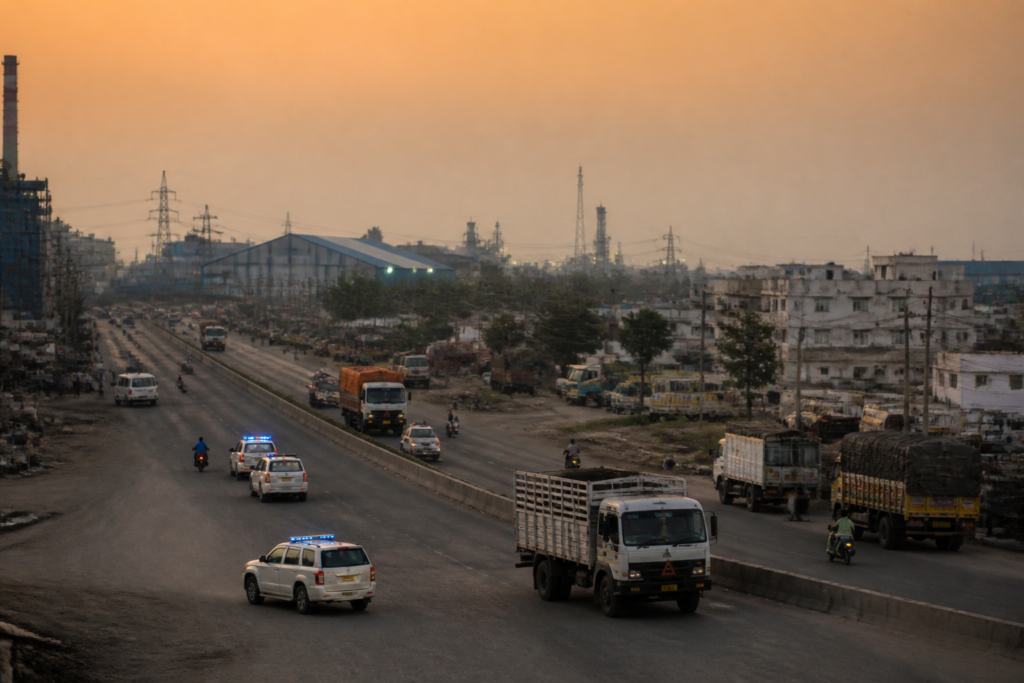
A report by The Times of India says Gujarat’s industrial towns and transport-linked settlements have become locations where suspects wanted in serious Punjab crimes were allegedly able to remain out of sight. Gujarat Police records cited in the report show that the Anti-Terrorist Squad arrested 25 accused linked to 11 Punjab cases across the state, including cases involving murder, political killings, arms and grenade supply, and alleged terror-related offences.
The report places the arrests across a wide geography rather than in Ahmedabad alone. The locations named include Kutch, Bharuch, Nadiad, Mehsana, Halol, Jamnagar, Ahmedabad, Deesa, Palanpur and Vapi. Several suspects were allegedly found working as industrial labourers, helpers or factory workers, while others were accused of providing shelter or logistical support to people wanted by police in Punjab.
The account points to a feature of Gujarat’s urban and industrial geography that can complicate policing: a network of manufacturing centres, highway-linked settlements, ports and temporary labour markets spread across the state. These places are economically connected but administratively dispersed. Workers can move between industrial clusters, factory jobs and labour settlements, while police investigations involving suspects from another state depend on the quality and speed of information-sharing between agencies.
A senior Gujarat police officer, quoted by The Times of India, said the state’s “industrial base, transport networks, ports, and highway establishments made it structurally useful as a place to vanish.” The officer also said people involved in crimes came to Gujarat looking for work, particularly in industrial areas, and that some found shelter through contacts from their native places. Police were investigating whether local people had assisted the suspects, with legal action possible if a nexus was established.
The report separately says that the Ahmedabad Crime Branch arrested Parminder Prasad, also known as Parminder Kaka, on September 8. He was described as an alleged shooter in the case involving social media influencer Mad Sandhu. The report says Sandhu was killed in Amritsar in October 2026 and that three suspects connected to the case were eventually traced in Gujarat. The chronology and date of this account require confirmation from official police records because the supplied material does not establish how these events fit together.
The arrests were reportedly carried out through coordinated information-sharing between Punjab Police and Gujarat agencies, followed by operations at multiple locations. This suggests that the policing challenge extended beyond locating individuals in major cities. Investigators also had to identify smaller industrial towns, labour settlements and local networks where suspects could work or obtain accommodation.
That distinction matters for urban administration. Industrial expansion often produces a patchwork of formal factories, contractor-managed workforces, rented rooms, informal housing and transport corridors. These areas may be connected to several police jurisdictions and may contain a large population of short-term or mobile workers. The supplied report does not establish whether any particular housing, labour-registration or municipal system failed, but it does show how the physical and economic structure of industrial towns can become relevant to inter-state investigations.
The report’s locations also indicate that the alleged pattern was not confined to a single urban centre. Ahmedabad appears alongside smaller cities and industrial locations such as Bharuch, Halol, Vapi and Mehsana. The spread makes the issue one of inter-city coordination rather than only a metropolitan policing matter. It also raises questions about how agencies share information when suspects move through places where employment, accommodation and transport are organised through informal or private networks.
The stated role of local contacts remains an allegation under investigation. The police officer quoted in the report said authorities were examining whether local people had helped wanted suspects. No finding of a local criminal network is established in the supplied material, and the report does not provide details of charges, court proceedings or convictions against the people arrested.
The case also illustrates the limits of reading industrial towns only through their economic output. Factories, logistics facilities, highways and ports support employment and regional connectivity, but they also create high-mobility environments in which people may arrive, change jobs and move between settlements. The supplied report does not provide data on worker registration, rental housing, contractor records or police resources, so it cannot establish whether those systems contributed to the alleged concealment.
For the agencies involved, the reported arrests underline the importance of cross-border intelligence and coordinated operations. Gujarat Police and Punjab Police were said to have exchanged information before searches and arrests were conducted at different locations. The account does not specify the formal mechanism used, the time taken to act on intelligence or whether the coordination will lead to a permanent institutional arrangement.
The most important unresolved issue is therefore not simply where the suspects were found, but how mobility across industrial settlements is monitored without treating migrant workers or informal residents as inherently suspicious. The supplied report identifies workers, helpers and factory employees among those allegedly arrested, but it does not distinguish between lawful migrant employment and alleged assistance to fugitives. That distinction would be necessary for any broader assessment of policing, labour administration or urban governance.
The report also leaves several factual questions open. It does not provide the names of all 25 accused, the dates of each arrest, the specific police stations involved, the charges filed in each case or the status of the cases in Punjab courts. It also does not establish whether the alleged suspects were living under false identities, whether employers or landlords were aware of their identities, or whether any local facilitators had been charged.
The supplied material should therefore be treated as a reported account requiring official verification rather than as a complete record of a state-wide criminal trend. Confirmation from Gujarat Police, Punjab Police, the Ahmedabad Crime Branch and relevant court documents is needed to establish the arrest figures, case links, dates and legal status. Until then, the evidence supports a narrower conclusion: authorities reportedly traced suspects wanted in Punjab cases across several Gujarat locations, including industrial towns and labour settlements, through coordinated policing operations.


