

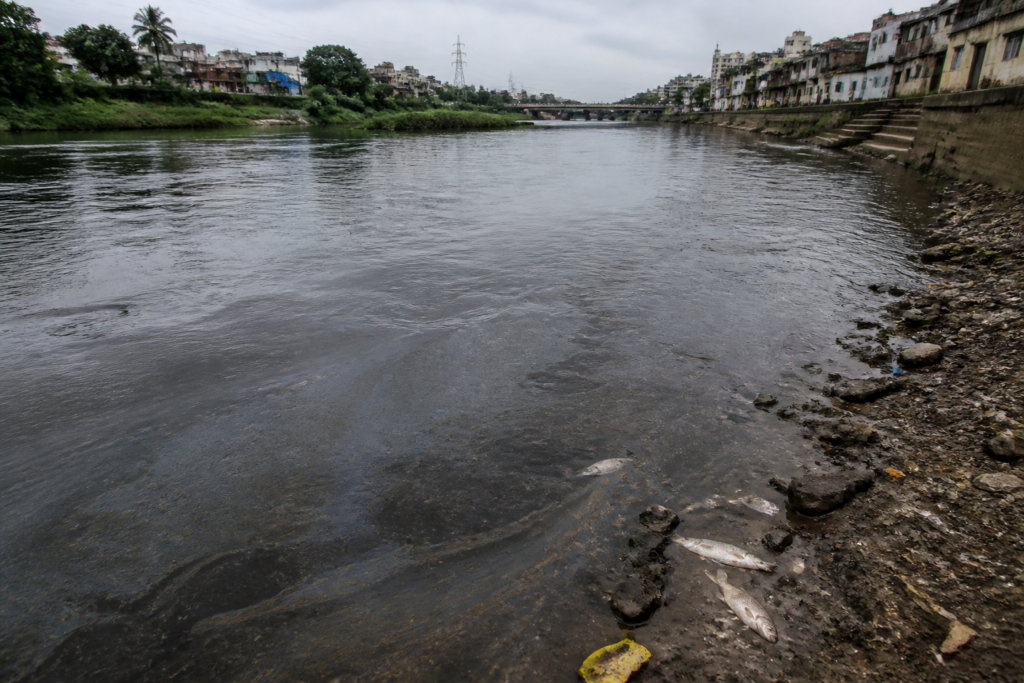
The latest fish deaths near Gopalpura in Alandi are more than an isolated pollution incident. They point to a wider administrative problem along the Indrayani River: responsibility for water quality is distributed across villages, the Pune Metropolitan Region Development Authority, Pimpri Chinchwad Municipal Corporation, pollution-control authorities and industrial units, while the river continues to receive the consequences of failures across that chain.
A large number of fish were found dead near Gopalpura on Wednesday, renewing concerns about pollution in a river that is important to devotees visiting the temples at Alandi and Dehu. Activists said similar incidents have occurred repeatedly in recent months, including one reported the previous month. Their account describes a river system in which pollution is not being experienced as a single event, but as a recurring condition.
The reported incident also places the focus on a familiar urban contradiction. The Indrayani flows through settlements and industrial areas that are part of a rapidly developing metropolitan region, but its protection depends on institutions whose administrative boundaries do not follow the river. The river originates in the Lonavala region, passes through several villages within PMRDA limits and then enters the PCMC area. Any response that stops at one municipal boundary is therefore unlikely to address the complete pollution pathway.
### What the Indrayani River pollution report establishes
The available account establishes three important facts. First, fish deaths were observed at Alandi. Second, residents and activists say the problem has recurred across stretches near Moshi, Dudulgaon, Alandi and Charholi. Third, a river rejuvenation project planned by PCMC has not yet moved to on-ground execution, even though work orders have reportedly been issued.
The account does not establish the precise cause of the fish deaths. Activist Nisar Sayyed said a thick, oily layer was visible on the river and alleged that chemicals may have been discharged by nearby industrial units. He linked such a layer to the possibility of reduced dissolved oxygen and fish deaths. These are allegations and observations from an activist, not a confirmed finding from a laboratory test or pollution-control authority. The distinction matters because identifying the pollutant is essential to determining legal responsibility and the appropriate remedial action.
A senior PCMC official told the Times of India that surveys are under way and that work will begin after they are completed. The official said work orders have already been issued. PCMC’s nuisance squads are also inspecting nearby industrial units and initiating action against those found violating norms. This indicates that the civic response currently has two tracks: preparing a longer-term sewage and river-rejuvenation intervention, and checking possible violations in the short term.
What remains unclear from the available information is equally important. There is no reported test result identifying a chemical pollutant, no publicly cited dissolved-oxygen reading, no stated count of dead fish and no confirmed attribution of the incident to a particular industrial unit. The report also does not specify the number, capacity or locations of the proposed sewage-treatment plants. These gaps prevent the latest incident from being treated as proof of one specific pollution source.
That uncertainty should not be confused with an absence of evidence of deterioration. Repeated reports of fish deaths, residents’ complaints across multiple stretches and the existence of a planned rejuvenation project together indicate a persistent water-management concern. They show that the river is already the subject of recurring public complaints and an official infrastructure response, even if the immediate cause of the latest deaths has not been publicly established.
### Why the institutional chain matters
The Indrayani’s route makes the governance challenge visible. A river does not stop when it crosses from one local authority into another, but enforcement, sewage management and industrial inspections are generally carried out through separate administrative systems. PMRDA limits, PCMC jurisdiction and the jurisdictions of other local bodies along the river can create a fragmented response unless agencies share monitoring data, coordinate inspections and act on pollution sources upstream as well as downstream.
PCMC’s proposed rejuvenation project appears to recognise that sewage treatment is part of the problem. The project includes the installation of several sewage-treatment plants, and work orders were reportedly issued earlier this year. However, the project has been delayed, with surveys still under way and construction yet to begin on the ground. The gap between issuing work orders and starting physical work is therefore central to understanding why assurances have not yet translated into visible change for residents.
The project’s delay also illustrates the difference between an administrative milestone and an environmental outcome. A work order shows that a procurement or implementation process has advanced. It does not, by itself, mean that sewage is being intercepted, treated or prevented from entering the river. For residents observing the water and fish deaths, the meaningful test is whether pollution levels fall and whether the river’s ecological condition improves.
The same principle applies to inspections. PCMC’s nuisance squads are reported to be checking industrial units and taking action against violators. Such enforcement can be important, but inspections need to establish what was discharged, when it was discharged and whether the discharge entered the river. Without public information on findings, penalties, compliance and follow-up inspections, it is difficult to assess whether enforcement is preventing pollution or merely responding to complaints after damage has occurred.
### The missing data in the Indrayani River pollution response
The latest episode highlights the need for a more complete public record of river health. The supplied report mentions visible oily material and recurring fish deaths, but it does not provide water-quality measurements or an official cause. For a river passing through a dense and expanding urban region, a credible response would depend on regular monitoring at multiple points rather than testing only after a visible incident.
The monitoring points would need to reflect the river’s movement through different land uses. Sampling upstream, near industrial stretches, around settlements and downstream of suspected discharge points would help distinguish between sewage contamination, industrial discharge and other causes. The available report does not say whether such a coordinated monitoring system is in place. It also does not identify which institution is responsible for publishing a consolidated account of the river’s condition.
The absence of these details leaves residents dependent on visual evidence and episodic complaints. Dead fish and an oily layer can alert authorities to a serious problem, but they cannot by themselves identify the pollutant or determine its concentration. Nor can a single inspection establish whether pollution is occasional, continuous or caused by multiple sources. Those questions require time-bound testing and transparent reporting.
There is also a basic capacity question. PCMC plans several sewage-treatment plants, but the report does not provide their treatment capacity, catchment areas, commissioning schedule or connection plan. Without those details, the public cannot assess whether the proposed infrastructure will address the volume of sewage entering the system or whether untreated flows will continue through gaps in the network.
This is where the river’s urban context becomes significant. The Indrayani passes through places including Moshi, Dudulgaon, Alandi and Charholi, where settlement, industrial activity and religious use coexist along the same corridor. The reported spread of complaints across these locations suggests that the problem should not be framed only as an Alandi incident. At the same time, the available evidence does not establish that every stretch has the same source or severity of pollution. A corridor-wide response must therefore combine local investigations with basin-level coordination.
### From repeated assurances to measurable implementation
Temple authorities in Alandi and Dehu, along with local activists, have repeatedly raised the pollution issue during interactions with the chief minister, according to the report. Residents say assurances have been made about long-term measures, but that conditions on the ground remain unchanged. This creates a credibility problem for public agencies: announcements and commitments are visible, while implementation is either delayed or difficult for residents to verify.
The proposed rejuvenation project is now the clearest official milestone. PCMC says surveys are under way and that work will start after their completion. The next meaningful development is therefore not another assurance but evidence that surveys have concluded, work has begun and the treatment infrastructure is connected to the sewage flows it is intended to manage.
Industrial inspections are the other immediate test. If violations are found, the public interest lies in knowing what action was taken and whether compliance was sustained. If no violations are found, that result would not by itself resolve the wider concern, because sewage and other sources may still be contributing to the river’s condition. The response must be capable of testing competing explanations rather than assuming one source before evidence is available.
The central lesson from the latest fish deaths is that river rejuvenation cannot be measured by project approval alone. It must be measured through completed infrastructure, functioning treatment systems, pollution-source enforcement and publicly available water-quality information. The report confirms that PCMC has issued work orders and begun surveys, while the cause of the latest fish deaths remains unconfirmed. The developments to watch are the completion of those surveys, the start of on-ground work, the findings of industrial inspections and the release of evidence that shows whether the Indrayani is actually becoming cleaner.


