

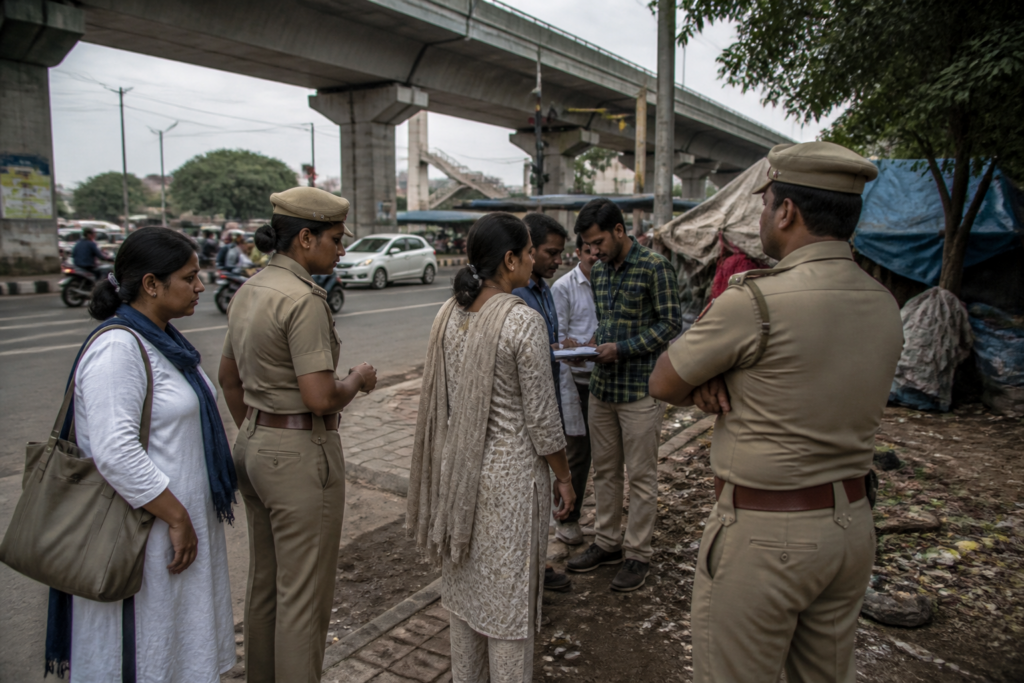
Bengaluru police have arrested four people and rescued 13 children who were allegedly forced to beg at traffic signals across the city, bringing renewed attention to how vulnerable minors are brought into urban public spaces and placed under adult control. The children, comprising nine boys and four girls, have been handed over to the Child Welfare Committee (CWC) for further action.
The rescue operation was carried out by the Central Crime Branch’s Women Protection Wing and the Social Welfare Department after the CWC received information about the children. A joint team raided makeshift huts erected on a footpath beneath a flyover near Kogilu Cross, within the limits of Yelahanka police station.
Police identified those taken into custody as Karthik, 45, who currently resides in Bengaluru, his son, and two other men, Mukesh and Subhash, both from Maharashtra. According to the police, the children were allegedly deployed to beg at different traffic intersections across the city.
The arrests have not yet established how the children came into the group’s custody or whether the adults had any biological relationship with them. Police said the adults claimed that the children belonged to them and that five women found at the site were their wives. These claims remain unverified.
A senior police officer said a case had been registered at Yelahanka police station and that the children had been produced before the CWC. “The committee is yet to submit its report. The claims made by the adults regarding their relationship with the children need to be verified through address checks and other procedures, including DNA testing,” the officer said.
The police investigation is examining how the minors were brought to Bengaluru, how long the adults had been living in the city and whether the children were connected to a wider exploitation network. The presence of roughly three to four children with each of the men is among the circumstances being examined by investigators.
The CWC is expected to assess the children’s living conditions and the circumstances in which they were found. It will also attempt to trace their biological parents and determine the appropriate care and protection measures for the minors.
The case highlights the administrative challenge of responding to children who are visible at traffic signals but whose movement, guardianship and living arrangements may be difficult to establish. In this instance, action followed a tip-off to the CWC and required coordination between the child-welfare body, police and the Social Welfare Department.
The immediate next steps are the CWC’s report, verification of the adults’ claims through address checks and possible DNA testing, and further investigation into the suspected child exploitation network. Police have not yet disclosed whether additional arrests will follow.


