

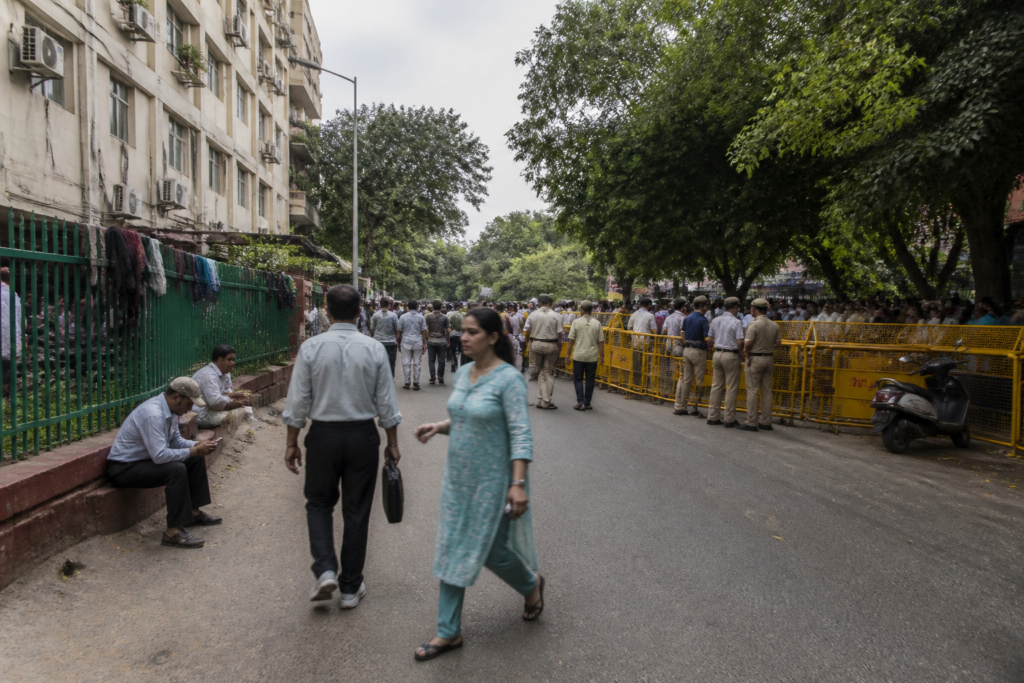
The reported de-notification of Jantar Mantar as a designated protest site has given nearby residents hope that noise, crowds and security restrictions will ease, but it has also exposed a difficult question for Delhi: how should the city protect the right to protest without making an established residential neighbourhood function as a permanent zone of disruption?
The Times of India reported that residents living near Jantar Mantar are waiting to see how the change affects daily life. Their accounts describe a neighbourhood where ordinary activities—going to work, buying groceries, accessing shops or crossing nearby roads—could become difficult when demonstrations brought loudspeakers, protest slogans, crowds and security personnel into the area.
The central urban issue is not simply whether residents prefer quieter mornings. It is how a city allocates public space when several legitimate uses compete for the same streets. Jantar Mantar has been used as a visible location for people to gather and raise public demands. At the same time, the surrounding area contains homes, lanes, shops and routes used by people who are not participating in a demonstration. When these functions overlap without adequate separation, the costs are experienced at street level.
David, a resident quoted in the report, said security forces and restrictions made routine tasks difficult. He described getting rations, stepping out for work and crossing the area as activities that could require navigating around barricades and security arrangements. His account presents access not as an occasional inconvenience but as a recurring problem in the operation of the neighbourhood.
That distinction matters in urban governance. A road or public square may be legally available for assembly, but its practical use is shaped by police deployment, barricading, traffic controls, crowd movement and the availability of alternative routes. For residents, the result can be a reduction in the usable area around their homes even when their own buildings remain physically accessible.
Sushil Yadav, who told the newspaper he has lived in the area for nearly 50 years, described disruption extending into residential lanes. Recalling events in July, he said people had come close to the lanes, with some asking residents for water and access to toilets. He said restrictions sometimes made residents feel as though they were locked inside their own homes.
Yadav’s account also clarifies that the issue is not necessarily opposition to protest itself. He said people should be able to make their voices heard, but argued that a designated location where demonstrations could occur without overturning residents’ daily lives would work better. That is a demand for spatial separation rather than the removal of public dissent from the city.
This is the core planning challenge revealed by the change at Jantar Mantar. A protest site is not only a symbolic location. It is also an operational system. Its performance depends on how people arrive, where they stand, how sound is managed, how emergency and residential access are preserved, where sanitation is provided and how security measures affect surrounding streets. The report supplies evidence about the consequences when those systems become difficult for residents to navigate, but it does not establish what replacement arrangements, if any, will now be used.
The absence of those details is important. The report does not identify the authority that issued the de-notification, provide the formal notification, specify when the change takes effect or explain whether another designated protest venue has been identified. It also does not state what restrictions will apply to demonstrations at Jantar Mantar in the future. These unanswered administrative questions will determine whether residents experience a durable change or only a temporary reduction in activity.
The distinction between a site being de-notified and protests disappearing altogether is also significant. The supplied report says residents hope the change will reduce disruption, but it does not say that public demonstrations have been prohibited across Delhi or that all activity at Jantar Mantar has ended. A change in designation may alter the way authorities manage assemblies, but the material provided here does not establish the new legal or operational framework.
For Mark, who has fixed office timings, the problem has been closely linked to mobility. He said crowds and noise made ordinary travel stressful, particularly because there was no nearby metro service. His comments show how the effect of a protest site can extend beyond the demonstration area itself. When a route is crowded, restricted or difficult to cross, the burden falls on workers, school-going children, older residents and anyone making short trips on foot or by road.
Akanksha described a similar problem in more domestic terms. Even a quick trip to buy snacks for her daughter could involve uncertainty about how to move through the area. She said travelling with her daughter could become chaotic when the child’s school was closed and that noise sometimes added to the difficulty. These accounts show how public-space decisions are experienced through small, repeated journeys rather than only through major traffic disruptions.
That ground-level experience is often missing from debates about protest management. Official discussions tend to focus on permissions, security, crowd control and public order. Residents encounter the same arrangements through blocked lanes, altered routes, noise, limited access and the need to plan errands around events. The difference between those two perspectives can make a policy appear orderly from an administrative viewpoint while remaining highly disruptive at neighbourhood level.
There is, however, another side to the spatial conflict. The report quotes unnamed people who said protests may cause occasional inconvenience but that the issues being raised are much larger than the disruption to daily life. Their response is a reminder that a protest site exists because public demands require visibility and collective presence. Moving or de-notifying such a site can change who is able to reach decision-makers and how easily an issue enters public view.
This creates a governance trade-off that cannot be resolved by measuring noise or congestion alone. A city must account for residents’ right to safe and usable access to their homes, while also recognising that public assembly is part of urban democratic life. The supplied material does not provide enough information to assess how authorities have weighed those competing rights in this case. It does show, however, that the existing arrangement generated clear costs for some residents.
The reported change therefore raises three linked institutional questions. First, which authority is responsible for deciding whether a location remains a designated protest site? Second, what operational standards govern access, sanitation, sound and security around demonstrations? Third, what alternative space is available if a prominent protest location is withdrawn? Without answers to these questions, the debate risks becoming a choice between residents’ convenience and protesters’ visibility, rather than a discussion about how public space can be managed more effectively.
The article also highlights the importance of monitoring outcomes after a policy change. Residents quoted by the Times of India have expressed hope, but David said the community would wait to see what happens next. That caution is justified because the impact of de-notification will depend on what follows: whether crowds reduce, whether restrictions are lifted, whether surrounding roads become easier to use and whether demonstrations shift elsewhere in ways that create new conflicts.
No formal implementation timeline, replacement venue, authority statement or enforcement arrangement is included in the supplied report. Those details remain necessary to understand the policy beyond its immediate announcement. For now, the evidence establishes a neighbourhood-level conflict over access, noise and security, alongside a continuing need for space where public grievances can be expressed.
Jantar Mantar’s reported de-notification has thus made the location a test of Delhi’s ability to manage public space as both civic infrastructure and lived neighbourhood. The next significant development will be whether the change produces measurable relief for residents while preserving a workable, clearly managed avenue for public assembly.


