

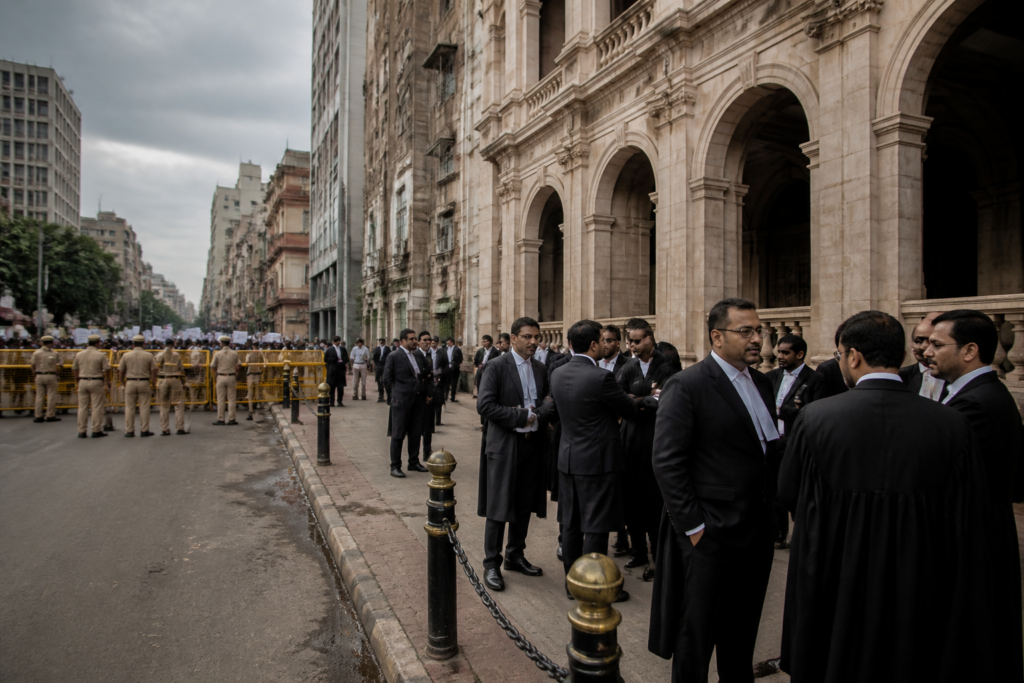
The Bombay Bar Association’s condemnation of alleged police excesses against protesters and lawyers points to a wider governance problem: how public authorities manage dissent when demonstrations involve citizens, members of the legal profession and disagreement with the state. Its resolution, issued after protests on October 10, 2026, does not establish the allegations independently, but it places police conduct, detention and the treatment of advocates at the centre of a constitutional debate.
The association said it was “deeply disturbed” by what it described as police excesses, physical assault, manhandling, brutality and detention of peaceful protesters in New Delhi. It also referred to the detention of lawyers in Mumbai and other cities. The resolution was signed by Bombay Bar Association President Nitin Thakker, Vice-President Venkatesh Dhond and Secretary Naushad Engineer.
The significance of the statement lies partly in the institution issuing it. The BBA is one of India’s oldest bar associations, and its resolution frames the episode not as an isolated confrontation between police and demonstrators but as a question concerning constitutional freedoms, professional independence and the rule of law. That framing matters because public protest is managed through institutions that exercise coercive power: the police, local administrations and other public authorities responsible for maintaining order.
The BBA’s central claim is that peaceful assembly, expression of dissent and protest are constitutional rights rather than permissions granted at the discretion of the state. It said the freedom to disagree with the government or any public authority is a constitutional guarantee that the state is duty-bound to respect and protect. The association also said police are required to uphold the Constitution and protect the life, liberty and dignity of every citizen.
These statements establish the principles the association says should guide public-order administration. They do not, by themselves, determine what happened during the October 10 protests or whether the conduct described met the legal threshold for excessive force or unlawful detention. The supplied account records the BBA’s position and its description of events; it does not include a police response, an official inquiry, court findings or an independent account from the protesters involved.
That distinction is important in assessing the episode. The BBA specifically referred to the treatment of senior advocates and singled out Senior Advocate Shadan Farasat, who it said was physically manhandled and hauled “like a parcel of goods”. The association called this particularly shocking and unacceptable. The description is an allegation and characterisation contained in the BBA resolution, not an independently established finding in the material available.
Yet even with that limitation, the resolution raises a structural issue for urban governance. Cities are the places where constitutional freedoms meet administrative systems in real time. Demonstrations take place on streets, outside public buildings and in other shared urban spaces. Police decisions about dispersal, detention and crowd control therefore affect not only protesters but also the wider functioning of public space, mobility and civic participation.
The resolution also draws attention to the special position of lawyers in disputes involving state power. The BBA said the dignity and independence of the legal profession must be respected and described the physical manhandling or detention of advocates as an affront to the constitutional values the Bar is committed to defend. Lawyers may participate in public demonstrations as citizens, but they also occupy an institutional role in defending legal rights and scrutinising the conduct of public authorities.
That does not place advocates beyond the law or establish that every detention is improper. It does, however, explain why the association treats the alleged treatment of lawyers as an institutional concern rather than only a personal grievance. If legal professionals are detained or physically handled during a protest, the episode can become a test of whether the same authorities whose actions may later face legal scrutiny are respecting the independence and dignity of those who may represent affected citizens.
The BBA’s argument is built around a contradiction. It said the rule of law cannot be preserved through methods that undermine the rule of law itself. In practical terms, the association is questioning whether public-order enforcement can claim legitimacy if it relies on conduct that disregards life, liberty and dignity. The resolution does not propose a specific administrative mechanism for resolving that contradiction, but it identifies the point at which enforcement becomes a constitutional governance issue.
The reference to both New Delhi and Mumbai also broadens the concern beyond one location. The BBA said protesters in New Delhi faced alleged excesses during the October 10 demonstrations and that lawyers were detained in Mumbai and other cities. The supplied report does not provide a city-by-city account, the number of detainees, the reasons recorded for detention or the duration of custody. It therefore cannot support a comparison of police practices across cities.
What it does show is the emergence of a common institutional response to conduct the association regards as unacceptable. Rather than focusing only on the identity of the protesters or the causes for which they demonstrated, the BBA said it would defend constitutional freedoms and civil liberties irrespective of who exercised them or what cause they represented. This universal framing is central to the association’s position: rights should not depend on whether public authorities agree with the political or social message of a demonstration.
For city administrations, that principle creates a demanding operational balance. Public authorities must manage safety and order, but the BBA’s resolution insists that such responsibilities cannot be separated from constitutional protections. The supplied material does not state what crowd-management instructions were issued, whether protesters were given directions before detention, what legal grounds were recorded or whether any use-of-force review was initiated. Those unanswered questions are essential to understanding how the events unfolded.
The absence of those details also limits what can be concluded from the resolution. A public statement by a respected bar association can establish that the association has formally condemned the conduct and has identified the constitutional principles it believes were violated. It cannot substitute for an investigation into individual incidents. The factual record would need to include official accounts, detention records, police statements, witness testimony, video evidence or judicial findings before responsibility could be assessed conclusively.
Still, institutional statements such as this one can influence how public authorities are held accountable. The BBA has placed its objection on record, identified the officials who signed the resolution and committed the association to continued defence of constitutional freedoms, civil liberties and the rule of law. That creates a public benchmark against which subsequent explanations or inquiries may be assessed.
The episode also demonstrates why protest governance cannot be reduced to crowd control. A demonstration is simultaneously a public-order event, an exercise of civic participation and a potential point of contact between citizens and state authority. When police action is alleged to involve assault or detention, the question is not only whether a protest disrupted traffic or public activity. It is also whether enforcement was proportionate, documented and compatible with the rights that public institutions are required to protect.
The BBA resolution leaves several material questions open. The supplied report does not state whether the police have responded to the allegations, whether any complaint has been registered, whether an inquiry has been ordered or whether courts have considered the incidents. It also does not establish the precise circumstances of the detention of lawyers in Mumbai and other cities. Those gaps mean the association’s account should be treated as a significant institutional allegation requiring further examination, not as a final finding of fact.
What is established is that the Bombay Bar Association has formally condemned alleged police treatment of protesters and lawyers, invoked constitutional protections for peaceful dissent, and warned that disregard for life, liberty and dignity undermines the rule of law. The next stage is the public record of official responses, any independent investigation and any judicial or administrative proceedings that may clarify what happened on October 10 and whether accountability mechanisms were activated.


