

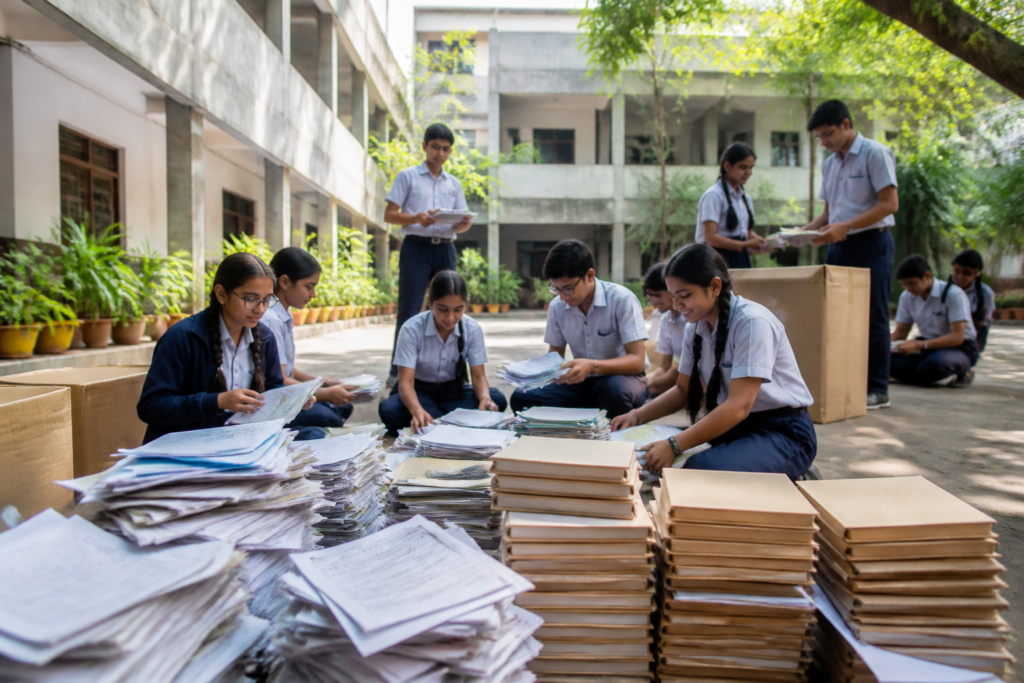
Made@gain began with a simple observation: large quantities of unused notebook paper were being discarded at the end of the academic year. Two years later, the Bengaluru initiative has collected more than 20,000 kilograms of used stationery and converted it into around 12,000 notebooks, linking school waste reduction with access to stationery for children who need it.
The initiative was started by Samaira Garg, now a Class 11 student at The International School Bangalore. About two years ago, she noticed that many notebooks still contained unused sheets when the school year ended. Her first attempt was to tape the sheets together and make notebooks by hand. That produced about 20 notebooks of 60 to 100 pages, but the limited scale and unfinished appearance led her to look for a way to process the paper into new notebooks.
That search brought her to Ashutosh Ananth, co-founder of Bengaluru-based Rescript, a company working with reprocessed paper to manufacture stationery. Rescript uses pre-consumer and post-consumer waste, and helped assess whether collected notebook paper could be transformed into commercially finished products. The collaboration converted a school-level collection effort into a repeatable process involving collection, processing, manufacturing and distribution.
The first collection drive generated 2,000 kilograms of paper and produced 1,000 notebooks. Made@gain formally came into being in February 2025. Since then, around 8,000 notebooks have been distributed to students across 10 schools, children from the Soliga tribal community at BR Hills, and children of migrant construction workers. The remaining notebooks form part of the initiative’s continuing distribution and outreach efforts, according to the information provided by Made@gain and reported by The Hindu.
The numbers are significant not only because of the products created, but also because they show the volume of recoverable material present in educational spaces. Made@gain’s collection network now covers five schools, 10 corporates, six communities and about 800 individual donors. The network indicates that paper recovery is not limited to municipal collection systems or specialist recycling facilities. It can also be organised through institutions where waste is generated predictably and where participation can be built into everyday routines.
That institutional dimension is visible at National Public School-East. Principal Meenu Bhattacharya said the school generates substantial paper waste, particularly at the end of the academic year. In the absence of a workable recycling arrangement, such material tends to be discarded. After Samaira presented a plan to the school, Made@gain was introduced through NPS-East’s Social Empowerment through Work Education and Action programme. Older students explained the initiative to junior classes, helping turn collection into a school-wide activity rather than an individual donation exercise.
The model matters because waste segregation depends on what happens after material is separated. Paper placed in a dry-waste stream does not automatically become a new product. It must be collected, sorted, transferred and processed by an organisation capable of using it. Ashutosh said paper often ends up in landfills despite segregation efforts, and urged people to hand it to waste collectors, aggregators or initiatives such as Made@gain. The initiative therefore addresses a gap between awareness of recycling and the practical systems required to complete it.
Made@gain also illustrates the limits of treating sustainability as a classroom concept alone. Samaira is studying economics, and Bhattacharya described the initiative as an example of circular thinking being put into practice. Students are not only being told that paper has environmental consequences; they are participating in a chain that connects consumption, collection, manufacturing and redistribution. The initiative’s ambassador programme extends this approach by allowing students to lead collection drives and apply ideas related to sustainability, leadership and responsible consumption.
The reported environmental benefits are presented by Rescript as part of the initiative’s impact. Ashutosh said approximately 46,200 litres of water were saved in creating Made@gain notebooks and that 1,368 kilograms of carbon dioxide emissions were prevented. He also said that no trees were cut for the notebooks. These figures are claims attributed to the company involved in processing the paper; the supplied report does not provide the methodology or baseline used to calculate them. They nevertheless show how the initiative measures impact beyond the number of notebooks distributed.
The social dimension is equally central. Made@gain has distributed notebooks to schools and to children from communities where new stationery cannot be assumed. Samaira said her visits to two schools serving children from the Soliga tribal community at BR Hills changed her understanding of what a new notebook can represent. For children accustomed to using hand-me-downs, a new notebook can carry practical and symbolic value beyond its material cost.
This link between waste recovery and access to educational materials gives the initiative a wider urban relevance. Bengaluru’s schools, apartment complexes and corporate offices are large, distributed generators of paper waste. They also contain networks that can support collection: students, parents, teachers, facility managers, employees and residents. Made@gain’s expansion across these settings suggests that the challenge is not simply whether paper can be recycled, but whether institutions can create reliable pathways for material to reach recyclers and manufacturers.
The approach also reveals why local participation is important in a city’s waste system. Municipal waste management depends on segregation, collection and processing at scale, but the quality of that system is influenced by what households and institutions do before collection. When paper is discarded in mixed waste, its recovery becomes more difficult. When it is kept separate and directed to an identified processor or aggregator, it retains greater value as a raw material. Made@gain’s model operates at this point of intervention, before paper becomes part of a mixed waste stream.
Its structure combines three forms of coordination. Schools and other institutions supply used stationery. Rescript provides the manufacturing link that turns the collected material into notebooks. Made@gain coordinates distribution to beneficiary schools and communities. This division of roles helps explain why the initiative moved beyond a one-time donation drive. It created a chain in which waste has a defined destination and the finished product has a defined social use.
The model is also being adapted for participation by companies, apartment communities and individual donors. Made@gain permits personalisation at ₹18 per notebook, covering the cover design, contributor branding and the Thinking Circular concept on the back cover. This feature creates an additional way for organisations to participate while retaining a connection between the collected material and the notebooks produced from it.
The initiative’s reported growth has attracted interest from other students and schools that want to replicate it. NPS-East has added an orientation for parents, and efforts are under way to involve other branches of the school. These developments show that replication depends on more than enthusiasm. It requires an institution willing to organise collection, explain the process to participants and maintain a relationship with a processing partner.
There are also limits to what the available evidence establishes. The supplied report does not provide a city-wide estimate of paper waste from Bengaluru’s schools, details of the total cost of processing, or independent verification of the environmental savings claimed. It also does not establish how many of the 12,000 notebooks have been distributed, beyond the approximately 8,000 reported as reaching identified schools and communities. Those gaps do not erase the initiative’s documented activity, but they matter when assessing whether the model can be scaled across the city.
What Made@gain does establish is a practical example of circularity operating through everyday urban institutions. Paper that might otherwise be discarded is collected from schools, companies, communities and individuals, processed into new stationery and directed towards children who need it. The initiative’s next test is whether its collection network and ambassador programme can continue expanding while maintaining the processing and distribution links that make the model work. For Bengaluru, the larger question is whether similar institutional pathways can turn other forms of recoverable waste into useful products rather than landfill-bound material.


