

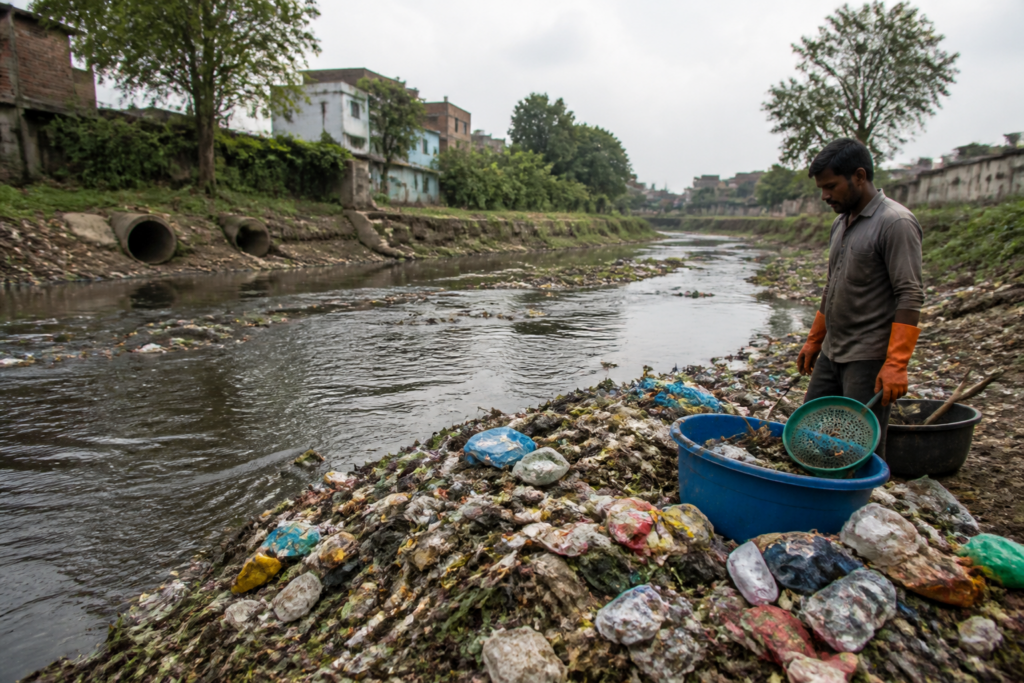
The return of garbage to the Ajnar River within 30 days of an extensive manual cleanup has exposed a persistent urban governance problem in Biaora: removing visible waste cannot restore a waterway when the systems around it continue to send rubbish, sewage and industrial discharge into the river.
The latest account, published by Deccan Chronicle, centres on 21-year-old Surendra Singh Chaudhari, popularly known as Bittu Tabahi. After spending eight months manually removing debris and toxic materials from the Ajnar in Madhya Pradesh’s Rajgarh district, Chaudhari left for a cleaning effort on the Yamuna in Delhi. When he returned to Biaora after 30 days, he found the river littered again.
“I am disappointed to see Ajnar filled with rubbish and waste materials again. My eight-month-long hard work to clean the river has gone down the drain,” Chaudhari was quoted as saying. He attributed the renewed pollution to the dumping of waste by local people, but the report also identifies a wider infrastructure failure: parts of the river’s flow are fed by untreated wastewater, drainage pipes empty directly into it, and industrial discharge from nearby manufacturing units enters the waterway.
That distinction is central to understanding the Ajnar’s deterioration. A cleanup operation can remove accumulated material from a riverbed or its banks, but it cannot prevent fresh pollution unless waste collection, drainage management and industrial compliance operate continuously. The recurrence described in Biaora therefore points to a gap between visible environmental action and the less visible institutions responsible for preventing pollution at source.
The Ajnar originates near Andalheda village in Rajgarh district and flows through Biaora. The river extends for about 52 kilometres, receiving water from small forest streams and seasonal tributaries before entering neighbouring Rajasthan, where it joins the Kalisindh River. Its length and cross-border flow mean that the condition of the river is not limited to a single dumping location or a single municipal boundary.
The report does not provide details of a formal river-management plan, a publicly stated monitoring schedule or the responsibilities assigned to local authorities and industrial units. It also does not specify the volume or composition of the waste that reaccumulated during Chaudhari’s absence. Those gaps matter because the response required for household rubbish is different from the response required for untreated sewage or industrial discharge.
The reported presence of direct drainage pipes creates a basic urban services question. Where wastewater networks are incomplete, poorly maintained or absent, drains often become the quickest route for sewage to reach natural channels. A river then becomes part of the city’s disposal system rather than a protected ecological and public asset. Manual removal may improve its appearance temporarily, but the inflow continues to carry contamination into the waterway.
Industrial discharge raises a separate regulatory issue. The report refers to manufacturing units around the river but does not identify the facilities involved, the substances discharged or any enforcement action. Without those details, it is not possible to determine whether the problem involves illegal discharge, inadequate treatment capacity, weak inspection or failures in operating treatment systems. What is established is that industrial waste has been identified as one of the sources affecting the river’s current flow.
The Ajnar case also shows how environmental responsibility can become personalised. Chaudhari’s work drew attention from industrialist Anand Mahindra and Boyan Slat, founder and chief executive officer of the Netherlands-based non-profit organisation The Ocean Cleanup. Slat reportedly offered Chaudhari a job after seeing a social-media post of him cleaning the river. Madhya Pradesh Chief Minister Mohan Yadav also honoured him for the effort.
That recognition helped make the cleanup visible, but it did not convert an individual act into an institutional system. Chaudhari reportedly suffered from a skin disease during the eight-month effort, underlining the physical risks involved when a person works directly with contaminated waste and water. The report does not state whether he had protective equipment, medical support or formal authorisation for the work.
His decision to resume cleaning after finding the river polluted again reflects the continuing dependence on individual intervention. It also reveals the limits of relying on volunteers to perform work that requires coordinated municipal services, environmental regulation and safe waste handling. A citizen can remove what is already present; only the responsible agencies and generators can stop the next load from arriving.
The Ajnar’s geography makes source control especially important. Because the river is fed by seasonal tributaries and later enters Rajasthan to meet the Kalisindh, pollution introduced in one stretch can move beyond the place where it is dumped. The report does not establish how pollution is distributed along the 52-kilometre course or whether downstream authorities are involved in monitoring it. Even so, the river’s movement across the landscape means that a localised administrative response may not address the full system.
There is also a difference between removing solid waste and restoring river health. The supplied report records the return of rubbish and waste materials, along with untreated wastewater and industrial discharge, but it does not provide water-quality measurements or confirm the presence of specific contaminants. As a result, the available evidence can establish repeated visible pollution and multiple reported inflow sources, but not the precise ecological or public-health condition of the river.
That limitation should shape the next stage of the response. A credible restoration effort would require authorities to identify the drainage outlets, establish where wastewater originates, inspect industrial discharge points and clarify who is responsible for preventing renewed dumping. It would also need regular monitoring rather than a single cleanup followed by a period without public reporting. The source material does not say whether such steps have been announced or initiated.
The institutional question is therefore not whether Bittu Tabahi can clean the Ajnar again. It is whether the agencies responsible for sanitation, drainage, river protection and industrial oversight can prevent the river from being used as a waste channel in the first place. The report records no formal response from those authorities to the renewed accumulation of garbage or to the identified wastewater and industrial discharge.
For Biaora, the episode is a reminder that river restoration is inseparable from everyday urban administration. Waste collection determines whether rubbish reaches the bank. Drainage infrastructure determines whether sewage reaches the channel. Industrial regulation determines whether manufacturing waste is treated before discharge. Each function may sit with a different institution, but the river receives the combined result.
The Ajnar story also raises a broader question about how environmental success is measured. A cleared river can create a powerful image and attract public recognition, while the systems that determine whether it remains clean are slower, less visible and harder to document. The return of waste within a month shows why a one-time improvement should not be treated as restoration without evidence that pollution sources have been controlled.
What the available evidence confirms is limited but significant: the Ajnar was manually cleaned for eight months, garbage reaccumulated within 30 days, and the river is reportedly receiving untreated wastewater, direct drainage flows and industrial discharge. What remains unclear is which authorities are responsible for each source, whether enforcement has followed, and whether any water-quality or pollution-control monitoring is under way. Those are the facts that will determine whether the next cleanup is another temporary intervention or the beginning of a functioning river-management system.


