

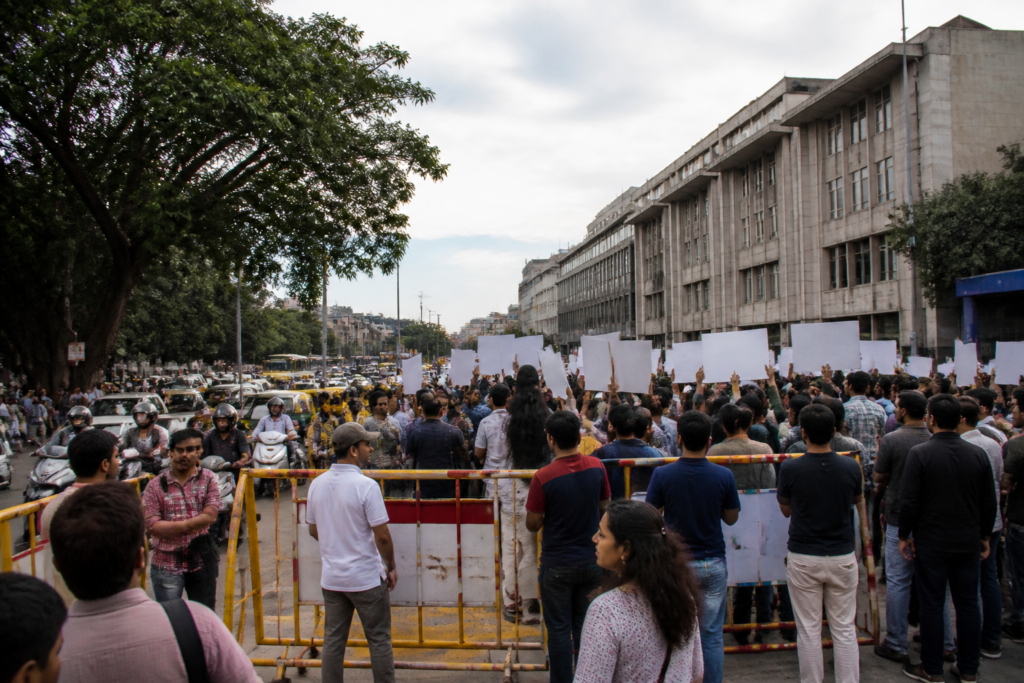
Bengaluru’s debate over protest venues is no longer only about whether demonstrations should be held at Freedom Park. It is becoming a question about how the city distributes democratic access, manages movement and protects livelihoods when public dissent is concentrated in one central location. Traders are seeking designated protest sites across the city, while activists argue that decentralisation should bring demonstrations closer to the communities and institutions connected to their grievances rather than simply move restrictions elsewhere.
Sajjan Raj Mehta, a trade activist, has written to the chief minister proposing five protest hubs across Bengaluru, one in each of the Greater Bengaluru Authority’s five divisions. The proposal seeks advance public notifications and clear traffic-management protocols for permitted rallies. Its stated purpose is to reduce the disruption caused when demonstrations are concentrated in the central business district, where traders say blocked roads and reduced access affect customers, workers, street vendors and transport workers.
The proposal therefore places two forms of public access in direct proximity. One is access to commercial establishments and workplaces, which can be disrupted when rallies occupy roads or alter traffic movement. The other is access to public authority, which activists say is weakened when all protests are directed to a single venue far from the office, agency or community associated with the grievance. The central administrative question is not simply where a protest can be held, but how the city decides which public spaces remain available for assembly and how those decisions are linked to traffic and policing.
That distinction matters because Freedom Park has become the focal point of Bengaluru’s protest system. Activists from the Campaign for the Right to Protest have argued that concentrating demonstrations there restricts the ability of marginalised groups to engage directly with authorities. They have referred to protests by workers, farmers, Dalit activists and residents raising local civic issues, and said demonstrations should be held near the relevant institution, such as labour offices, the chief electoral officer’s office or other authorities connected to a dispute.
The argument exposes a limitation in treating protest management as a purely logistical exercise. A central venue may make policing and traffic control easier, but it can also create distance between a grievance and the institution expected to respond to it. The supplied account does not establish that every protest must be held at Freedom Park or that all demonstrations are prevented from approaching relevant offices. It does show that activists consider the current arrangement a form of centralisation that affects who can participate, whom they can address and how visible their demands remain.
The legal framework adds another layer. Activists have urged the state government to withdraw the 2021 police licensing order and restore the 2009 framework. Other activists have pointed out that the Karnataka high court’s August 2022 order directed compliance with the 2021 licensing regime. They have also argued that the state government retains the power to amend or withdraw that regime. The 2021 order, according to the report, allows the police commissioner to designate another suitable venue depending on the situation.
This means the present dispute is not only between protesters and traders. It also concerns the allocation of authority between the state government, the police commissioner and the courts. If the licensing regime already permits another suitable venue to be designated, the policy question becomes how that discretion is exercised: whether venues are identified in advance, whether local impacts are assessed, whether notice is predictable and whether the reasons for permitting or refusing a location are publicly explained.
Mehta’s proposal for five hubs attempts to convert that discretionary system into a more predictable spatial arrangement. Zone-wise venues could allow the police and civic agencies to prepare traffic diversions, emergency access and public notifications in advance. They could also reduce the need for every demonstration to converge on the central business district. But a designated-site model would only address the access problem identified by activists if the sites are close enough to the institutions and communities concerned. Otherwise, the city may gain a traffic-management mechanism without resolving the democratic-access concern.
The trade impact described in the report illustrates why this is also an urban economy issue. Prakash Bhojani, president of the Karnataka Hosiery and Garment Association, told the Times of India that traders were feeling the impact, particularly during the festive season. The association has 1,500 shops under its establishment. Kalaram Choudhury, president of the Karnataka Stainless Steel Trade and Industry Association, said peaceful protests should be respected but asked the Centre and the state government to provide venues outside city centres to protect public convenience, traffic, trade and micro, small and medium enterprises.
The reference to small merchants, street vendors and transport workers broadens the impact beyond large commercial establishments. A disruption in a central commercial area can affect people who depend on daily customer movement, deliveries and road access. At the same time, the report does not provide quantified losses, duration of closures or traffic data that would allow the economic impact to be measured. That limitation is important. The case for reform is being made through stakeholder accounts, but the public policy would be stronger if future decisions were informed by consistent information on protest frequency, road closures, affected routes, business disruption and emergency response times.
The anti-Special Intensive Revision mobilisation has added urgency to the dispute. Activists have called for the resignation of chief electoral officer V Anbukumar if he was unable or unwilling to ensure cancellation of the revision in Karnataka, restoration of electoral rolls as they stood in January 2025 and safeguards against arbitrary deletions. They have also demanded a transparent and publicly accountable process for future revisions. These demands are political and administrative in their subject, but their location in the city’s protest geography is an urban governance matter: people seeking a response from a public institution also need a practical, lawful and accessible place from which to make that demand.
The competing proposals suggest that Bengaluru is trying to solve three problems through one system: the right to peaceful assembly, the management of city movement and the protection of commercial activity. These objectives can conflict when the same roads and public spaces carry commuters, customers, workers, emergency vehicles and demonstrators. A policy that treats any one of these uses as automatically dominant will leave the other groups bearing the cost.
A more decentralised framework, as proposed by the traders and some activists for different reasons, could make the city’s response more differentiated. Demonstrations concerning labour could be considered near labour-related institutions; electoral grievances could be connected to the relevant electoral authority; and local civic disputes could be addressed closer to the affected neighbourhood. The supplied material does not establish that such a system has been designed or that the government has accepted it. It does, however, identify the institutional logic behind the demand: proximity may improve accountability, while advance notification may improve traffic management.
The unresolved issue is how to prevent decentralisation from becoming a method of making protests less visible or harder to reach. Activists have explicitly warned that new arrangements must protect the right to dissent rather than merely relocate restrictions. That concern places conditions on any zone-wise model. The sites would need to be accessible, publicly notified and connected to clear procedures for permitted rallies. The police commissioner’s existing power to designate another venue would also need to operate within a transparent framework if public confidence is to improve.
Bengaluru’s immediate debate therefore points to a larger question about the design of democratic cities. Public spaces are not only circulation corridors or commercial assets; they are also places where citizens make demands visible. Yet the right to use them exists alongside the rights of workers, businesses, commuters and residents who depend on the same urban network. The evidence supplied here confirms that both sides regard the present concentration of protests as creating costs, but it does not establish the scale of those costs or whether the government is preparing a revised system.
The next developments to watch are the state government’s response to the proposal for five protest hubs, any decision on the 2021 licensing order, and how authorities address demands for protests near relevant institutions. The quality of that response will depend on whether Bengaluru treats protest venues as a fixed policing problem or as part of a wider system of access, mobility, livelihood and public accountability.


