

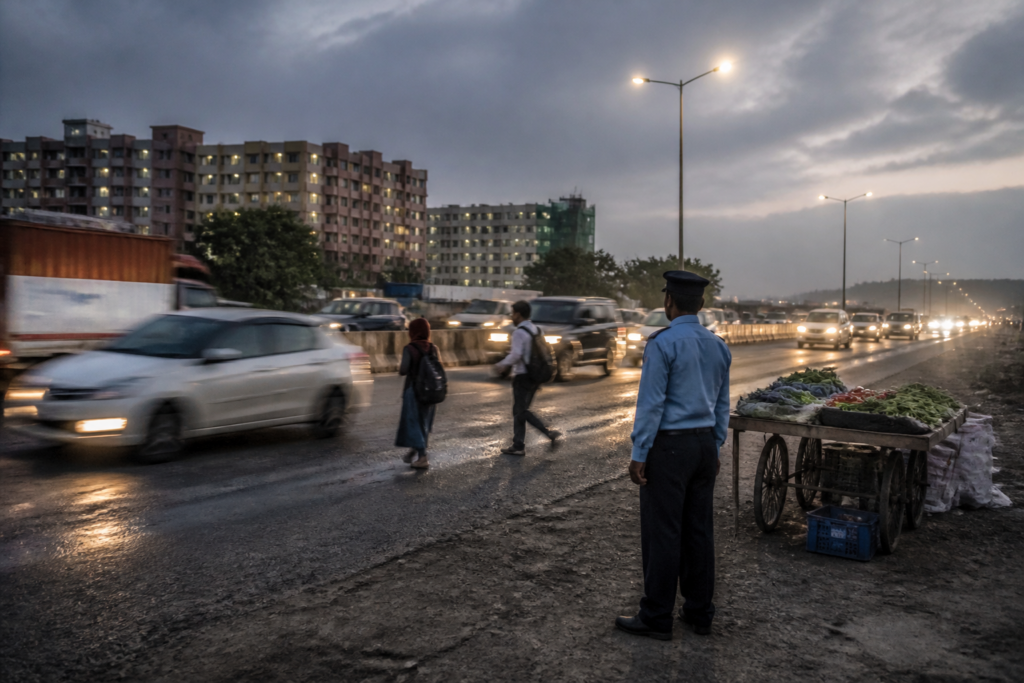
The Pune-Solapur Highway accident that killed 62-year-old vegetable vendor Latabai Dattatray Raskar in Loni Kalbhor was not only a collision involving a car and a pedestrian. It also exposed the risks faced by people whose daily work and homes require them to cross a high-speed road without any documented safe crossing facility at the location described in the report.
Raskar was crossing the highway near Shaurya Hostel in Loni Kalbhor at around 7 pm on October 4, accompanied by a security guard, when a white Tata Curvv EV travelling from Pune towards Solapur hit her. She suffered serious injuries and died later that night at Sassoon Hospital in Pune, according to the report published by Sakal – Pune. Her family filed a complaint at the Lonik Kalbhor police station on October 13, nine days after the accident.
The delay between the crash and the police complaint is one of the most important facts in the case. It does not, by itself, establish why the complaint was delayed or determine responsibility for the collision. The report states that the family completed the funeral and related rituals before approaching the police. It also records the family’s allegation that the driver had ignored traffic rules and driven negligently. The police investigation remains underway.
That sequence illustrates how a road death moves through the urban administrative system. The first response is usually immediate and physical: bystanders arrange medical assistance, hospitals treat the injured person and the family manages the emergency. The formal accountability process may begin later, through a police complaint that identifies the vehicle and sets an investigation in motion. In this case, the complaint named the vehicle registration number as MH 16 DW 9107 and described it as the car involved in the crash.
The available account does not establish whether the driver was identified at the scene, whether the vehicle was seized, whether surveillance footage was collected or whether an independent reconstruction of the collision was conducted. Those details are relevant to determining what happened but are not provided in the supplied report. The confirmed public record available here is narrower: a pedestrian was struck while crossing the highway, was seriously injured, died after being moved between hospitals and became the subject of a police complaint filed nine days later.
The medical chain also shows how road safety failures become family crises. After the collision, citizens took Raskar to Shantai Hospital in Loni Kalbhor. She had serious injuries to her chest and both knees. Because her condition was critical, she was shifted on October 5 to Shivam Hospital in Fursungi. When her condition worsened at around 8.30 pm, she was taken to Sassoon Hospital, where doctors declared her dead at approximately 10.45 pm.
For the family, the incident therefore involved more than the moment of impact. It included emergency transport, transfers between hospitals, medical decisions, funeral arrangements and the later filing of a complaint. The report identifies Raskar as a resident of Malimala in Loni Kalbhor and says that she sold vegetables to support her family. Her occupation is important to understanding the road’s human geography: she was not an occasional visitor to the area but a worker whose livelihood was connected to everyday movement through the locality.
The location described in the report is also significant. Shaurya Hostel stands along the Pune-Solapur Highway, a corridor carrying traffic between Pune and Solapur. The report does not provide the road’s speed limit, traffic volume, lane configuration, lighting conditions, footpath provision, median design or the distance to the nearest pedestrian crossing. Without those details, it is not possible to conclude whether the collision resulted from speeding alone, a visibility problem, an unsafe crossing point, inadequate lighting, road geometry, driver behaviour or a combination of factors.
What can be established is that the crossing was taking place on a highway in the evening, with a 62-year-old woman accompanied by a security guard. The presence of an accompanying person did not prevent the collision. That fact should direct attention towards the design and management of the corridor, not only towards individual conduct. A road that passes through or alongside inhabited areas creates repeated interactions between fast-moving vehicles and people walking, working or accessing homes and institutions.
This is where the administrative question becomes larger than one criminal complaint. Responsibility for a road corridor is often distributed among several institutions. Police investigate alleged traffic violations and establish the circumstances of a crash. Road-owning or road-managing agencies are responsible for the physical design and maintenance of the corridor. Local authorities influence access, lighting and surrounding land use. Hospitals handle emergency care. Families and witnesses provide information that may become part of the official record.
The supplied report does not identify the agency responsible for the stretch near Shaurya Hostel, nor does it mention any inspection or remedial action after the accident. It also does not say whether officials assessed the site for pedestrian safety or whether similar incidents had previously been recorded there. Those omissions matter because a road death can be treated either as an isolated incident involving one driver or as evidence requiring an examination of the road environment.
The numbers in this case create a clear timeline. The collision occurred at about 7 pm on October 4. Raskar was moved from Shantai Hospital to Shivam Hospital on October 5 and then to Sassoon Hospital later that day. She died at about 10.45 pm. The complaint was filed on October 13, nine days after the crash. The vehicle was identified in the complaint as a white Tata Curvv EV with registration number MH 16 DW 9107. These details are central to the investigation and should be distinguished from the family’s allegation of negligent driving, which remains an allegation while the police inquiry continues.
The use of an electric vehicle is a descriptive detail in the report, but the supplied evidence does not establish that the vehicle’s powertrain contributed to the collision. The relevant questions are the same ones that apply to any road crash: vehicle speed, driver attention, road conditions, visibility, pedestrian movement, traffic controls and the availability of a safe crossing. Treating the incident primarily as an electric-vehicle story would shift attention away from the pedestrian-safety issue that the facts support.
The case also demonstrates why crash reporting needs to capture more than the identity of the vehicle and the injured person. For public agencies, useful investigation would include the exact point of impact, road width, lane markings, lighting, sight distance, nearby access points, traffic speed, the presence or absence of a median barrier and the location of any formal crossing. None of these facts is supplied in the report, so they cannot be treated as established findings here. They are, however, the information needed to assess whether the site creates a recurring risk.
The wider urban challenge is the overlap between mobility corridors and ordinary livelihoods. A highway may be planned primarily for vehicle movement, while the surrounding settlement continues to generate pedestrian crossings. Hostels, roadside vendors, homes, workplaces and transport connections bring people close to fast traffic. If pedestrian movement is not incorporated into the corridor’s design, residents may cross where the road offers the shortest or most practical route, regardless of whether the location is formally designated for crossing.
That does not remove the need for individual road users to follow traffic rules. It does mean that enforcement alone cannot answer every question raised by a death on a busy urban-edge highway. The police investigation can examine the conduct of the driver and the circumstances of the crash. A parallel site assessment would be needed to determine whether the road environment made a dangerous interaction more likely.
At present, the evidence confirms a fatal pedestrian collision, a delayed complaint, a sequence of hospital transfers and an ongoing police investigation. It does not establish the driver’s final legal responsibility, the precise cause of the crash or whether the road location has a documented history of similar incidents. The next important developments are therefore the police findings, confirmation of the vehicle and driver’s role, and any official examination of pedestrian safety near Shaurya Hostel on the Pune-Solapur Highway.


