

The National Green Tribunal’s cancellation of the environmental clearance for Shubh Landmarks’ Shubh Gateway project in Viman Nagar has exposed a serious gap between regulatory approval on paper and the scrutiny required for a large urban development already occupied by residents. The tribunal found that the project’s environmental impact assessment did not address the mandatory conditions in its terms of reference point by point, weakening the basis on which the clearance was granted.
The case is significant not simply because an approval has been revoked. It shows how environmental regulation can become vulnerable when a project moves ahead, diverges from an earlier sanctioned plan, and reaches an advanced stage before the quality of its subsequent assessment is conclusively tested. The order now requires Maharashtra’s State Environment Impact Assessment Authority to reconsider the project’s application and issue a fresh decision within two months from the date on which the judgment is uploaded.
The project is located on Survey Nos. 227/1 to 17, Plot Nos. 1 and 2, in Viman Nagar. It includes residential and commercial components. According to the report by Civic Mirror – Pune, the western zonal bench of the NGT passed the order on an appeal filed by Pune environmental activist Tanaji Balasaheb Gambhir. The bench comprised Justice Dinesh Kumar Singh, judicial member, and Dr Sujit Kumar Bajpai, expert member.
The environmental clearance under challenge was issued on 9 February 2024. The tribunal concluded that the clearance could not stand because it was based on an inadequate assessment. The ruling followed a regulatory history that began with an earlier clearance issued on 26 March 2019 for 45,141.56 square metres of built-up area. The State Environment Impact Assessment Authority later found that the developer had constructed a development different from the plan described in the earlier approval.
That difference transformed the matter into a violation case under the Environment Impact Assessment Notification, 2006. The developer applied in January 2023 for terms of reference under the violation category. The SEIAA fixed those terms in April 2023. The developer subsequently submitted an environmental impact assessment report, an environmental management plan, an assessment of environmental damage and a restoration plan as part of its application for a fresh environmental clearance.
The tribunal’s central objection concerned the quality and completeness of the EIA report. The report was 28 pages long, despite the terms of reference containing multiple conditions and requirements. The tribunal observed that the report did not respond to each condition in a point-by-point manner. Its reasoning treated environmental impact assessment as more than a procedural formality: the competent authority must be able to determine whether every requirement in the terms of reference has actually been met.
The omission was not limited to presentation. The report also did not include the environmental damage cost and the natural resource augmentation plan referred to in the minutes of the State Expert Appraisal Committee. These elements were important because the project was being considered in the context of construction that differed from the earlier clearance. Without them, the basis for deciding how environmental damage should be assessed and addressed was incomplete.
This is the institutional weakness at the centre of the case. An environmental clearance is meant to be a decision based on disclosed impacts, mitigation measures and enforceable conditions. When the assessment does not clearly answer the questions set by the regulator, the approving authority is left without a transparent record showing how it reached its conclusion. In this case, the tribunal found that the deficiencies affected the foundation of the approval itself, rather than representing minor defects that could be ignored.
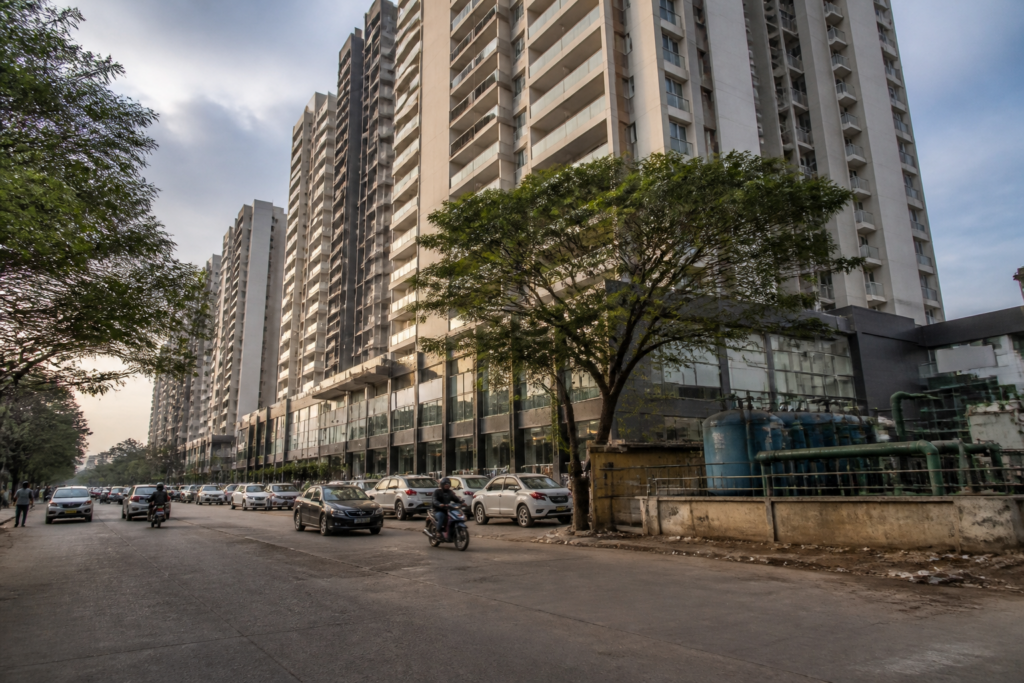
The case also highlights the difficulty created when regulatory scrutiny follows construction rather than preceding it. The Maharashtra Pollution Control Board’s inspection on 5 September 2025 found that Buildings A, B, C and D had been completed. Each building had a basement, a ground floor and 12 upper floors. Residents were living in the buildings, the clubhouse had been completed and commercial shops had begun operating.
The inspection also recorded environmental infrastructure at the site. A sewage treatment plant with a capacity of 220 cubic metres a day was functioning, as was an organic waste-processing machine with a capacity of 550 kilograms of waste a day. These facilities may demonstrate that some environmental systems were in operation, but their presence does not resolve the tribunal’s objection to the adequacy of the assessment on which the clearance was granted. Operational equipment and regulatory compliance are related, but they are not interchangeable.
That distinction matters for residents and commercial occupants. A completed and occupied project creates practical consequences that do not exist when an application is still at the proposal stage. Any fresh examination must now take place against the reality of occupied buildings, functioning shops and installed infrastructure. The tribunal’s order, as reported, does not itself decide the project’s final regulatory status; it requires the competent authority to reconsider the application and make a new decision.
The case also shows why changes from an earlier approved plan require close institutional attention. The 2019 clearance covered a stated built-up area, but the later construction was found to differ from the earlier plan. Once a project is treated as a violation case, the assessment must account for what has already been built and the environmental consequences associated with it. The subsequent application therefore needed to do more than describe a proposed mitigation framework. It had to provide the authority with a complete basis to evaluate the existing development and the damage and restoration measures connected to it.
The regulatory chain involved several institutions. The SEIAA fixed the terms of reference and issued the environmental clearance. The SEAC’s minutes contained observations relating to environmental damage costs and natural resource augmentation. The MPCB inspected the completed project and recorded the status of buildings, residents and environmental facilities. The NGT reviewed the challenge to the clearance and directed the SEIAA to reconsider the application. The case therefore illustrates that environmental governance depends not on one approval alone, but on the quality of coordination and documentation across appraisal, approval, inspection and judicial review.
The two-month deadline ordered by the tribunal is the next formal milestone. The SEIAA must reconsider the application in accordance with law and issue a fresh decision after the judgment is uploaded. The available report does not establish what the authority’s eventual decision will be, whether additional studies will be required, or what immediate operational directions will apply to the occupied premises. Those issues remain for the regulatory process and any further orders.
The larger lesson is narrower but important: environmental clearance cannot be reduced to the existence of a report or the operation of mitigation equipment. The record must demonstrate that the prescribed questions were answered, that environmental damage was assessed where required, and that restoration and resource augmentation measures were examined before approval. In the Shubh Gateway case, the NGT found that the record did not meet that standard. Pune’s immediate concern is now how the project will be reassessed while four completed buildings, their residents and their commercial premises remain part of the urban reality.


